Fiscal Year 2025
2,193
Loans Approved
$1.5B
Total Value
Dallas business owners know how quickly opportunity can turn into a financing problem. A buyer finds the right gas station in Richardson. A restaurant group wants to build out a second location in Bishop Arts. A dental practice in Plano needs acquisition capital and new equipment. A logistics company near Irving needs working capital before a larger contract begins. Each situation calls for capital, but not every lender understands the deal in the same way.
That is why the SBA 7(a) program is such a practical option for many qualified small businesses in Dallas – it can support all sorts of major business moves. The program may be used for business acquisitions, owner-occupied commercial real estate, equipment, construction, renovations, eligible debt refinancing, working capital, or a combination of approved business purposes.
Most SBA 7(a) loans are capped at $5 million. For most 7(a) loan programs, the SBA guarantees 85% of loans of $150,000 or less and 75% of loans above $150,000, with the SBA’s maximum guaranteed exposure generally capped at $3.75 million. That guarantee is not a shortcut around underwriting, but it can make lenders more willing to consider qualified requests that may be difficult to approve for conventional financing.
Note: 7aSavvy is an SBA 7(a) loan broker, not a lender. We are paid by the lender, so our help is free to you. Instead of approaching banks one at a time and hoping for a fit, you start with one focused path to the lenders most likely to fund your request.
SBA 7(a) Financing for Dallas Small Businesses
Dallas is not a one-industry city, and that matters when choosing a financing path. The needs of a restaurant operator in Deep Ellum, a med spa in Uptown, a trucking company near I-20, a contractor in Oak Cliff, a hotel owner near the airport corridor, and a professional services firm in North Dallas can all be very different.
A good SBA 7(a) loan request should begin with the business purpose, not with a generic loan amount. What is the capital actually meant to accomplish? Is the borrower buying a company, improving a facility, adding equipment, refinancing eligible debt, preserving working capital, or expanding into a new location? Once that purpose is clear, the lender search becomes much more focused.
Our platform helps Dallas borrowers connect the details of a request with SBA lending options that fit the deal. Eligible uses commonly include:
- Buying an existing business
- Purchasing owner-occupied commercial real estate
- Financing equipment, machinery, fixtures, or vehicles used by the business
- Funding renovations, buildouts, leasehold improvements, or construction
- Refinancing eligible business debt
- Supporting working capital needs
- Expanding into another location
- Combining several approved uses into one loan request
There is also an important limitation to keep in mind. SBA 7(a) financing is intended for active operating businesses. It is generally not meant for passive investment activity, such as buying commercial or residential real estate that the borrower’s operating business will not primarily occupy or use.
Buy
Buying an existing business is one of the most common uses of the SBA 7(a) program. The borrower is not just financing an idea; they are often financing a company with customers, employees, revenue, operating history, and a track record that a lender can evaluate.
In Dallas, that might mean acquiring a home services company with recurring accounts, a dental office with an established patient base, a franchise location with existing sales, a car wash, a convenience store, a daycare, a specialty retailer, or a professional services firm. It may also mean buying a commercial property to house the business, especially when ownership gives the company more control over long-term occupancy costs.
Acquisition financing is also one of the most detail-sensitive parts of SBA lending. A lender will usually want to understand the buyer’s background, the seller’s financials, the purchase price, the valuation, the source of equity injection, the cash flow available to repay the loan, the transition plan, and any collateral involved. A promising deal can lose momentum when those pieces are scattered or when the borrower starts with a lender that does not like that type of acquisition.
Build
Some businesses do not need to buy another company. They need a better space, a larger facility, or a location that can finally support demand.
SBA 7(a) proceeds may be used for many build-related business purposes, including:
- Ground-up construction for business use
- Interior buildouts
- Leasehold improvements
- Building additions
- Equipment installation
- Facility renovations
- Improvements to owner-occupied commercial property
For Dallas borrowers, that can apply across many local scenarios: a medical practice finishing out a clinic in Frisco, a restaurant converting a second-generation space in Lower Greenville, a fitness studio building out a leased location, a manufacturer upgrading a facility in Garland, or a childcare operator adapting a property for licensing and daily use.
These requests usually require more than a basic application. Lenders may review contractor estimates, construction budgets, permits, timelines, contingency planning, collateral, lease terms or property ownership documents, and projected cash flow after the improvements are complete. The lender has to understand not only what is being built, but why the finished project supports repayment.
Expand
Growth can create a cash crunch even when business is healthy. A company may have rising demand, stronger sales, or a clear expansion opportunity, but still need capital before they can make a move.
SBA 7(a) financing can help qualified Dallas businesses fund expansion without relying entirely on short-term debt or draining operating cash. Common expansion uses include:
- Opening an additional location
- Hiring and training staff
- Buying inventory
- Adding vehicles, machinery, or technology
- Increasing production or service capacity
- Funding marketing tied to a growth plan
- Supporting seasonal or contract-driven working capital
- Investing in systems needed for a larger operation
Expansion looks different across Dallas industries. A trades contractor may need trucks and payroll support. A healthcare practice may need equipment and tenant improvements. A franchisee may need capital for a new unit. A retailer may need inventory before a busy season. A logistics company may need working capital to take on a larger customer.
Industries That Use SBA 7(a) Loans in Dallas
The SBA 7(a) program supports a wide range of for-profit small businesses, which makes it especially useful in a market as broad as Dallas-Fort Worth. The same program can serve a family-owned restaurant, a hotel operator, a dental practice, a logistics firm, a franchise buyer, or a light industrial company, but the loan story will be different in each case.
Businesses that commonly explore SBA 7(a) financing include:
- Restaurants, cafés, bakeries, and food service businesses
- Hotels, motels, and lodging businesses
- Dental, medical, and healthcare practices
- Professional service firms
- Franchise businesses
- Convenience stores and gas stations
- Car washes
- Retail and specialty shops
- Childcare and education-related businesses
- Fitness, wellness, and personal care businesses
- Light manufacturing companies
- Distribution and logistics businesses
- Home services and trades businesses
- Owner-operated businesses with real estate needs
The lender fit changes by industry. A hotel renovation is not underwritten the same way as a dental acquisition. A car wash purchase does not look like a professional services expansion. A restaurant buildout carries different risks than a logistics working capital request. 7aSavvy helps Dallas borrowers avoid treating those deals as interchangeable and instead look for SBA 7(a) lenders that understand the business behind the numbers.
SBA 7(a) Loan Qualifications in Dallas
SBA 7(a) eligibility begins with the basic program rules. In general, the business must be an operating, for-profit small business located in the United States or its territories and must meet the SBA size standards that apply to its industry.
Eligible business structures include:
- Sole proprietorships
- Limited liability companies
- Partnerships
- Corporations
- Other eligible for-profit entities
Those baseline rules are only the starting point. A lender will still evaluate the borrower, the business, the use of proceeds, repayment ability, credit profile, collateral, ownership structure, and the overall risk of the transaction.
For a Dallas borrower, the documentation can vary widely by loan purpose. A business acquisition may require seller financials, a purchase agreement, valuation support, and transition details. A real estate purchase may require property information, occupancy details, appraisals, and environmental review. A buildout may require contractor estimates and project budgets. A working capital loan may depend more heavily on historical cash flow and the borrower’s explanation of need.
7aSavvy helps borrowers approach the process with more structure. Our platform is built around connecting small business owners with SBA 7(a) lending options that fit the business type, use of funds, loan size, and borrower profile.
SBA 7(a) Loans in Dallas: Pros and Cons
The SBA 7(a) program is often attractive because it can support larger, longer-term business needs with more flexibility and security than many conventional or short-term financing options.
Benefits borrowers often consider include:
- Flexible use of proceeds across approved business purposes
- Longer repayment terms than most conventional business loans
- Financing for acquisitions, expansion, equipment, real estate, eligible refinancing, working capital, construction, and improvements
- Lower equity injection requirements than conventional commercial loans
- Fully amortized terms – no balloon payments
- The ability to combine multiple eligible uses into one request
The cash flow impact can be significant. When repayment is spread over a longer term, the monthly payment may be more manageable than it would be with conventional financing. That matters for Dallas owners who are buying a business, improving a location, or expanding while still needing enough cash to operate day to day.
One trade-off is that SBA-backed loans usually require more documentation and a more involved review process than simpler forms of financing. A borrower should be ready to provide financial records, tax returns, ownership information, debt schedules, collateral details, business plans or projections where needed, and transaction-specific documents. A construction request or acquisition will usually take more work than a straightforward working capital request.
Other key trade-offs are the size limit and strict citizenship requirement. 7(a) loans are only available up to $5 million, so if your project costs more, the program may not be for you – although sometimes a combination of a 7(a) and conventional or 504 loan can make a large project work. The citizenship requirement means that as of 2026, all owners of the business must be U.S. citizens or nationals. This excludes lawful permanent residents, foreign nationals, asylum seekers, visa holders, and all others from accessing SBA-backed capital.
SBA 7(a) Loans vs. Other Types of Loans
SBA 7(a) Loans vs Conventional Loans
A conventional business loan is made by the lender without an SBA guarantee. Because the lender carries the full risk, conventional loans usually require stronger collateral, a higher down payment, longer operating history, cleaner financials, and/or a simpler transaction.
An SBA 7(a) loan includes a partial SBA guarantee to the lender. That guarantee helps qualified borrowers access financing when a conventional loan is out of reach at comparable terms.
For a Dallas business with strong financials and a simple request, conventional financing may work well. For a business with more borderline financials, a more complex request, or less money to go toward a down payment, the SBA 7(a) program may be worth a closer look.
SBA 7(a) Loans vs SBA 504 Loans
SBA 7(a) and SBA 504 loans are both SBA-backed, but they are designed for different situations.
The SBA 7(a) program is broader. It can be used for working capital, business acquisitions, owner-occupied real estate, equipment, construction, renovations, eligible refinancing, and expansion. That flexibility is useful when a Dallas borrower needs one loan to cover several approved business purposes.
The SBA 504 program is more focused on long-term fixed assets, especially owner-occupied commercial real estate and major equipment. It can be a strong fit for certain property or equipment purchases, but it is not designed for the same range of working capital or acquisition needs as the 7(a) program.
A borrower purchasing only a building or major fixed asset should compare both options. A borrower who also needs working capital, acquisition financing, refinancing, or a more flexible structure will likely find that an SBA 7(a) loan is the better match.
Example Scenario: Car Wash Acquisition in Dallas
Priya had managed a car wash in the Dallas area for five years. When the owner of a well-established car wash in a high-traffic North Dallas corridor decided to sell, Priya saw an opportunity to step into ownership. The property included the car wash facility, equipment, a small detail shop, and the underlying real estate.
The total project cost was $1,625,000:
- Business acquisition (goodwill, customer base, existing equipment, brand): $500,000
- Real estate (car wash facility on 0.8 acres with street frontage): $900,000
- Equipment upgrades (tunnel system components, water reclamation system, vacuum stations): $150,000
- Working capital for the ownership transition: $75,000
Priya had $162,500 available for a down payment (10%) and needed financing for the remaining $1,462,500.
She approached two conventional lenders. One considered car washes a specialty property and wouldn’t finance it. The other would look at the real estate but wouldn’t include the business acquisition, equipment upgrades, and working capital in the same loan.
Through 7aSavvy, Priya was matched with an SBA 7(a) lender experienced with car wash acquisitions in the DFW Metroplex. The lender understood the revenue model and was comfortable financing the full project in a single loan.
Loan Details:
- Total project cost: $1,625,000
- Down payment: $162,500 (10%)
- Loan amount: $1,462,500
- Interest rate: Prime + 1.5 (8.25% at the time of closing)
- Term: 25 years, fully amortized
- Monthly payment: $11,531
The car wash was generating annual cash flow of $195,000, giving it a DSCR of 1.41. Priya’s hands-on management experience, the location’s strong traffic count, a loyal membership base, and consistent revenue history all supported the approval.
The loan closed in 68 days. Owning both the business and the real estate gave Priya full control over the operation, and the equipment upgrades improved wash speed and water efficiency. The working capital covered transition costs and staff onboarding under new ownership.
This is an illustrative example based on typical SBA 7(a) loan terms and a realistic car wash acquisition scenario in Dallas. Actual loan terms, timelines, and outcomes vary based on the borrower, business, and lender.
SBA 7(a) Loan Program History
The SBA 7(a) program traces back to the Small Business Act of 1953, which created the U.S. Small Business Administration. The “7(a)” name comes from the section of that law that authorizes the loan program.
The program was built around a practical lending problem: many small businesses have legitimate capital needs but do not always fit the risk profile of a conventional bank loan. By guaranteeing a portion of eligible loans made by approved lenders, the SBA helps reduce lender risk and expands access to capital for qualified small businesses.
Decades later, the 7(a) program remains one of the primary SBA financing tools for small business owners. In Dallas, it can support the kinds of moves that define a business’s next stage: buying a company, acquiring property, expanding into another location, investing in equipment, refinancing eligible debt, or strengthening working capital.
Dallas SBA 7(a) Loan Program Statistics
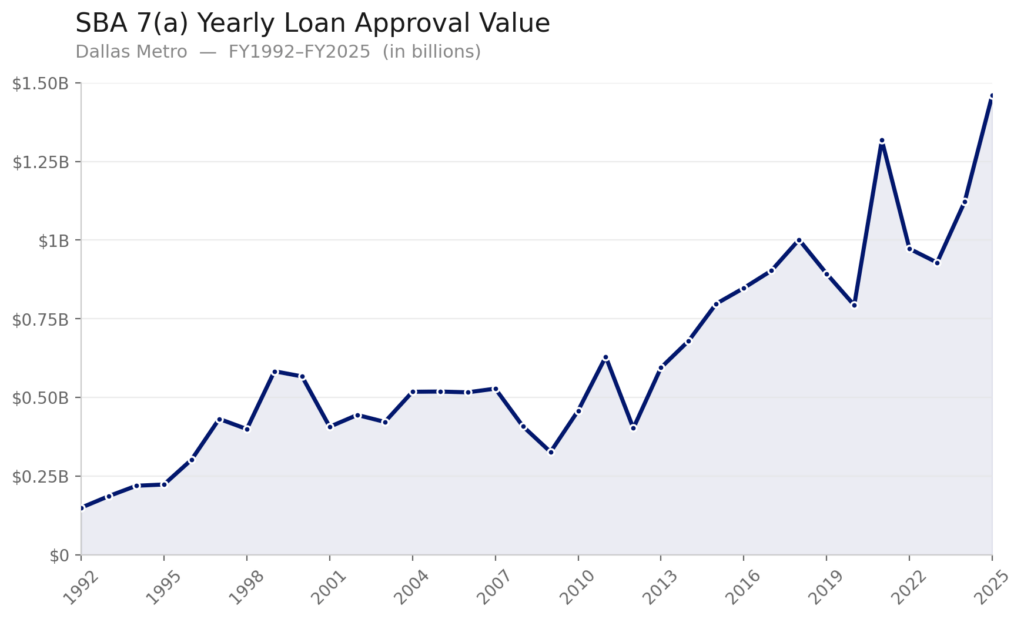
These are the year-by-year* statistics of the SBA 7(a) loan program in the Dallas-Fort Worth Metroplex from fiscal year 1992 to today, including the number of 7(a) loans approved and total approval amount.
| Fiscal Year | Loans Approved | Approval Amount |
| 1992 | 538 | $149,656,080 |
| 1993 | 680 | $186,404,301 |
| 1994 | 1,100 | $219,292,733 |
| 1995 | 1,278 | $223,346,569 |
| 1996 | 1,343 | $302,371,778 |
| 1997 | 1,450 | $431,729,269 |
| 1998 | 1,420 | $399,473,650 |
| 1999 | 1,507 | $583,204,785 |
| 2000 | 1,403 | $566,732,737 |
| 2001 | 1,078 | $406,749,445 |
| 2002 | 1,330 | $444,317,728 |
| 2003 | 1,983 | $422,118,704 |
| 2004 | 2,230 | $517,969,375 |
| 2005 | 2,181 | $518,689,036 |
| 2006 | 2,497 | $516,161,658 |
| 2007 | 2,745 | $527,914,933 |
| 2008 | 1,679 | $408,177,518 |
| 2009 | 906 | $326,649,111 |
| 2010 | 1,213 | $457,966,800 |
| 2011 | 1,343 | $629,353,900 |
| 2012 | 1,104 | $402,119,300 |
| 2013 | 1,195 | $594,613,300 |
| 2014 | 1,378 | $679,546,900 |
| 2015 | 1,652 | $797,638,100 |
| 2016 | 1,808 | $847,617,000 |
| 2017 | 1,709 | $902,768,700 |
| 2018 | 1,568 | $1,001,265,700 |
| 2019 | 1,272 | $893,012,800 |
| 2020 | 1,015 | $793,046,000 |
| 2021 | 1,371 | $1,317,477,000 |
| 2022 | 1,205 | $972,494,000 |
| 2023 | 1,402 | $928,613,300 |
| 2024 | 1,823 | $1,121,976,000 |
| 2025 | 2,193 | $1,460,962,500 |
Source: SBA, 7(a) & 504 FOIA
*U.S. Federal Government fiscal years
SBA 7(a) Loans On the Rise
The SBA 7(a) loan program has seen outstanding recent growth in Dallas, with the annual total value of approved loans tripling in the last 15 years.