Fiscal Year 2025
6,302
Loans Approved
$3.2B
Total Value
An SBA 7(a) loan is a business loan issued by an approved lender and partially guaranteed by the U.S. Small Business Administration. The SBA does not lend directly to the business owner. Instead, banks, credit unions, and other approved lenders provide the funding, while the SBA guarantee reduces part of the lender’s risk.
That structure can make SBA 7(a) financing a strong option for qualified small businesses that may not fit neatly into a conventional bank loan. SBA loans can be used for many business purposes, including working capital, business acquisition, equipment, commercial real estate, expansion, refinancing eligible business debt, and other approved needs.
For most SBA 7(a) loans, the maximum loan amount is $5 million. The SBA guarantee is generally up to 85% for loans of $150,000 or less and up to 75% for loans above $150,000, depending on the loan type and program rules.
Note: 7aSavvy is an SBA 7(a) loan broker, not a lender. We are paid by the lender, so our help is free to you. Instead of approaching banks one at a time and hoping for a fit, you start with one focused path to the lenders most likely to fund your request.
Uses of SBA 7(a) Loans in Florida
SBA 7(a) financing gives Florida business owners a flexible way to fund major business needs, from buying an existing company to expanding operations, purchasing equipment, refinancing eligible debt, or securing working capital.
As an SBA loan broker, 7aSavvy helps borrowers explore how this financing option may fit their plans and connect with lending options that align with their business goals. Whether the request involves a business acquisition in Tampa, commercial real estate in Orlando, equipment financing in Miami, or working capital for a growing company in Jacksonville, our platform is built to make the SBA loan process easier to navigate.
SBA 7(a) loans are commonly used for:
- Commercial real estate purchases
- Business acquisitions
- Equipment purchases
- Construction or renovation projects
- Eligible debt refinancing
- Working capital
These use-of-proceeds options make SBA loans a practical financing solution for Florida businesses that want to grow, improve cash flow, stabilize operations, or invest in long-term assets.
SBA 7(a) loans are intended for active operating businesses. They generally cannot be used for passive real estate investment, including commercial or residential investment properties that are not primarily occupied and used by the operating business.
Buy
Florida business owners can use SBA 7(a) financing to purchase a company and/or the assets that help move a company forward. This may include buying an existing business, acquiring owner-occupied commercial real estate, or purchasing essential equipment.
For entrepreneurs looking to buy a business in Florida, SBA loans can be useful because they can support acquisitions across many industries. A buyer may use the loan to purchase a company with existing revenue, customers, employees, and growth potential.
7aSavvy helps borrowers approach the acquisition process with more structure. Our SBA 7(a) loan brokering can help organize the funding request, identify what lenders may want to review, and support a smoother path toward financing.
Build
An SBA 7(a) loan can also support construction and improvement projects tied to an active business. For Florida companies that need more space, updated facilities, or a better physical location, this type of financing may help fund projects that improve both day-to-day operations and long-term business value.
Eligible projects may include:
- Leasehold improvements
- Interior buildouts
- Facility renovations
- Building additions
- Ground-up construction for business use
- Improvements to owner-occupied commercial property
A construction-related SBA loan request can involve more details than a standard working capital loan. Lenders may need to review project costs, contractor information, timelines, collateral, business financials, and the borrower’s ability to repay. 7aSavvy helps Florida borrowers better understand those moving parts before approaching lenders.
Expand
When a company is ready to grow, access to capital can determine how quickly it can act. SBA 7(a) financing can provide longer-term funding for expansion plans, helping business owners invest in new opportunities without relying only on short-term financing.
Florida businesses may use SBA loans to:
- Open a new location
- Increase operating capacity
- Hire additional staff
- Purchase inventory
- Add equipment or technology
- Support seasonal or growth-related working capital needs
Our platform helps borrowers explore SBA 7(a) loan options that match the purpose of the funding. Instead of treating every request the same way, 7aSavvy helps connect business owners with SBA lending options based on the details of their transaction, business model, and location.
SBA 7(a) Loan Industries in Florida
SBA 7(a) loans can be used across many for-profit industries, which is one reason they are a common financing option for small business owners in Florida. The program may support businesses that need capital for acquisition, expansion, real estate, equipment, debt refinance, or working capital.
Common industries that may use SBA business loans include:
- Convenience stores
- Hotels, motels, and bed and breakfasts
- Gas stations
- Restaurants
- Retail stores
- Storage facilities
- Car washes
- Service businesses
- Medical practices
- Franchise businesses
- Manufacturing companies
- Franchise businesses
Florida’s economy includes many industries where SBA 7(a) financing can be useful. Hospitality businesses may need capital for property improvements. Restaurants may need equipment or working capital. Medical practices may need financing for acquisition or expansion. Franchise operators may need funding to open or grow locations.
7aSavvy works as an SBA 7(a) loan broker for borrowers who want a clearer path through this process. Our goal is to help business owners understand how their use of funds may fit within SBA lending requirements and connect them with financing options that make sense for their business.
SBA 7(a) Loan Qualifications in Florida
Qualifying for an SBA 7(a) loan starts with meeting the basic eligibility standards set for small business borrowers. For Florida business owners, this means the business generally must be a for-profit company and meet SBA size and eligibility requirements.
An SBA 7(a) loan may be available to several common business structures, including:
- Sole proprietorships
- Corporations
- Partnerships
- Limited liability companies
- Other eligible for-profit business entities
These requirements create the starting point for SBA 7(a) financing. From there, lenders review the full picture of the borrower, the business, and the loan request.
As an SBA loan brokering platform, 7aSavvy helps Florida borrowers understand what lenders may evaluate before they apply. Our platform is designed to make the process less confusing by helping business owners organize the details of their request and explore lending options that fit their goals.
SBA 7(a) Loans in Florida: Pros and Cons
An SBA 7(a) loan can offer Florida business owners access to flexible, longer-term financing for major business goals. Compared with many conventional or short-term business loan options, SBA 7(a) financing may provide a more manageable structure for qualified borrowers.
Key benefits include:
- Longer repayment terms than many conventional business loans
- Lower equity injection requirements
- Competitive interest rates for eligible business purposes
- Flexible use of proceeds
- Fully amortized repayment structures based on the loan purpose
- Financing options for acquisition, expansion, real estate, equipment, refinancing, and working capital
These features can make SBA loans a strong fit for small businesses that need capital without putting unnecessary pressure on monthly cash flow. Longer amortization periods help reduce payment strain, while lower down payment requirements allow borrowers to preserve more working capital for operations.
However, there are also some downsides to SBA 7(a) financing. A maximum loan size of $5 million makes larger real estate deals difficult, a problem in Florida’s hot real estate market. Additionally, government restrictions limit SBA financing to U.S. citizens or nationals, meaning the program isn’t an option for green card holders. This can be an issue in a state that’s home to many recent immigrants looking for their share of the American Dream.
SBA 7(a) Loans vs. Other Types of Loans in Florida
SBA 7(a) Loans vs Conventional Loans
A conventional business loan is funded and underwritten entirely by the lender without an SBA guarantee. Because the lender carries the full risk, conventional loans may be harder to qualify for, especially if the borrower has limited collateral, a newer business, or a more complex transaction.
An SBA 7(a) loan includes a partial government guarantee, which can help reduce lender risk. This makes SBA 7(a) financing more accessible for more borrowers.
For Florida business owners, the difference often comes down to fit. A highly qualified borrower with a simple loan purpose and strong collateral and cash flow may consider a conventional loan. A borrower with less collateral, with cash flow that’s anything below excellent, or needing a more flexible financing structure may find that an SBA 7(a) loan is worth exploring.
SBA 7(a) Loans vs SBA 504 Loans
SBA 7(a) loans and SBA 504 loans are both SBA-backed financing options, but they are commonly used for different purposes.
SBA 7(a) loans are generally more flexible. They may be used for working capital, business acquisitions, commercial real estate, equipment, construction, eligible refinancing, and expansion.
SBA 504 loans are more restrictive. They are only available for long-term, fixed-asset financing, such as major equipment or owner-occupied commercial real estate. Their main benefit is that 504 loan sizes can go up to $11.25 million, providing more headroom for large real estate or equipment deals.
For a Florida business that needs to buy equipment or property, either program may be worth reviewing. For a business that needs more than $5 million in financing for a real estate or equipment purchase, an SBA 504 loan may be the best option. For a business that needs $5 million or less, or also needs working capital, acquisition financing, or a broader use of proceeds, the SBA 7(a) program is likely the stronger choice.
Example Scenario: Restaurant Acquisition in Tampa
Sofia had spent 15 years in the restaurant industry in the Tampa Bay area, the last five as a general manager. When a well-regarded restaurant in South Tampa went up for sale, Sofia saw the opportunity she had been waiting for. The owner also held the real estate, a 3,200-square-foot freestanding building with a patio and dedicated parking.
The total project cost was $1,750,000:
- Business acquisition (goodwill, customer base, liquor license, existing equipment and furnishings): $700,000
- Real estate (building and land): $900,000
- Kitchen equipment upgrades (range, walk-in cooler, ventilation improvements): $75,000
- Working capital for the ownership transition: $75,000
Sofia had $175,000 available for a down payment (10%) and needed financing for the remaining $1,575,000.
She reached out to two conventional lenders. One wouldn’t consider the deal at all due to the industry. The other was willing to look at the real estate but wouldn’t finance everything else together in one deal. Sofia would have needed to find separate financing for each component, with different terms and repayment schedules.
Through 7aSavvy, Sofia was matched with an SBA 7(a) lender in Florida that regularly funded restaurant acquisitions. The lender understood how to evaluate a restaurant and the seasonality of the Tampa market. The lender was comfortable financing the full project in a single loan.
Loan Details:
- Total project cost: $1,750,000
- Down payment: $175,000 (10%)
- Loan amount: $1,575,000
- Interest rate: Prime + 2.0 (8.75% at the time of closing)
- Term: 25 years, fully amortized
- Monthly payment: $12,950
The restaurant was generating annual cash flow of $210,000, giving it a DSCR of 1.35. Sofia’s management experience, the restaurant’s long history and stable revenue, the included real estate, and a well-structured transition plan all made the deal a clean approval for the lender.
The loan closed in 73 days. Combining everything into one SBA 7(a) loan simplified the transaction and gave Sofia a single monthly payment to manage. The 25-year term applied because real estate made up more than half the total project cost, giving her long term security.
This is an illustrative example based on typical SBA 7(a) loan terms and a realistic restaurant acquisition scenario in Florida. Actual loan terms, timelines, and outcomes vary based on the borrower, business, and lender.
SBA 7(a) Loan Program History
The SBA 7(a) loan program has been part of the small business financing landscape for decades. The program traces back to the Small Business Act of 1953, which created the U.S. Small Business Administration and established the framework for federal support of small business lending.
The name “7(a)” comes from the section of the Small Business Act that authorizes the program. Over the last 70+ years it’s been the SBA’s primary business loan program, helping small businesses access capital through approved lenders.
For Florida businesses, this history matters because the program was built around a practical financing gap: many small businesses need funding but may not qualify easily through traditional lending alone. By providing a partial guarantee to lenders, the SBA 7(a) program can help expand access to capital for eligible borrowers.
Today, SBA 7(a) loans continue to support small businesses across many industries, including restaurants, hotels, professional services, healthcare, franchises, retail, manufacturing, construction, transportation, and other owner-operated businesses.
Florida SBA 7(a) Loan Program Statistics
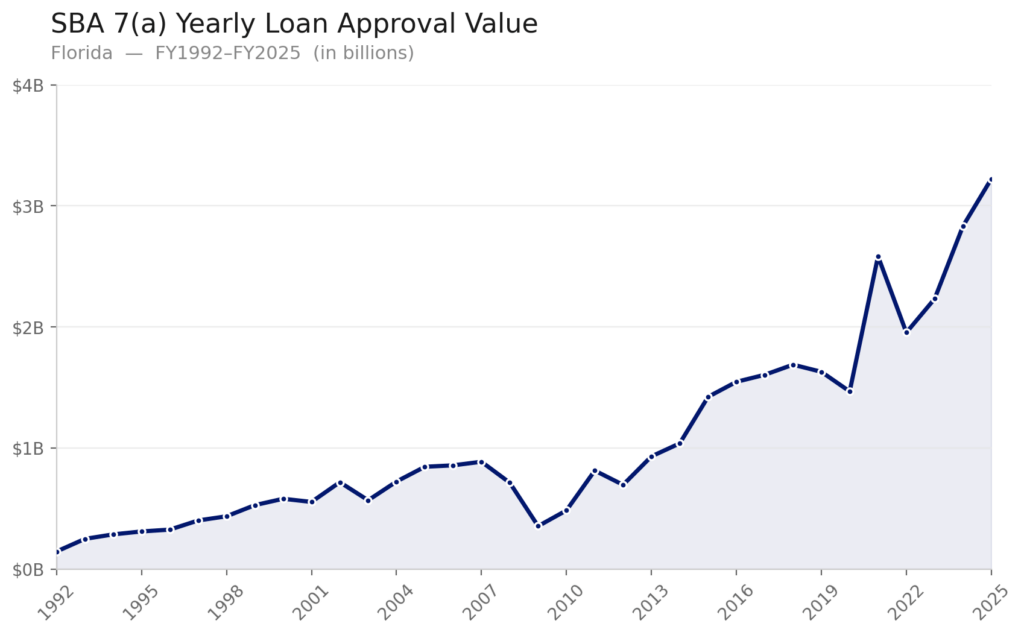
These are the year-by-year* statistics of the SBA 7(a) loan program in Florida from fiscal year 1992 to today, including the number of 7(a) loans approved and total approval amount.
| Fiscal Year | Loans Approved | Approval Amount |
| 1992 | 527 | $145,482,182 |
| 1993 | 786 | $249,663,332 |
| 1994 | 1,056 | $286,868,202 |
| 1995 | 2,055 | $311,024,690 |
| 1996 | 1,766 | $326,259,437 |
| 1997 | 1,634 | $401,872,553 |
| 1998 | 1,614 | $436,267,253 |
| 1999 | 1,812 | $528,444,515 |
| 2000 | 1,869 | $580,988,844 |
| 2001 | 1,910 | $554,788,537 |
| 2002 | 2,448 | $717,898,672 |
| 2003 | 3,926 | $568,437,675 |
| 2004 | 5,036 | $723,207,927 |
| 2005 | 4,978 | $845,335,271 |
| 2006 | 5,495 | $857,115,109 |
| 2007 | 5,847 | $886,839,140 |
| 2008 | 3,418 | $713,493,228 |
| 2009 | 1,310 | $354,876,769 |
| 2010 | 1,666 | $484,972,700 |
| 2011 | 2,013 | $813,847,300 |
| 2012 | 1,666 | $695,911,000 |
| 2013 | 1,898 | $931,028,300 |
| 2014 | 2,013 | $1,038,619,300 |
| 2015 | 3,022 | $1,422,748,600 |
| 2016 | 3,383 | $1,547,042,900 |
| 2017 | 3,556 | $1,605,051,900 |
| 2018 | 3,693 | $1,688,626,700 |
| 2019 | 3,376 | $1,629,728,500 |
| 2020 | 2,376 | $1,467,641,300 |
| 2021 | 3,202 | $2,584,496,600 |
| 2022 | 3,249 | $1,953,913,800 |
| 2023 | 4,625 | $2,233,503,700 |
| 2024 | 5,902 | $2,833,508,300 |
| 2025 | 6,302 | $3,223,548,800 |
Source: SBA, 7(a) & 504 FOIA
*U.S. Federal Government fiscal years
SBA 7(a) Loans On the Rise
The SBA 7(a) loan program has seen unbelievable growth in Florida, with the annual total value of approved loans up 22x since 1992.