
Fiscal Year 2025
2,552
Loans Approved
$1.1B
Total Value
Miami has no shortage of entrepreneurs with a real opportunity in front of them, but lining up the right SBA 7(a) lender is often the part that stalls. A borrower might be trying to buy an existing company, pay for equipment, refinance business debt, open a second location, acquire owner-occupied commercial property, or simply cover working capital while things ramp up. The complication is that lenders do not all read the same SBA 7(a) request the same way, and a deal one bank passes on is a deal another bank actively wants. This is the gap a broker fills. 7aSavvy is not a lender. We are an SBA 7(a) broker that reads through your deal, knows which Miami-area lenders fund that specific type of request, and puts you in front of the one that fits.
An SBA 7(a) loan is issued by an approved lender and carries a partial guarantee from the U.S. Small Business Administration. The SBA itself does not hand money to business owners directly. Instead the financing comes from banks, credit unions, and other approved lenders, and the government guarantee takes some of the risk off the lender’s side of the table.
That arrangement is part of why SBA 7(a) financing can work well for a qualified Miami small business that does not slot cleanly into a conventional bank loan. On most SBA 7(a) loans the ceiling is $5 million. The SBA guarantee generally runs up to 85% on loans of $150,000 or less and up to 75% on loans above $150,000, though this is subject to the particular type of loan involved.
Note: 7aSavvy is an SBA 7(a) loan broker, not a lender. We are paid by the lender, so our help is free to you. Instead of approaching banks one at a time and hoping for a fit, you start with one focused path to the lenders most likely to fund your request.
Uses of SBA 7(a) Loan Proceeds in Miami
Borrowers in Miami often need financing that can move at the speed of the deal, whether the plan is to acquire a company, buy equipment, fix up a space, purchase owner-occupied commercial real estate, refinance business debt that qualifies, or shore up working capital. SBA 7(a) loans can cover these purposes, which makes them a workable option for a lot of qualified small businesses across the metro area.
As an SBA 7(a) loan brokering platform, 7aSavvy helps Miami borrowers get a clearer sense of how SBA-backed financing might fit what they are trying to do, and then connects them with lenders that line up with the specifics of the request. A restaurant acquisition in Little Havana is not the same lending problem as a warehouse purchase in Doral, an equipment package for a clinic in Kendall, or working capital for a growing firm over in Brickell, and lenders do not treat those situations alike.
The platform exists to take the friction out of the lender search. Instead of contacting lenders one at a time and starting over with each, a borrower can use 7aSavvy to find SBA 7(a) financing with more focus.
SBA 7(a) loan proceeds are commonly used for:
- Business acquisitions
- Owner-occupied commercial real estate purchases
- Equipment purchases
- Construction, renovation, or buildout projects
- Eligible business debt refinancing
- Working capital
- Business expansion needs
Because the list of eligible uses is so wide, SBA 7(a) loans can be useful for all sorts of Miami entrepreneurs.
SBA 7(a) loans are meant for active operating businesses. They are generally not intended for passive real estate investment, which would include commercial or residential investment property that the operating business does not itself occupy and use.
Buy
A Miami borrower may use SBA 7(a) financing to purchase the assets a business occupies or uses, or to acquire an existing company outright. That can mean buying a business that already has customers and revenue coming in, purchasing owner-occupied commercial property, or paying for equipment that the day-to-day operation depends on.
For someone looking to buy a business in Miami, an SBA 7(a) loan is often a sensible fit. The financing can back acquisitions across a wide spread of industries, from professional services and healthcare to restaurants, franchises, import and distribution companies, and local service businesses.
7aSavvy helps borrowers take a more orderly approach to acquisition financing. Our SBA 7(a) loan brokers can help a Miami buyer work through the funding request, get a sense of what a lender is going to want to look at, and then connect with the SBA lending options that match how the deal is actually put together.
Build
SBA 7(a) loan proceeds can also go toward construction, renovation, and improvement work tied to an operating business. For a Miami company that needs more room, a stronger customer-facing space, or upgrades to a building it already uses, this kind of financing can help pay for projects that improve both the operation itself and the long-term value of the business.
Eligible business-related projects may include:
- Leasehold improvements
- Interior buildouts
- Facility renovations
- Building additions
- Ground-up construction for business use
- Improvements to owner-occupied commercial property
A construction-related SBA 7(a) request usually carries more moving parts than a straightforward working capital request. The lender is going to look at project budgets, contractor details, timelines, permits, collateral, business financials, and the borrower’s overall repayment ability.
Expand
Growth tends to call for money before the payoff actually shows up, which is another way of saying it takes money to make money. A Miami business might need funding to open an additional location, bring on staff, build up inventory, buy equipment, upgrade its technology, or hold cash flow steady through a stretch of expansion.
SBA 7(a) financing may be used to support expansion needs such as:
- Opening a new location
- Increasing operating capacity
- Hiring additional staff
- Purchasing inventory
- Adding equipment or technology
- Supporting seasonal working capital needs
- Strengthening cash flow during growth
- Expanding into new markets
As an SBA 7(a) loan broker working with Miami entrepreneurs, 7aSavvy helps borrowers look at lending options based on what the money is actually for. A working capital request tied to growth is a different animal than a real estate purchase or a business acquisition, and lenders weigh each one differently.
The process is set up to help borrowers land with SBA 7(a) lenders that have real experience with the type of financing being requested. For a Miami borrower, that tends to make the loan process quicker and less of a slog, especially at the front end.
SBA 7(a) Loan Industries in Miami
SBA 7(a) loans are open to many kinds of for-profit businesses, which is a big part of why the program is such a flexible financing option for Miami entrepreneurs. Whether a borrower needs capital to buy a business, move their business into a new space, purchase equipment, refinance debt, or cover working capital, SBA 7(a) financing can offer a way forward as long as the request meets SBA and lender requirements.
Miami runs on an unusually broad mix of small businesses, from Cuban restaurants and family-owned retailers to medical practices, hospitality operators, import and export firms tied to the port and the airport, franchise groups, and light manufacturers out in areas like Hialeah. Financing needs are not identical from one industry to the next, so being matched with the right SBA lender matters a lot.
Common Miami industries that can use SBA 7(a) business loans include:
- Restaurants and food service businesses
- Hotels, motels, and hospitality businesses
- Gas stations and convenience stores
- Retail stores
- Medical, dental, and healthcare practices
- Franchise businesses
- Import, export, and distribution companies
- Service-based companies
- Car washes
- Storage facilities
- Manufacturing companies
- Professional service firms
A restaurant on Calle Ocho may need money for kitchen equipment, tenant improvements, or working capital. A dental practice in Coral Gables may be looking at financing for an acquisition, a buildout, or an expansion. A franchise owner in Doral may want capital to open another unit. A logistics or distribution company near Miami International Airport may need funds for warehouse space, trucks, or additional staff to keep up with cross-border trade.
For a lot of Miami companies, getting SBA 7(a) financing is more involved than simply going to any old bank. You first have to reach a lender that understands the industry, along with the use of funds and the repayment story behind the request.
SBA 7(a) Loan Qualifications in Miami
Qualifying for an SBA 7(a) loan starts with meeting the basic eligibility rules for small business borrowers. As a general matter the business has to be a for-profit company, operate inside the United States or its territories, come in under SBA size standards, and put the loan proceeds toward an eligible business purpose.
SBA 7(a) financing is open to all common business structures, including:
- Sole proprietorships
- Corporations
- Partnerships
- Limited liability companies
- Other eligible for-profit business entities
Those basic requirements are only the front door. Once a Miami business is found to be eligible, the lender goes on to review the full loan request, including all documentation. That review can take in the company’s financial performance, its credit profile, the ownership structure, the industry, the collateral, the use of proceeds, the management team’s experience, and the ability to repay.
As an example, a borrower after money to acquire an existing business may have to supply different information than a borrower buying owner-occupied commercial real estate or refinancing business debt. A lender looking at a restaurant loan may zero in on different details than one looking at a medical practice, a franchise, or an import company loan.
7aSavvy helps Miami business owners start from a more focused position. Our SBA 7(a) loan brokering connects borrowers with lending options that fit their goals, their industry, and the funding they are after.
SBA 7(a) Loans in Miami: Pros and Cons
An SBA 7(a) loan can give a Miami borrower access to flexible financing for the things that matter, from buying a company to expanding the operation, paying for equipment, refinancing eligible debt, or investing in owner-occupied commercial real estate. For a borrower who qualifies, this kind of financing comes with a more workable structure than a lot of conventional business loan options.
Because SBA 7(a) loans are issued by approved lenders and carry a partial guarantee from the U.S. Small Business Administration, lenders are able to entertain requests that would not fit tidily into a traditional financing box. That can make the program useful for Miami businesses that have a solid plan but a more complicated funding picture or thinner cash flow.
Key benefits may include:
- Longer repayment terms than most business financing options
- Flexible use of proceeds for eligible business purposes
- Financing for business acquisitions, expansion, equipment, working capital, eligible debt refinancing, and owner-occupied commercial real estate
- Fully amortized repayment structures
- Competitive interest rates for qualified borrowers and eligible uses
- Lower upfront down payments compared with conventional financing options
For a lot of Miami businesses the real benefit is not simply that the capital is available. It is that the capital comes with a structure built to support growth over the long haul. A longer, fully amortized repayment timeline means long-term security, and the flexibility lets a borrower easily cover all of their business needs through a single financing solution.
The SBA 7(a) program is not the right answer for every borrower, though, and there are limits. To get SBA financing, the business has to be 100% owned by U.S. citizens or nationals, with no legal permanent residents anymore (as of March 1, 2026). On top of that the loan tops out at $5 million. This means some deals, especially real estate deals in Miami’s increasingly expensive market, may simply be too large to fit inside the program.
SBA 7(a) Loans vs. Other Types of Loans
SBA 7(a) Loans vs Conventional Loans
With a conventional business loan there is no SBA guarantee, so the lender carries the full credit risk on its own. That can make a conventional loan harder to qualify for, particularly when the borrower is short on collateral, has weaker cash flow, has not been operating very long, or is bringing a transaction that does not line up with the bank’s standard credit box.
An SBA 7(a) loan works along different lines. The loan still comes from an approved lender, but the U.S. Small Business Administration provides a partial guarantee. That guarantee brings the lender’s risk down, and it is what lets a lot of small businesses attain financing when they do not match the profile a conventional loan calls for. On top of that, 7(a) financing tends to carry better terms, including a lower down payment and a longer, fully amortized loan term.
For a Miami borrower, the choice usually turns on the profile of the business and the kind of transaction involved. A business with strong cash flow, a good amount of collateral, and a simple need might look at a conventional loan. A borrower with less collateral, less cash on hand for a down payment, cash flow that is anything short of very strong, or a need for more flexibility in how the money is used may be better served exploring SBA 7(a) financing.
SBA 7(a) Loans vs SBA 504 Loans
SBA 7(a) loans and SBA 504 loans are both backed by the SBA, but they’re used for different jobs.
SBA 7(a) loans are the more flexible of the two. They can go toward working capital, business acquisitions, owner-occupied commercial real estate, equipment, construction, eligible refinancing, and expansion. That flexibility can make the 7(a) program handy when a Miami business needs money for more than one thing at once, or when the request does not fit neatly into a fixed-asset loan.
SBA 504 loans can only be used for major fixed assets, such as owner-occupied commercial real estate or large equipment purchases. For a business whose main need is to finance a property or a big piece of equipment, an SBA 504 loan may be worth a look.
In some respects the loan terms run parallel for both, including a standard 10% down payment and a maximum 25-year term on real estate loans. There are some real differences, though. SBA 504 interest rates are usually lower and fixed, while SBA 7(a) rates usually run a little higher and variable, although they can be fixed in certain cases. A 7(a) loan tops out at $5 million, while a 504 loan can go up to $11.25 million, which makes 504 the better fit for larger real estate transactions.
One more thing worth knowing is that a 504 loan is really two loans stitched together, one from a regular business lender and one from a non-profit Certified Development Company (CDC). Because of that, the 7(a) loan process is simpler and faster, even for the same business and the same loan purpose.
For a Miami business buying a building, either program might be on the table depending on the project. For a borrower who also needs working capital, acquisition financing, eligible debt refinancing, or a broader funding structure, an SBA 7(a) loan will offer more utility.
SBA 7(a) Loan Program History
The SBA 7(a) loan program has been part of small business lending for a long time. Its origins go back to the Small Business Act of 1953, which created the U.S. Small Business Administration and set up a federal structure for helping small businesses get capital.
The “7(a)” name comes from the section of the Small Business Act that authorizes the program. Since 1953 it has been the SBA’s main business loan program, helping eligible small businesses get financing through approved lenders.
For Miami businesses, that history is worth something, because for the many small companies that need capital but might not qualify easily through traditional lending on its own, such a long track record shows this is a program that actually works. A growing restaurant group, a healthcare practice, a franchise operator, an import company, a retailer, a contractor, or a service business may have a strong plan and still need a lender willing to look at the whole picture, and SBA 7(a) lenders have been doing exactly that for more than 70 years.
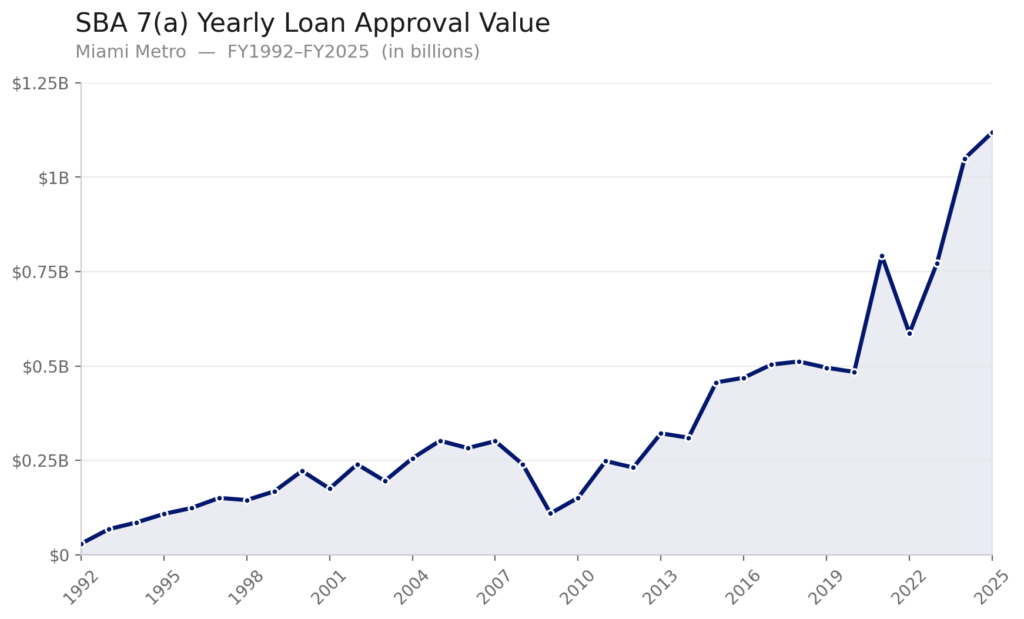
Miami SBA 7(a) Loan Program Statistics
These are the year-by-year* statistics of the SBA 7(a) loan program in the Miami metro area from fiscal year 1992 to today, including the number of 7(a) loans approved and total approval amount.
| Fiscal Year | Loans Approved | Approval Amount |
| 1992 | 112 | $29,271,691 |
| 1993 | 220 | $67,678,580 |
| 1994 | 338 | $85,508,568 |
| 1995 | 774 | $108,174,828 |
| 1996 | 680 | $123,865,038 |
| 1997 | 631 | $150,498,235 |
| 1998 | 546 | $144,870,076 |
| 1999 | 531 | $168,031,527 |
| 2000 | 636 | $221,991,307 |
| 2001 | 648 | $175,266,289 |
| 2002 | 843 | $239,536,800 |
| 2003 | 1,696 | $195,501,399 |
| 2004 | 2,423 | $255,483,663 |
| 2005 | 2,305 | $302,007,652 |
| 2006 | 2,431 | $282,554,950 |
| 2007 | 2,536 | $300,950,800 |
| 2008 | 1,412 | $239,031,250 |
| 2009 | 371 | $109,459,833 |
| 2010 | 524 | $150,957,000 |
| 2011 | 706 | $248,116,500 |
| 2012 | 637 | $230,980,100 |
| 2013 | 687 | $321,587,800 |
| 2014 | 678 | $309,958,100 |
| 2015 | 1,034 | $456,363,400 |
| 2016 | 1,126 | $468,849,900 |
| 2017 | 1,327 | $503,632,700 |
| 2018 | 1,491 | $511,837,800 |
| 2019 | 1,323 | $495,261,900 |
| 2020 | 869 | $484,191,600 |
| 2021 | 1,011 | $792,598,500 |
| 2022 | 1,163 | $586,627,800 |
| 2023 | 2,024 | $772,192,200 |
| 2024 | 2,470 | $1,049,237,800 |
| 2025 | 2,552 | $1,118,380,600 |
Source: SBA, 7(a) & 504 FOIA
*U.S. Federal Government fiscal years
SBA 7(a) Loans On the Rise
The SBA 7(a) loan program has seen mind-boggling growth in Miami, with the annual total value of approved loans up 39x since 1992.
About 7aSavvy
7aSavvy is an SBA 7(a) loan broker and matching service for Miami business owners. We are not a lender and we are not the SBA. We do not approve loans and we do not set rates.
What we do is simpler and, for most borrowers, more useful. We look at your deal, we know which lenders actually fund that kind of request in the Miami market, and we connect you with the right one. Because the lender pays us, the service is free to you.
Our team has decades of SBA loan experience, led by our founder and CEO, Brett Smith. He has worked on over $1 billion of SBA loans and has more than 10 years of experience as both a lender and a broker, which gives him a deep well of experience and a unique point of view on every loan. We put that experience to work helping borrowers find the right lender for their loan and giving them the best shot at business success.
How 7aSavvy Works
Step 1: You tell us about the deal. Use our Get Connected form to share the basics, including the loan purpose, the rough size, the industry, and the location in Miami.
Step 2: We read the request. We look at the use of proceeds, whether that is an acquisition, real estate, equipment, a refinance, or working capital, along with the details a lender is going to care about.
Step 3: We match you to the right lender. We know which Miami-area lenders have the appetite, the industry fit, and the capacity for your deal, and we make the introduction.
Step 4: We stay with the deal. We help keep the request moving toward funding instead of leaving you to chase the bank on your own.
Case Study
To give a sense of how this plays out, here is an anonymized example of a past deal we have done.
Ana ran an import and distribution company in Doral, moving consumer goods between Latin America and the U.S. market. She had been leasing her warehouse for years and wanted to buy the building she operated out of, along with a competitor’s customer list and inventory that came up for sale at the same time. All in, she needed about $2.6 million, which was roughly $2.1 million for the real estate and $500,000 for the acquisition and added inventory. She had the cash for a 10% down payment, so she was looking at a loan of a little over $2.3 million.
She started with her business bank, but the combination of a real estate purchase and an acquisition in one request did not fit their standard conventional box, and they were not comfortable with it. She had heard about 7aSavvy and came to us. We connected her with a lender that regularly handles SBA deals tied to import and distribution businesses and understood how that kind of company runs. The process took about 90 days from start to finish, and Ana was able to close on both the building and the acquisition.