
Fiscal Year 2025
9,692
Loans Approved
$4.8B
Total Value
California business owners often have strong growth opportunities, but finding the right SBA 7(a) lender can be difficult. A borrower may need funding to buy a company, purchase equipment, refinance eligible debt, open a new location, acquire commercial real estate, or support working capital. The challenge is that not every lender views every SBA 7(a) loan request the same way. That is where a broker helps. We are an SBA 7(a) brokering service that reads your deal, knows which California lenders fund that type of request, and makes the introduction to the right one.
An SBA 7(a) loan is made by an approved lender and partially guaranteed by the U.S. Small Business Administration. The SBA generally does not lend directly to small business owners. Instead, banks, credit unions, and other approved lenders provide the financing, while the SBA guarantee helps reduce part of the lender’s risk.
That structure can make SBA 7(a) financing a valuable option for qualified small businesses in California that may not fit perfectly into a conventional bank loan. For most SBA 7(a) loans, the maximum loan amount is $5 million. The SBA guarantee is generally up to 85% for loans of $150,000 or less and up to 75% for loans greater than $150,000, subject to SBA rules and the specific loan type.
Note: 7aSavvy is an SBA 7(a) loan broker, not a lender. We are paid by the lender, so our help is free to you. Instead of approaching banks one at a time and hoping for a fit, you start with one focused path to the lenders most likely to fund your request.
Uses of SBA 7(a) Loan Proceeds in California
California borrowers often need flexible financing to move quickly, whether the goal is to acquire a company, purchase equipment, improve a facility, buy owner-occupied commercial real estate, refinance eligible business debt, or strengthen working capital. SBA 7(a) loans can support these needs, making them a practical funding option for qualified small businesses across the state.
As an SBA 7(a) loan brokering platform, 7aSavvy helps California borrowers understand how SBA-backed financing may fit their plans and connect with lenders that are better aligned with the details of their request. A business acquisition in Los Angeles may require a different lending fit than a commercial real estate purchase in San Diego, equipment financing in San Jose, or working capital for a growing company in Sacramento.
Our platform is built to make the lender-finding process easier. Instead of approaching lenders one by one, borrowers can use 7aSavvy to start with a more focused path toward SBA 7(a) financing.
SBA 7(a) loan proceeds may commonly be used for:
- Business acquisitions
- Owner-occupied commercial real estate purchases
- Equipment purchases
- Construction, renovation, or buildout projects
- Eligible business debt refinancing
- Working capital
- Business expansion needs
These use-of-proceeds options can make SBA 7(a) loans useful for California business owners who want to grow, improve operations, invest in long-term assets, or create more breathing room in their cash flow.
SBA 7(a) loans are designed for active operating businesses. They are generally not meant for passive real estate investment, including commercial or residential investment properties that are not primarily occupied and used by the operating business.
Buy
California business owners may use SBA 7(a) financing to purchase important business assets or acquire an existing company. This can include buying a business with established customers and revenue, purchasing owner-occupied commercial property, or financing equipment that supports daily operations.
For entrepreneurs looking to buy a business in California, an SBA 7(a) loan can be a strong fit. The financing can help support acquisitions in a wide range of industries, from professional services and healthcare to restaurants, franchises, manufacturing, and local service businesses.
7aSavvy helps borrowers take a more organized approach to the acquisition financing process. Our SBA 7(a) loan brokers can help California buyers think through the funding request, understand what lenders may want to evaluate, and connect with SBA lending options that best match the structure of the deal.
Build
SBA 7(a) loan proceeds may also be used for construction, renovation, and improvement projects tied to an active business. For California companies that need a larger location, a better customer-facing space, or improvements to an existing facility, this type of financing can help support projects that improve both operations and long-term business value.
Eligible business-related projects may include:
- Leasehold improvements
- Interior buildouts
- Facility renovations
- Building additions
- Ground-up construction for business use
- Improvements to owner-occupied commercial property
Construction-related SBA 7(a) requests usually involve more detail than a simple working capital request. Lenders will review project budgets, contractor information, timelines, permits, collateral, business financials, and the borrower’s repayment ability.
Expand
Growth often requires capital before the return is fully realized – or in other words, takes money to make money. A California business may need funding to open another location, add employees, increase inventory, purchase equipment, upgrade technology, or support cash flow during a period of expansion.
SBA 7(a) financing may be used to support expansion needs such as:
- Opening a new location
- Increasing operating capacity
- Hiring additional staff
- Purchasing inventory
- Adding equipment or technology
- Supporting seasonal working capital needs
- Strengthening cash flow during growth
- Expanding into new markets
As an SBA 7(a) loan broker in California, 7aSavvy helps borrowers explore lending options based on the actual purpose of the funding. A growth-focused working capital request is not the same as a real estate purchase or business acquisition, and lenders may evaluate each scenario differently.
Our process is designed to help borrowers connect with SBA 7(a) lenders that are experienced with the type of financing being requested. For California business owners, that makes the early stage of the loan process quicker, more efficient and more effective.
SBA 7(a) Loan Industries in California
SBA 7(a) loans may be used by many types of for-profit businesses, which makes the program a flexible financing option for California business owners. Whether a company needs capital to buy another business, expand into a new location, purchase equipment, refinance eligible debt, or support working capital, SBA 7(a) financing may offer a path forward when the request meets SBA and lender requirements.
California has a diverse small business landscape, from local service companies and restaurants to medical practices, franchise operators, retail businesses, hospitality groups, and manufacturers. Because each industry can have different financing needs, working with the right SBA lender matters.
Common California industries that can use SBA 7(a) business loans include:
- Restaurants and food service businesses
- Hotels, motels, and hospitality businesses
- Gas stations and convenience stores
- Retail stores
- Medical, dental, and healthcare practices
- Franchise businesses
- Service-based companies
- Car washes
- Storage facilities
- Manufacturing companies
- Professional service firms
A restaurant in Los Angeles may need funding for equipment, tenant improvements, or working capital. A medical practice in San Diego may need financing for acquisition, buildout, or expansion. A franchise owner in Sacramento may need capital to open another location. A service business in San Jose may need funds to hire staff, purchase vehicles, or support growth.
For many California companies, the process of attaining SBA 7(a) financing is not as simple as just getting access to capital. You must first find a lender that understands the industry, as well as the use of funds and the repayment story behind the request.
SBA 7(a) Loan Qualifications in California
Qualifying for an SBA 7(a) loan begins with meeting the basic eligibility requirements for small business borrowers. In general, the business must be a for-profit company, operate in the United States or its territories, meet SBA size standards, and use the loan proceeds for an eligible business purpose.
SBA 7(a) financing is available to several common business structures, including:
- Sole proprietorships
- Corporations
- Partnerships
- Limited liability companies
- Other eligible for-profit business entities
These basic requirements are only the starting point. Once a California business meets the general eligibility framework, lenders review the full loan request. That review may include the company’s financial performance, credit profile, ownership structure, industry, collateral, use of proceeds, management experience, and ability to repay the loan.
For example, a borrower seeking funding to acquire an existing business may need to provide different information than a borrower purchasing owner-occupied commercial real estate or refinancing eligible business debt. A lender reviewing a restaurant loan may focus on different details than one reviewing a medical practice, franchise, or manufacturing company loan.
7aSavvy helps California business owners start with a more focused path. Our SBA 7(a) loan brokering connects borrowers with lending options that fit their goals, industry, and funding needs.
Important Note:
Meeting the basic SBA 7(a) loan qualifications does not guarantee approval. Final eligibility and approval depend on the specific business, use of proceeds, credit profile, repayment ability, required documentation, and the lender’s underwriting criteria.
SBA 7(a) Loans in California: Pros and Cons
An SBA 7(a) loan can give California business owners access to flexible financing for important business needs, from buying a company to expanding operations, purchasing equipment, refinancing eligible debt, or investing in owner-occupied commercial real estate. For qualified borrowers, this type of financing may offer a more practical structure than many conventional business loan options.
Because SBA 7(a) loans are issued by approved lenders and partially guaranteed by the U.S. Small Business Administration, lenders may be able to consider loan requests that do not fit neatly into a traditional financing box. That can make the program useful for California businesses with strong plans but more complex funding needs or weaker cash flow.
Key benefits may include:
- Longer repayment terms than most business financing options
- Flexible use of proceeds for eligible business purposes
- Financing for business acquisitions, expansion, equipment, working capital, eligible debt refinancing, and owner-occupied commercial real estate
- Fully amortized repayment structures
- Competitive interest rates for qualified borrowers and eligible uses
- Lower upfront down payments compared with conventional financing options
For many California businesses, the benefit is not just access to capital. It is access to capital with a structure that better supports long-term growth. A longer repayment timeline may help reduce pressure on monthly cash flow, while flexibility gives borrowers the ability to fund multiple business needs through one financing solution.
However, the SBA 7(a) program is not for every borrower, there are some limitations. To receive SBA financing, a business must be 100% owned by U.S. citizens or nationals – no legal permanent residents anymore (as of March 1, 2026). Additionally, the maximum loan size is $5 million, meaning that some deals, especially those involving expensive California real estate, may be too large to fit.
SBA 7(a) Loans vs. Other Types of Loans
SBA 7(a) Loans vs Conventional Loans
Because there is no SBA guarantee behind a conventional business loan, the lender takes on the full credit risk. That can make conventional loans more difficult to qualify for, especially when the borrower has limited collateral, weaker cash flow, a shorter operating history, or a transaction that does not fit a bank’s standard credit box.
An SBA 7(a) loan works differently. The loan is still made by an approved lender, but the U.S. Small Business Administration provides a partial guarantee. That guarantee reduces lender risk, which allows many small businesses to access financing when they don’t fit the profile for a conventional loan. Additionally, 7(a) financing comes with better terms – such as a lower down payment and a longer, fully amortized loan term.
For California borrowers, the comparison often comes down to the profile of the business and type of transaction. A business with strong cash flow, significant collateral, and a simple funding need may consider a conventional loan. A borrower with less collateral, less cash for a down payment, anything other than very strong cash flow, or needing a more flexible use of proceeds may benefit from exploring SBA 7(a) financing.
SBA 7(a) Loans vs SBA 504 Loans
SBA 7(a) loans and SBA 504 loans are both SBA-backed financing options, but they are commonly used for different business needs.
SBA 7(a) loans are more flexible. They may be used for working capital, business acquisitions, owner-occupied commercial real estate, equipment, construction, eligible refinancing, and expansion. This flexibility can make the 7(a) program useful when a California business needs funding for more than one purpose or when the request does not fit neatly into a fixed-asset loan.
SBA 504 loans are more focused on long-term, fixed-asset financing. They are commonly used for major fixed assets, such as owner-occupied commercial real estate or large equipment purchases. For businesses that mainly need to finance a property or major equipment, an SBA 504 loan may be worth reviewing.
In some ways, the loan terms are similar for both – such as a standard 10% down payment and a maximum 25-year term for real estate loans. However, there are some key differences. SBA 504 interest rates are usually lower and fixed-rate, while SBA 7(a) interest rates are usually a bit higher and variable-rate (although they can be fixed in some cases). 7(a) loans have a maximum loan size of $5 million, while 504 loans have a maximum size of $11.25 million, making them a better fit for larger real estate transactions.
Lastly, as a 504 loan is actually two loans put together, one from a standard business lender and one from a non-profit Certified Development Company (CDC), the 7(a) loan process is simpler and faster, even for the same business and loan purpose.
For a California business purchasing a building, either program may be considered depending on the project. For a borrower who also needs working capital, acquisition financing, eligible debt refinancing, or a broader funding structure, an SBA 7(a) loan may offer more flexibility.
SBA 7(a) Loan Program History
The SBA 7(a) loan program has supported small business lending for decades. Its roots trace back to the Small Business Act of 1953, which created the U.S. Small Business Administration and established a federal framework for helping small businesses access capital.
The name “7(a)” comes from the section of the Small Business Act that authorizes the program. Since 1953 it has been the SBA’s primary business loan program, helping eligible small businesses obtain financing through approved lenders.
For California businesses, that history matters because for the many small companies that need capital but may not qualify easily through traditional lending alone, such a long track record of success shows that this is a program that works. A growing restaurant group, healthcare practice, franchise operator, manufacturer, retailer, contractor, or service business may have a strong plan, but still need a lender willing to understand the full picture, and SBA 7(a) lenders have been doing that for over 70 years.
California SBA 7(a) Loan Program Statistics
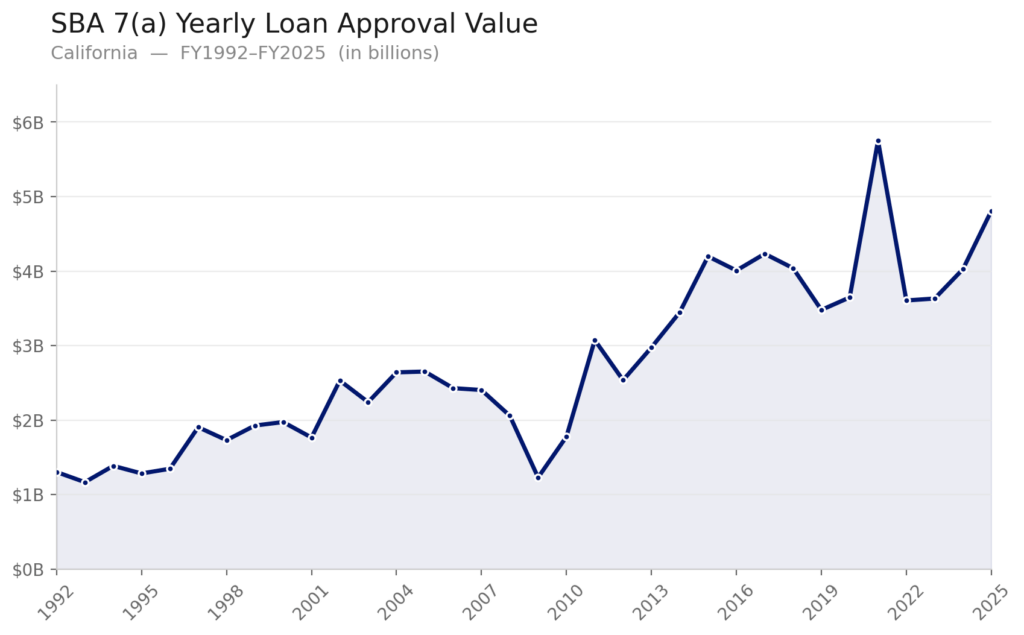
These are the year-by-year* statistics of the SBA 7(a) loan program in California from fiscal year 1992 to today, including the number of 7(a) loans approved and total approval amount.
| Fiscal Year | Loans Approved | Approval Amount |
| 1992 | 3,748 | $1,302,827,255 |
| 1993 | 3,585 | $1,167,370,581 |
| 1994 | 4,234 | $1,386,188,651 |
| 1995 | 5,619 | $1,283,925,131 |
| 1996 | 5,525 | $1,346,548,497 |
| 1997 | 6,476 | $1,905,027,947 |
| 1998 | 6,872 | $1,730,590,179 |
| 1999 | 6,870 | $1,926,926,944 |
| 2000 | 6,220 | $1,973,840,299 |
| 2001 | 5,781 | $1,766,449,095 |
| 2002 | 8,044 | $2,531,238,270 |
| 2003 | 10,705 | $2,240,943,335 |
| 2004 | 12,240 | $2,640,849,976 |
| 2005 | 11,731 | $2,652,064,635 |
| 2006 | 12,681 | $2,428,929,278 |
| 2007 | 14,531 | $2,404,189,540 |
| 2008 | 8,816 | $2,058,760,288 |
| 2009 | 4,281 | $1,230,407,100 |
| 2010 | 4,910 | $1,777,519,000 |
| 2011 | 5,830 | $3,074,331,000 |
| 2012 | 5,270 | $2,536,283,600 |
| 2013 | 5,981 | $2,974,946,900 |
| 2014 | 6,936 | $3,448,449,400 |
| 2015 | 8,980 | $4,198,270,400 |
| 2016 | 8,736 | $4,007,649,900 |
| 2017 | 7,856 | $4,233,019,000 |
| 2018 | 7,283 | $4,039,678,300 |
| 2019 | 6,304 | $3,479,128,800 |
| 2020 | 5,339 | $3,647,180,900 |
| 2021 | 5,826 | $5,749,880,000 |
| 2022 | 4,909 | $3,606,306,500 |
| 2023 | 6,108 | $3,632,366,800 |
| 2024 | 8,278 | $4,027,076,800 |
| 2025 | 9,692 | $4,808,572,400 |
Source: SBA, 7(a) & 504 FOIA
*U.S. Federal Government fiscal years
SBA 7(a) Loans On the Rise
The SBA 7(a) loan program has seen good growth in California, with the annual total value of approved loans up almost 4x since 1992.
About 7aSavvy
7aSavvy is an SBA 7(a) loan broker and matching service for California business owners. We are not a lender and we are not the SBA. We do not approve loans or set rates.
What we do is simpler and, for most borrowers, more useful: we look at your deal, we know which lenders actually fund that kind of request in California, and we connect you with the right one. Because the lender pays us, the service is free to you.
Our team has decades of SBA loan experience, led by our founder and CEO, Brett Smith. He has worked on over $1 billion of SBA loans and has 10+ years of experience as both a lender and broker, giving him unparalleled experience and a unique perspective on every loan. We use our experience and expertise to help borrowers find the right lender for their loan and have the best chance at business success.
How 7aSavvy Works
Step 1: You tell us about the deal. Use our Get Connected form to share the basics: loan purpose, rough size, industry, and location in California.
Step 2: We read the request. We look at the use of proceeds (acquisition, real estate, equipment, refinance, or working capital) and the details a lender will care about.
Step 3: We match you to the right lender. We know which California lenders have the appetite, the industry fit, and the capacity for your deal, and we make the introduction.
Step 4: We stay with the deal. We help keep the request moving toward funding instead of leaving you to chase the bank alone.
Case Study
To illustrate, here’s an anonymized example of a past deal we’ve done.
Jason owned a gas station in Fresno, and he wanted to buy the real estate he operates in. He needed $3.1 million – $2.9 million for the real estate and $200k for improvements to spruce the place up a bit. He had the cash for a 10% down payment ($310k), so he needed a $2.79 million loan.
He went to his business bank, but he wasn’t a good candidate for a conventional loan. He heard about 7aSavvy, and came to us. We connected him with a lender that does a lot of gas station SBA loans and are familiar with what it takes to get them done. The process took 82 days, start to finish, and Jason was able to move forward with his purchase and improvements.