Fiscal Year 2025
3,930
Loans Approved
$2.0B
Total Value
Los Angeles business owners often need financing that can keep up with the cost, competition, and opportunity of operating in one of the country’s most active commercial markets. Whether the goal is to acquire an existing business, purchase owner-occupied commercial real estate, buy equipment, refinance eligible business debt, or secure working capital, an SBA 7(a) loan can be a practical option for qualified small businesses.
For many companies in Los Angeles, the challenge is not simply finding SBA financing. It is finding the right SBA lender for the specific loan request. Different lenders may have different credit preferences, industry experience, loan-size appetites, underwriting expectations, and timelines. That is where working with an SBA 7(a) loan broker can make the process more efficient.
7aSavvy helps small business owners get connected with SBA 7(a) lenders that are a better fit for their financing needs. Through our lender network and SBA-focused process, our platform is designed to help borrowers move from early-stage questions to serious lender conversations with more clarity.
Note: 7aSavvy is an SBA 7(a) loan broker, not a lender. We are paid by the lender, so our help is free to you. Instead of approaching banks one at a time and hoping for a fit, you start with one focused path to the lenders most likely to fund your request.
Uses of SBA 7(a) Loan Proceeds in Los Angeles
SBA 7(a) financing can help Los Angeles business owners fund major business needs without being limited to one narrow use of capital. For qualified borrowers, loan proceeds may support business acquisitions, owner-occupied commercial real estate, equipment purchases, eligible construction or renovation work, debt refinancing, inventory, and working capital.
That flexibility can be valuable in a market like Los Angeles, where businesses often face high real estate costs, competitive expansion opportunities, changing customer demand, and the need to invest in more efficient operations. A company may need funds to purchase a storefront, acquire another business, build out a leased space, upgrade equipment, refinance eligible obligations, or add working capital before a growth period.
As an SBA 7(a) loan broker, 7aSavvy helps Los Angeles borrowers approach this process with more direction. Our platform is designed to connect small business owners with SBA lending options based on how the funds will be used, the structure of the request, and the borrower’s business goals.
A business owner may be looking to buy an established company in Downtown Los Angeles, finance improvements for a restaurant in Hollywood, purchase owner-occupied commercial space in the San Fernando Valley, upgrade equipment for a manufacturing company in Vernon, or support working capital needs for a growing service business on the Westside. 7aSavvy helps make the lender search more focused from the start.
SBA 7(a) loan proceeds are commonly used for:
- Buying an existing business
- Purchasing owner-occupied commercial real estate
- Financing equipment, machinery, furniture, or fixtures
- Funding eligible construction, renovations, or leasehold improvements
- Purchasing inventory, supplies, or materials
- Refinancing eligible business debt
- Supporting short-term or long-term working capital needs
These uses make SBA 7(a) loans a practical financing option for Los Angeles companies that want to grow, improve operations, invest in business assets, or create a stronger financial base.
SBA 7(a) loans are intended for eligible operating businesses. They are generally not designed for passive investment activity, such as buying residential or commercial investment property that the business will not primarily occupy or use.
Buy
Los Angeles entrepreneurs and business owners may use SBA 7(a) financing to purchase assets that support business ownership and long-term growth. That can include buying an existing business, acquiring owner-occupied commercial property, or purchasing equipment needed to operate more efficiently.
For buyers pursuing a business acquisition in Los Angeles, SBA 7(a) financing may be useful because it can support eligible purchases across many industries. Instead of building a business from the ground up, a buyer can acquire a company that already has customers, revenue, employees, operating history, systems, and a local market presence.
A business acquisition loan request usually requires detailed review. SBA lenders evaluate the buyer’s background, management experience, seller financials, business cash flow, valuation, purchase agreement, collateral, and overall repayment ability. 7aSavvy helps borrowers take a more organized first step by connecting them with SBA 7(a) lending options that best fit the transaction.
Our SBA 7(a) loan brokering platform can be especially useful for Los Angeles buyers who do not want to contact lenders one at a time without knowing which institutions may be interested in and experienced with their type of request.
Build
SBA 7(a) loan proceeds may also be used for eligible improvements tied to an active operating business. For Los Angeles companies, this can be important when a location needs to be updated, expanded, built out, or adapted for business use.
Eligible project types may include:
- Leasehold improvements
- Interior buildouts
- Facility upgrades
- Renovations to an existing business location
- Building additions
- Ground-up construction for business use
- Improvements to owner-occupied commercial property
Construction and renovation requests often require more documentation than a simple working capital loan. The lender will need to review the project budget, contractor details, permits, timeline, collateral, business financials, and how the completed project will support future cash flow.
For Los Angeles borrowers, 7aSavvy helps organize these pieces before the request reaches a lender. Our platform helps connect business owners with SBA 7(a) loan options based on the purpose of the funds, the property or project type, and the overall financing structure.
Expand
When a Los Angeles business is ready to grow, the right financing can help it move forward without relying only on cash reserves or short-term funding. SBA 7(a) loan proceeds can be used to support expansion plans, operating needs, and investments that help the business serve more customers or increase capacity.
Los Angeles businesses may use SBA 7(a) financing to:
- Open another location
- Increase operating capacity
- Hire employees
- Purchase inventory
- Add equipment, vehicles, furniture, or technology
- Improve cash flow
- Fund seasonal or growth-related working capital needs
- Invest in systems that support scale
Expansion financing can look different from one business to another. A restaurant may need buildout capital for a new location. A medical or dental practice may need equipment and tenant improvements. A contractor may need vehicles, tools, and working capital. A retail company may need inventory, fixtures, and leasehold improvements. A professional services company may need capital to hire, market, and expand into a larger office.
7aSavvy helps Los Angeles borrowers explore SBA 7(a) loan options experienced with their particular use of funds. Rather than treating every financing request the same way, our brokering helps match business owners with SBA lending options based on the transaction, the business plan, and the type of capital needed.
SBA 7(a) Loan Industries in Los Angeles
SBA 7(a) loans can be used by many types of eligible for-profit businesses in Los Angeles. Because the program can support several approved funding needs, it may be a useful option for business owners in a variety of industries seeking capital for acquisitions, expansion, owner-occupied commercial real estate, equipment, eligible debt refinancing, or working capital.
Los Angeles has a diverse business environment, with companies operating across food service, healthcare, hospitality, retail, transportation, entertainment and entertainment-adjacent services, manufacturing, construction, professional services, and franchise operations. That variety means borrowers often need SBA lending options that fit not only the loan amount, but also the industry, business model, and reason for financing.
7aSavvy helps Los Angeles business owners explore SBA 7(a) lending options with the industry of the business and purpose of the loan in mind. Our SBA 7(a) loan brokering platform is built to help connect borrowers with lenders that are a good fit for their transaction, whether the request is for buying a restaurant, acquiring equipment for a dentist’s office, purchasing real estate for a retail store, constructing a hotel, or securing working capital for a manufacturing company.
Common industries that may use SBA 7(a) business loans include:
- Restaurants, cafés, bakeries, and food service businesses
- Hotels, motels, and lodging businesses
- Convenience stores
- Gas stations
- Retail stores
- Medical, dental, and healthcare practices
- Professional service businesses
- Franchise businesses
- Car washes
- Self-storage facilities
- Manufacturing companies
- Distribution, logistics, and transportation businesses
- Construction-related businesses
- Owner-operated companies with commercial real estate needs
For Los Angeles businesses, SBA 7(a) financing can support many different types of transactions. A restaurant owner may need capital for equipment, tenant improvements, and working capital. A medical practice may need funding for an acquisition, new office buildout, or expansion. A hotel or lodging business may need financing for eligible property improvements. A franchise operator may need capital to open a new location or purchase an existing one. A manufacturer or logistics company may need equipment, vehicles, or additional working capital to support growth.
SBA 7(a) Loan Qualifications in Los Angeles
Qualifying for an SBA 7(a) loan in Los Angeles starts with the basic eligibility requirements of the program. In general, the business must be a for-profit company, operate in the United States or its territories, and meet applicable SBA size and eligibility standards.
SBA 7(a) financing is available to several eligible business structures, including:
- Sole proprietorships
- Corporations
- Partnerships
- Limited liability companies
- Other eligible for-profit business entities
These basic requirements are only the beginning of the process. Once initial eligibility is considered, SBA lenders typically review the full financing request. That review includes the business profile, borrower experience, intended use of proceeds, repayment ability, credit history, available collateral, industry risk, and cash flow.
For Los Angeles borrowers, this step can feel difficult to navigate without knowing which lenders may be open to the specific type of business or loan request. 7aSavvy helps bring more organization to the process by helping business owners understand what lenders may evaluate and connect with SBA 7(a) lending options that align with their goals.
Important Note:
Meeting the basic SBA 7(a) loan requirements does not guarantee approval. Final eligibility and approval depend on the lender’s underwriting standards, the type of business, the borrower’s credit profile, the intended use of funds, repayment ability, available collateral, and SBA program rules.
SBA 7(a) Loans in Los Angeles: Pros and Cons
For many Los Angeles business owners, an SBA 7(a) loan can provide a practical way to access capital for important business needs without depending only on short-term financing or traditional bank loans. Whether the plan is to acquire a business, buy owner-occupied commercial real estate, purchase equipment, refinance eligible debt, or strengthen working capital, the SBA 7(a) program offers a useful structure for qualified borrowers.
In a market like Los Angeles, financing needs can vary widely from one business to another. A restaurant may need funds for a buildout and equipment. A healthcare practice may need acquisition or expansion capital. A contractor may need vehicles and working capital. A retail business may need inventory, fixtures, and improvements to a leased space. SBA 7(a) financing can support several approved uses, which makes it a flexible option for many eligible small businesses.
One of the main benefits of SBA 7(a) financing is that the loan structure is generally tied to the purpose of the funds. A real estate purchase, for example, may be handled differently than a working capital request, equipment financing need, or business acquisition. This can help borrowers pursue financing that better matches the asset, project, or business goal being funded.
Key benefits may include:
- Longer repayment terms than most other business financing options
- Competitive interest rates for eligible business purposes
- Flexible use of proceeds for approved business needs
- Financing for acquisitions, expansion, equipment, real estate, refinancing, and working capital
- Repayment structures that align with the loan purpose
- Lower equity injection requirements than conventional loans
These features can make SBA 7(a) loans useful for Los Angeles small businesses that need capital while still managing day-to-day cash flow. Longer amortization periods may help reduce monthly payment pressure, and flexible use-of-proceeds rules can allow business owners to address more than one eligible need through a single financing request.
But there are also some limitations to SBA loans. One is the strict citizenship requirement. As of 2026 all owners of the business must be U.S. citizens or nationals – that means no lawful permanent residents. That is unfortunate in a city like Los Angeles, full of immigrants chasing the American Dream. Another is the loan size limit of $5 million. Los Angeles real estate can be very expensive, so larger deals involving real estate may not be compatible with 7(a) financing.
SBA 7(a) Loans vs. Other Types of Loans
SBA 7(a) Loans vs Conventional Loans
A conventional business loan is based entirely on the lender’s own underwriting standards. Since there is no SBA guarantee involved, the lender is responsible for the full credit risk. That often means a borrower may need a stronger overall profile, such as substantial cash flow, sufficient collateral, solid credit, a longer operating history, and a loan request that is easy for the lender to evaluate.
For some Los Angeles companies, that can work well. A business with strong financials, clear repayment ability, and a straightforward funding need may be able to secure conventional financing through a bank or credit union. This route may be appropriate when the lender already understands the business, the collateral is strong, and the financing request is relatively simple.
SBA 7(a) loans are built differently. Because approved lenders receive a partial SBA guarantee, the structure gives lenders more room to review eligible requests that do not fit a conventional box. Borrowers still need to qualify, and lenders still underwrite the deal, but the SBA-backed structure can be useful when the request involves more complexity.
That can matter in Los Angeles, where many financing needs are not one-dimensional. A business may have more inconsistent cash flow or lack collateral. A borrower may be buying a business and need working capital after closing. A company may be purchasing owner-occupied commercial real estate while also funding improvements. A growing operation may need equipment, inventory, and cash flow support at the same time.
SBA 7(a) Loans vs SBA 504 Loans
SBA 7(a) and SBA 504 loans are both SBA-backed financing programs, but they are designed for different types of business needs.
SBA 504 financing is generally tied to long-term fixed assets. It is often used for owner-occupied commercial real estate, construction, major equipment, facility improvements, or similar long-term investments. For a Los Angeles business that is primarily focused on buying or improving a property, a 504 loan may be one option to review.
SBA 7(a) financing offers broader flexibility. In addition to long-term fixed assets, loan proceeds may be used for working capital, business acquisitions, eligible refinancing, expansion, and other approved business purposes. That wider range of eligible uses can make the 7(a) program a better fit when the financing need includes more than a fixed asset purchase.
For example, a company buying a building may want to compare SBA 504 and SBA 7(a) options. But if the same business also needs funds for business acquisition, inventory, transition costs, payroll support, or eligible debt refinancing, SBA 7(a) financing may be more practical to review.
Case Study: Facility Purchase in Los Angeles
Diana owned a specialty food production company in L.A., but the business had outgrown its leased commercial kitchen space. When a large food production facility came on the market, Diana saw a chance to buy a building that could support future growth. The space already had some of the infrastructure she needed, but it would require a significant buildout to meet her requirements.
The total project cost was $2,900,000:
- Real estate (12,000-square-foot production facility with loading docks and parking): $2,200,000
- Renovations (kitchen buildout, cold storage, packaging line, health department compliance): $350,000
- Equipment (production line, bottling equipment, industrial mixers, labeling machine): $250,000
- Working capital for the move and production transition: $100,000
Diana had $290,000 available for a down payment (10%) and needed financing for the remaining $2,610,000.
She approached two conventional lenders. One was inexperienced with food manufacturing and declined. The other would consider the deal, but wanted 20% down, which Diana couldn’t afford.
Through 7aSavvy, Diana was matched with an SBA 7(a) lender that had experience with food production businesses and understood how to evaluate the industry. They were comfortable financing the full project, including the real estate, buildout, equipment, and working capital, in a single loan.
Loan Details:
- Total project cost: $2,900,000
- Down payment: $290,000 (10%)
- Loan amount: $2,610,000
- Interest rate: Prime + 2.25 (9.00% at the time of closing)
- Term: 25 years, fully amortized
- Monthly payment: $21,900
The business was generating annual cash flow of $340,000, giving it a DSCR of 1.29. Diana’s track record of revenue growth, existing distribution relationships, and a clear plan for increasing output all supported the lender’s approval.
The loan closed in 82 days. Owning the facility eliminated the rising lease costs and gave Diana full control over the production environment. The equipment and renovations allowed her to turn the facility into a powerhouse of production, and the working capital portion covered the costs of the transition.
This is an illustrative example based on typical SBA 7(a) loan terms and a realistic food production business scenario in Los Angeles. Actual loan terms, timelines, and outcomes vary based on the borrower, business, and lender.
SBA 7(a) Loan Program History
The SBA 7(a) loan program was created to address a problem many small business owners still face today: a business may be viable, growing, and ready for financing, but its cash flow, collateral, industry, or desired loan purpose(s) don’t fit the conventional lending mold.
The program traces back to the Small Business Act of 1953, which established the U.S. Small Business Administration. The name “7(a)” comes from the section of that law that gives the SBA authority to support this type of lending. Instead of lending directly in most cases, the SBA works with approved lenders by providing a partial guarantee on eligible loans.
That guarantee is one of the reasons the program remains relevant for business owners in Los Angeles. Lenders still review the borrower, business financials, repayment ability, collateral, credit profile, and use of funds, but the SBA-backed structure helps certain qualified businesses access financing when a conventional loan is not the right fit.
For Los Angeles companies, this can matter at important stages of growth or transition. A borrower may be preparing to acquire an established company, purchase owner-occupied commercial property, invest in new equipment, refinance eligible business debt, renovate a location, or add working capital. Each of those needs can involve a different type of risk for a lender, which is why the right lender match are important.
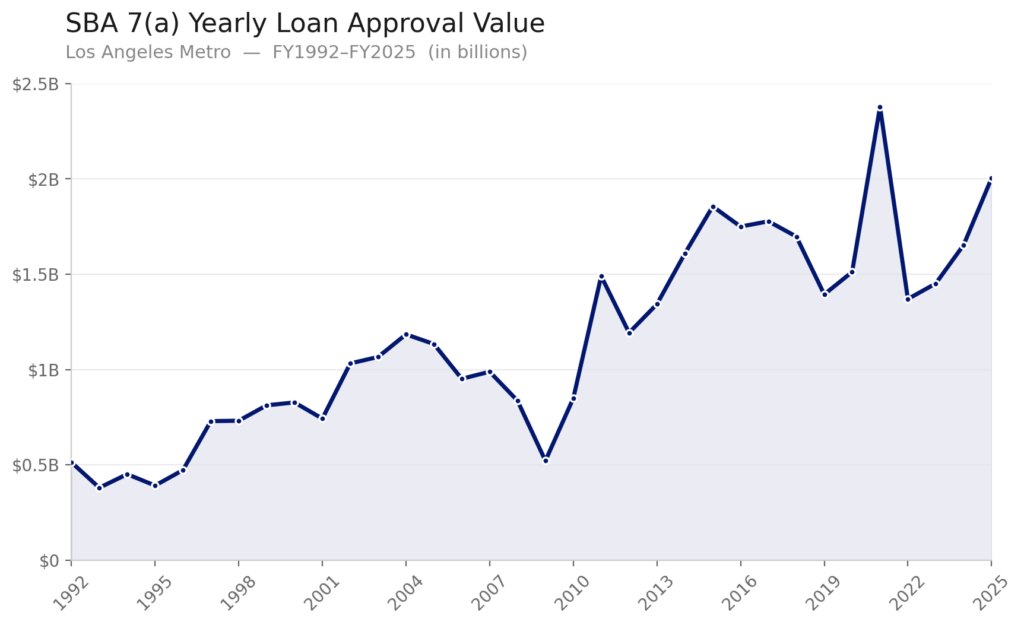
Los Angeles SBA 7(a) Loan Program Statistics
These are the year-by-year* statistics of the SBA 7(a) loan program in the Los Angeles metropolitan area from fiscal year 1992 to today, including the number of 7(a) loans approved and total approval amount.
| Fiscal Year | Loans Approved | Approval Amount |
| 1992 | 1,260 | $513,169,180 |
| 1993 | 1,052 | $379,752,283 |
| 1994 | 1,171 | $450,992,671 |
| 1995 | 1,535 | $391,288,956 |
| 1996 | 1,781 | $472,374,019 |
| 1997 | 2,329 | $729,173,993 |
| 1998 | 2,915 | $731,360,383 |
| 1999 | 2,856 | $812,026,310 |
| 2000 | 2,442 | $827,345,052 |
| 2001 | 2,333 | $742,418,402 |
| 2002 | 3,325 | $1,031,862,134 |
| 2003 | 5,069 | $1,065,907,339 |
| 2004 | 6,001 | $1,184,253,714 |
| 2005 | 5,410 | $1,133,636,273 |
| 2006 | 5,518 | $951,315,887 |
| 2007 | 6,507 | $988,362,000 |
| 2008 | 3,960 | $836,101,400 |
| 2009 | 1,700 | $521,184,600 |
| 2010 | 2,071 | $849,035,300 |
| 2011 | 2,547 | $1,489,826,100 |
| 2012 | 2,338 | $1,192,690,100 |
| 2013 | 2,619 | $1,342,922,000 |
| 2014 | 3,040 | $1,607,989,000 |
| 2015 | 3,831 | $1,855,483,800 |
| 2016 | 3,619 | $1,749,700,800 |
| 2017 | 3,178 | $1,777,288,300 |
| 2018 | 2,932 | $1,697,264,000 |
| 2019 | 2,583 | $1,393,860,800 |
| 2020 | 2,163 | $1,511,718,600 |
| 2021 | 2,268 | $2,377,874,600 |
| 2022 | 1,861 | $1,369,637,200 |
| 2023 | 2,521 | $1,451,210,600 |
| 2024 | 3,398 | $1,653,597,100 |
| 2025 | 2,861 | $2,003,451,600 |
Source: SBA, 7(a) & 504 FOIA
*U.S. Federal Government fiscal years
SBA 7(a) Loans On the Rise
The SBA 7(a) loan program has seen outstanding growth in Los Angeles, with the annual total value of approved loans up 4x since 1992.