
Fiscal Year 2025
1,648
Loans Approved
$847M
Total Value
Most Arizona entrepreneurs who go looking for an SBA 7(a) loan start in the wrong place. They walk into the bank they already use, or they go to the first lender then find. Then the answer comes back as a no, and the reason often has nothing to do with how good the business is. The lender simply does not fund that industry, that deal size, or that use of the money. 7aSavvy was built to skip that dead end. We are an SBA 7(a) Arizona loan broker, and our whole job is to figure out which lender wants your deal before you ever fill out an application.
Here is why that matters. Every SBA lender has a sense of what it likes and what it avoids, and no two lists match. One bank chases restaurant acquisitions and passes on ground-up construction. Another loves owner-occupied real estate but will not touch a business with seasonal revenue. Send the same file to both and you get two different answers. As an SBA 7(a) loan broker, we hold a working map of those preferences, so instead of guessing, we point your request at the lender whose appetite already lines up with it.
The loan itself is worth understanding. An SBA 7(a) loan is not money from the government. It comes from a regular bank, credit union, or non-bank lender, and the U.S. Small Business Administration simply promises to cover a chunk of the balance if the borrower defaults. That backstop is the reason a lender will approve a request it might otherwise turn down. The guarantee runs to 85% on loans up to $150,000 and 75% above that, and the program tops out at a $5 million loan.
Uses of SBA 7(a) Loan Proceeds in Arizona
A big reason the program is worth the paperwork is how many different problems one loan can solve. An Arizona borrower does not have to take out a separate facility for a building, another for equipment, and a line of credit on top. A single SBA 7(a) loan can cover a mix of eligible needs, which is why it fits businesses that are buying, growing, and re-tooling all at once.
Proceeds are commonly put toward:
- Acquiring an existing company
- Buying a commercial building
- Purchasing machinery, vehicles, or other equipment
- Paying for construction, remodels, or tenant buildouts
- Refinancing business debt
- Covering payroll, inventory, and other working capital
- Financing a second location or other expansion
One boundary is important to know. This financing is for companies that actively run and occupy their space. It is not a vehicle for passive real estate held purely as an investment, so a building your operating business will not use itself falls outside the program.
Buy
Buying is where we see the most Arizona 7(a) activity, and it takes two main shapes. The first is purchasing a company outright, one that already has staff, customers, and a track record a lender can examine. The second is buying real estate so the owner doesn’t have to pay rent to someone else. Both are strong fits for the program, and both are exactly the kind of request an SBA 7(a) broker should be able to route to a lender that funds that type of loan regularly rather than one seeing it for the first time.
Build
Construction and renovation money is the second bucket, and it covers more ground than people expect. A dentist fitting out two new operatories, a brewery adding a taproom, a manufacturer expanding a facility in Chandler, a franchisee remodeling to hit brand standards, all of it can sit inside an SBA 7(a) loan. Arizona’s building costs and permitting timelines vary a lot between the Phoenix metro, Tucson, and the northern part of the state, so the lender you pick should be comfortable with construction draws and the pace of the local market.
Expand
Growth burns cash before it produces any, and that lag is where good businesses stall. SBA 7(a) financing can bridge it, funding a new location, a bigger crew, new equipment to increase capacity, a jump in inventory ahead of a busy season, or the software and systems a growing company outgrows. For an owner staring at more demand than the current setup can handle, that funding often decides whether the next opportunity gets taken or handed to a competitor.
SBA 7(a) Loan Industries in Arizona
The businesses that qualify cut across nearly the whole Arizona economy, which is broad. The state is home to roughly 706,640 small businesses, about 99.5% of all employers, and together they put close to 1.2 million people to work, around 43% of the private workforce. A base that size means the deals crossing an Arizona SBA 7(a) loan broker’s desk in any given month rarely look alike.
Requests tend to cluster in industries such as:
- Restaurants, bars, and food service
- Hotels, resorts, and tourism-driven hospitality
- Convenience stores and fuel stations
- Medical, dental, and veterinary practices
- Auto repair, car washes, and service shops
- Franchise operations of many kinds
- Trucking, warehousing, and last-mile logistics
- Light manufacturing and fabrication
- Self-storage and specialty real estate users
- Professional, trade, and other service firms
The shape of Arizona’s economy explains a lot of that mix. Health care is the largest small-business employer in the state, followed closely by the accommodation and food sector that rides on year-round visitors to Phoenix, Scottsdale, Sedona, Tucson, and the Grand Canyon. Construction stays busy on the back of steady in-migration across the Valley, and the wave of semiconductor and advanced-manufacturing plants moving into the region pulls in a long tail of suppliers, contractors, and service companies. Each of those big sectors feeds smaller businesses that eventually need acquisition, real estate, or equipment money, and that is the point where an SBA 7(a) loan broker usually enters the picture.
SBA 7(a) Loan Qualifications in Arizona
Eligibility works in two layers, and it helps to keep them separate. The first layer is the SBA’s own gate. Your business has to be for-profit, based and operating in the United States, small enough to fall under the size standard for its industry, and putting the money toward an approved purpose. Clear those and you are eligible to apply. Sole proprietorships, partnerships, LLCs, and corporations all pass this layer without trouble.
The second layer is the lender’s, and it is the one that actually decides on the loan’s approval. Once your Arizona business is found eligible, the lender digs into the substance: revenue and margins, personal and business credit, the equity you are putting in, the collateral on the table, your experience running this kind of operation, and whether the numbers show the loan getting repaid. The documentation shifts with the deal too, since a business acquisition, a building purchase, and a debt refinance each ask for a different stack of paperwork. A big reason to start with an SBA 7(a) broker is to get that file pointed at a lender whose second-layer standards you can realistically meet.
SBA 7(a) Loans in Arizona: Pros and Cons
For most Arizona borrowers the appeal of an SBA 7(a) loan is simple: it makes financing possible for deals that a conventional bank would wave off. Because the government absorbs part of the risk, lenders can make loans with lighter collateral, a shorter history, or cash flow that swings with the seasons. That flexibility is real, and it is worth weighing against the tradeoffs before you commit.
On the plus side, borrowers generally get:
- Longer repayment schedules than most conventional business loans offer
- The freedom to combine several eligible uses in one loan
- Access to acquisition, real estate, equipment, refinance, and working-capital funding through a single program
- Full amortization, no balloon payment lurking at the end of the term
- Competitive pricing for well-qualified borrowers and eligible uses
- Down payment requirements that usually run lighter than conventional financing
The upside is not only the money, it is the structure. A longer, fully amortized term means security for the long haul, and rolling multiple needs into one loan beats juggling three separate obligations.
The tradeoffs deserve equal honesty. As of March 1, 2026, the business has to be owned entirely by U.S. citizens or U.S. nationals, a stricter rule than the program carried before. The $5 million ceiling can also feel snug on pricier real estate around Scottsdale and central Phoenix, where a single property can eat most of the loan. And SBA files ask for more documentation than a quicker conventional loan, which is one more reason to have someone experienced steering the request.
SBA 7(a) Loans vs. Other Types of Loans
SBA 7(a) Loans vs Conventional Loans
The clearest difference is who carries the risk. On a conventional loan, the lender is exposed to the full amount, so it wants strong collateral, seasoned cash flow, and a tidy story. Fall short on any of those and the answer is often no. An SBA 7(a) loan changes that math because the guarantee takes part of the risk off the lender, which frees it to approve deals a conventional lender would decline, and usually with a lower down payment and a longer runway. The catch is a heavier paperwork load and a slightly longer timeline. If your business is flush with collateral and clean numbers, a conventional loan may be faster and simpler. If it is not, the 7(a) route is often the only one that gets you funded, and that judgment call is one an SBA 7(a) loan broker can help you make early.
SBA 7(a) Loans vs SBA 504 Loans
Both programs carry an SBA guarantee, but they are built for different jobs. The 7(a) is the utility player, good for working capital, acquisitions, equipment, refinancing, and mixed-use requests. The 504 is a specialist, aimed squarely at long-term fixed assets like owner-occupied buildings and heavy equipment, and it is structured as two loans, a bank piece plus a second loan through a nonprofit CDC. A 504 tends to offer a lower fixed rate and can reach $11.25 million, well above the 7(a) cap, which suits a large single-property purchase. But it is slower and less flexible, so when a deal blends real estate with a business purchase or working capital, the 7(a) usually wins. When you cannot tell which fits, a short call with an SBA 7(a) loan broker will sort it out faster than reading another comparison chart.
SBA 7(a) Loan Program History
The SBA 7(a) loan program has been helping small businesses secure financing for more than seven decades. It originated with the Small Business Act of 1953, which established the U.S. Small Business Administration and created a national system for expanding access to capital for qualifying small businesses.
The program takes its name from Section 7(a) of the Small Business Act, the provision that authorizes the SBA to guarantee eligible business loans issued by approved lenders. Since its creation, the 7(a) program has been the SBA’s main lending initiative, supporting businesses that may have difficulty qualifying for conventional financing on standard terms.
For Arizona business owners, this long history demonstrates the program’s reliability and value. Restaurants, medical practices, franchise operators, construction companies, manufacturers, retailers, and professional service firms may have strong revenue potential and well-developed growth plans but still face challenges securing traditional funding. SBA 7(a) lenders are able to evaluate the broader strength of the business, giving qualified Arizona entrepreneurs access to financing for acquisitions, expansion, equipment, working capital, real estate, and other important business needs.
Arizona SBA 7(a) Loan Program Statistics
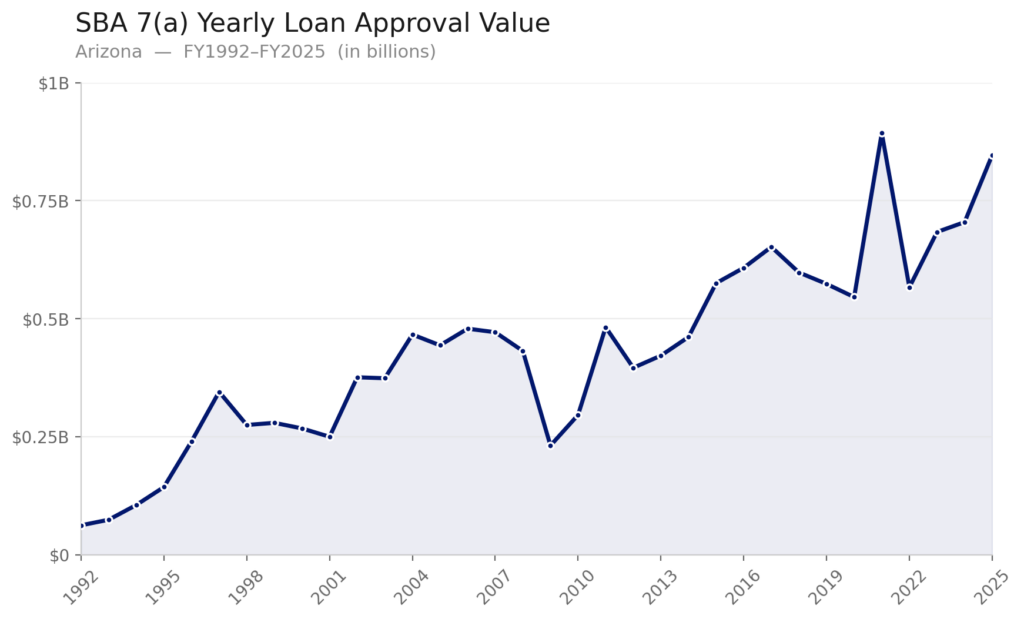
These are the year-by-year* statistics of the SBA 7(a) loan program in Arizona from fiscal year 1992 to today, including the number of 7(a) loans approved and total approval amount.
| Fiscal Year | Loans Approved | Approval Amount |
| 1992 | 228 | $62,417,872 |
| 1993 | 266 | $74,205,669 |
| 1994 | 377 | $105,482,803 |
| 1995 | 719 | $143,499,147 |
| 1996 | 863 | $240,094,065 |
| 1997 | 1,127 | $345,224,169 |
| 1998 | 985 | $274,964,955 |
| 1999 | 918 | $279,510,198 |
| 2000 | 837 | $267,672,350 |
| 2001 | 843 | $249,966,991 |
| 2002 | 1,075 | $376,004,024 |
| 2003 | 1,507 | $373,981,292 |
| 2004 | 1,748 | $466,580,150 |
| 2005 | 1,716 | $443,684,316 |
| 2006 | 2,050 | $478,968,616 |
| 2007 | 2,470 | $471,440,600 |
| 2008 | 1,757 | $431,750,800 |
| 2009 | 764 | $231,306,800 |
| 2010 | 972 | $296,251,700 |
| 2011 | 1,180 | $482,148,100 |
| 2012 | 929 | $396,107,600 |
| 2013 | 911 | $421,867,500 |
| 2014 | 1,017 | $461,395,600 |
| 2015 | 1,278 | $575,398,500 |
| 2016 | 1,291 | $607,933,200 |
| 2017 | 1,267 | $652,135,400 |
| 2018 | 1,159 | $597,989,500 |
| 2019 | 1,067 | $573,788,000 |
| 2020 | 871 | $545,861,100 |
| 2021 | 1,047 | $893,284,800 |
| 2022 | 827 | $566,655,100 |
| 2023 | 1,121 | $683,792,700 |
| 2024 | 1,334 | $704,717,000 |
| 2025 | 1,648 | $846,983,300 |
Source: SBA, 7(a) & 504 FOIA
*U.S. Federal Government fiscal years
SBA 7(a) Loans On the Rise
The SBA 7(a) loan program has seen fantastic growth in Arizona, with the annual total value of approved loans up almost 14x since 1992.
About 7aSavvy
7aSavvy is a loan brokering service for business owners across Arizona, and it is not a lender or the SBA. We do not fund anything, set rates, or approve loans. What we do is study your request, work out which lenders want that kind of deal, and hand you off to the right one. Because the lender pays us when your loan closes, the lender match costs you nothing.
The firm was founded by Brett Smith, who has worked on more than $1 billion of SBA loans over a career spanning over three decades, roughly 20 years of it inside lenders and another 15 on the brokering side. That background and our network of lender connections is why our brokering runs on real, current lender appetite instead of a stale directory. As an SBA 7(a) loan broker, we concentrate on the larger end of the market, generally deals between $500,000 and the $5 million ceiling.
How 7aSavvy Works
Step 1: Tell us the shape of the deal. Through the Get Connected form you share the essentials, what the money is for, roughly how much, the industry, and where in Arizona you operate.
Step 2: We read it like a lender would. We look at the use of proceeds and the details underwriters weigh, so we understand the request before we place it anywhere.
Step 3: We introduce you to the right lender. We connect you with a decision-maker at the vice president level or higher inside a lender that funds your type of deal, not a general application queue.
Step 4: We stick with it to closing. If the first lender stalls or passes, we re-route the file to another one and keep going until the loan closes.
Case Study
Say a family runs a well-regarded restaurant in Flagstaff and the building next door, a second-generation space they have wanted for years, finally lists for sale. The purchase and the buildout together run about $2.2 million, and they can put down roughly 10%. Their everyday bank likes them but does not do much hospitality real estate, so the file drifts for a month before dying. That is precisely the kind of request an SBA loan broker can move on quickly, sending it to a lender that funds restaurant and owner-occupied property deals and knows how to underwrite seasonal mountain-town revenue, instead of leaving the owners to knock on doors one at a time.
Get matched with an SBA 7(a) lender. Spend a few minutes on the Get Connected form and we will read your deal and steer it toward the lender most likely to fund it.