Fiscal Year 2025
4,456
Loans Approved
$2.8B
Total Value
Manufacturers took out more SBA 7(a) financing in fiscal year 2025 than they had in years, and the total dollar amount was up close to 17% over the prior year once you add the 504 program’s numbers. Part of the reason is that a single 7(a) loan can cover a lot of ground at once, which is useful in a business where a new machine, a bigger building, and the working capital to run both often need to be paid for at the same time.
An SBA 7(a) loan is not made by the SBA itself. It is issued by a bank, a credit union, or another approved lender, and the SBA guarantees a portion of it so the lender is willing to take on a borrower it might otherwise turn down. For loans of $150,000 or less the guaranty is 85%, and for loans above that figure it is 75%. The manufacturer still has to qualify with the lender, but the guaranty is what tends to open the door on longer terms and use cases that a conventional loan will not touch.
7aSavvy is a loan brokerage, not a lender. What we do is match manufacturers with SBA 7(a) lenders that are a reasonable fit for the project at hand, so that instead of applying to one bank and waiting, you are put in front of lenders that already work with manufacturing borrowers and understand the equipment and the margins involved. There is no cost to be matched, and being matched does not obligate you to anything.
Why Manufacturers Consider SBA 7(a) Financing
Manufacturing is capital heavy in a way that a lot of other small businesses are not. A single machining center or an injection molding press can cost as much as some companies spend on their entire storefront, and the money often has to go out well before the revenue from that machine comes in. On top of the equipment there is the building, the tooling, the raw material sitting on the floor waiting to be run, and the payroll for the people running it. Conventional lenders tend to look at all of that and get cautious, especially when a manufacturer is younger, is growing quickly, or does not have a warehouse full of real estate to pledge as collateral.
That is the situation where the 7(a) program tends to be worth a look. Because the SBA guarantees part of the loan, lenders can spread the repayment out over a longer period and can lend against a mix of purposes in one loan rather than making a manufacturer piece together an equipment loan here, a line of credit there, and a mortgage somewhere else. For an borrower who is trying to add capacity, bring a process in house, or buy out a retiring founder, having one loan that does several of those things at once is often the practical reason to consider it.
Uses of SBA 7(a) Loans for Manufacturers
The 7(a) program is broad on purpose. Below are the uses that come up most often for manufacturing borrowers, and in many real deals a loan will combine two or three of them.
Manufacturing Equipment and Machinery
This is the use most manufacturers think of first. A 7(a) loan can pay for CNC machining centers, lathes, press brakes, injection molding and blow molding equipment, laser and waterjet cutters, industrial robots and automated cells, conveyors and material handling systems, and the quality and testing instruments that go with them. It can also cover the software side that now runs alongside the hardware, including ERP systems, machine monitoring, and the AI-assisted inspection tools that the SBA has confirmed are eligible expenses. The loan can cover freight, rigging, installation, and the tooling that makes a new machine actually productive, which are the costs a lot of equipment-only financing leaves out.
Facility Buildout and Plant Improvements
Adding a line, upgrading electrical service for heavier equipment, pouring new machine foundations, improving ventilation and dust collection, or reconfiguring a floor for better flow are all eligible uses. These are the improvements that rarely have collateral value of their own, which is exactly why they are hard to finance conventionally, and why folding them into a 7(a) loan tends to make sense.
Business Acquisition
Buying an existing manufacturing business is one of the most common 7(a) uses, and it is often a cleaner path than starting from nothing because the machines, the customers, and the trained workforce are already in place. The loan can fund the purchase of the company along with the equipment and working capital needed to keep it running through the transition. Partial buyouts where one owner purchases the shares of another are also eligible, which matters in manufacturing where a lot of companies are still owned by the family or the partners who started them.
Working Capital and Production Ramp-Ups
When a manufacturer lands a larger contract, the costs come first and the payment comes later, sometimes a good deal later. A 7(a) loan can provide the working capital to cover payroll, raw material, and overhead during that ramp-up period so the company is not starved for cash right when it is growing. The SBA also runs a Working Capital Pilot program aimed specifically at manufacturers taking on new contracts, and a newer program called MARC that is built around revolving credit for this exact problem.
In October 2025 the SBA launched the 7(a) Manufacturers’ Access to Revolving Credit program, usually shortened to MARC, which blends a standard 7(a) term loan with a revolving line of credit so manufacturers can manage the working capital swings that come with taking on new contracts. It is open to businesses in NAICS sectors 31 through 33, it caps at $5 million, and it can be structured as a term loan or as a revolving facility depending on the need. For a manufacturer whose main constraint is cash to buy material and cover payroll while a new order ramps up, it is worth asking a lender about MARC alongside a standard 7(a) loan.
Inventory and Raw Materials
Steel, aluminum, resin, components, and other raw material can tie up a large amount of cash, particularly when prices move or when a manufacturer buys ahead to protect a delivery schedule. 7(a) proceeds can be used to purchase inventory and raw materials, which helps a company keep production moving without draining its operating account.
Real Estate Purchase or Refinance
If a manufacturer owns or wants to own the building they operate in, a 7(a) loan can be used to purchase owner-occupied plant real estate or to refinance an existing mortgage on it. Real estate stretches the repayment term out considerably, allowing for loan repayment over up to 25 years.
Business Debt Refinance
Manufacturers frequently accumulate a stack of higher-cost debt over the years, including equipment loans, and short-term notes taken during a busy period. In many cases a 7(a) loan can refinance eligible business debt into a single loan with a longer term, which lowers the monthly outflow and frees up cash for operations.
Multiple-Purpose Manufacturing Loans
The reason the 7(a) program fits manufacturing so well is that most manufacturing projects are not one thing. A typical deal might combine two machines, a buildout to make room for them, and the working capital to buy material and cover payroll while the new capacity comes online. Rather than arranging three separate loans, a manufacturer can often fund the whole project with one 7(a) loan on one set of terms, which is simpler to manage and usually cheaper to carry.
SBA 7(a) Loans for Manufacturers: Terms and Eligibility
How Much Can Manufacturers Borrow With an SBA 7(a) Loan?
The maximum 7(a) loan is $5 million. How close a given manufacturer can get to that number depends on the strength of the business and what the money is for, since a lender is going to size the loan to what the company can reasonably repay out of its cash flow. There has been movement in Congress to raise the manufacturing cap. A bill called the Made in America Manufacturing Finance Act, which would roughly double the limit to $10 million for manufacturers, passed the House in December and would apply specifically to this sector if it becomes law. As of now the working number is still $5 million, so plan around that figure and treat the higher cap as a possibility rather than a certainty.
To be eligible at all, a manufacturer generally needs to operate in NAICS sectors 31 through 33, be a for-profit business, operate in the United States, and qualify as small under the SBA size standards. For manufacturing those standards are based on employee count and run from roughly 500 up to 1,500 employees depending on the specific product code, which means most small and mid-sized manufacturers are well inside the limit. There is also an alternative size test that looks at tangible net worth, which cannot exceed $20 million, and average net income after tax, which cannot exceed $6.5 million.
SBA 7(a) Loan Repayment Terms for Manufacturers
The repayment term is tied to what the loan is paying for. Loans used for owner-occupied real estate or construction can run up to 25 years. Loans used for equipment, working capital, inventory, and most other business purposes generally run up to 10 years. When a single loan blends several uses, the maximum term reflects the mix, so a loan that is mostly equipment and working capital with a smaller real estate piece will land closer to the 10-year end. Longer terms lower the monthly payment, which for a manufacturer is often the difference between a project that pencils out and one that does not.
SBA 7(a) Loan Qualifications for Manufacturers
Lenders underwrite the whole picture and analyze all documentation, but the factors they weigh most heavily are fairly consistent. A lender reviewing a manufacturing loan will typically look at:
- Business and personal credit history of the owners
- Cash flow and whether it comfortably covers the proposed payment
- Debt service coverage ratio, often measured against a minimum of 1.25
- Time in business and the owners’ experience in manufacturing
- The specific equipment or project being financed and its useful life
- Existing debt and how the new loan changes the overall load
- Collateral available, including equipment, real estate, and other business assets
- The owners’ equity injection or down payment into the project
- Customer concentration and the stability of existing contracts
- The purchase details and financials of the seller in an acquisition
Important note: meeting the SBA eligibility requirements does not guarantee approval. Eligibility is what makes a manufacturer able to be considered for the program. The lender still makes its own credit decision, and two lenders can look at the same file and reach different conclusions, which is one of the reasons being matched with the right lender matters.
SBA 7(a) Loans for Manufacturers: Pros and Cons
A big advantage of the 7(a) program for a manufacturer is flexibility paired with a longer repayment period. One loan can cover equipment, a buildout, inventory, and working capital, and it can be stretched over 10 years, or up to 25 when real estate is involved, which gives long-term security. The SBA guaranty is what makes that possible, because it reduces the lender’s exposure and makes it willing to approve borrowers and structures it would otherwise decline. There is also a real cost break in play at the moment, since the SBA has set the upfront guaranty fee at zero for manufacturer 7(a) loans of $950,000 or less for this fiscal year, which lowers the cost of borrowing.
The tradeoffs are worth being honest about. A 7(a) loan involves more documentation than a quick equipment finance agreement, and the underwriting takes longer, usually 6-12 weeks from application to funding, which is not ideal if a machine has to be bought this week. And the $5 million cap, while generous for most small manufacturers, can be a real constraint on a larger expansion or a bigger acquisition. For most manufacturers the flexibility and the longer term outweigh these points, but they are the things to weigh going in.
SBA 7(a) Loans vs. Other Manufacturing Financing Options
SBA 7(a) vs. Conventional Manufacturing Loans
A conventional bank loan or an equipment finance agreement can be faster and simpler when the request is straightforward, for example a single machine with clear resale value that the bank can lend against with confidence. Where conventional financing tends to fall short for manufacturers is on the softer parts of a project, the buildout, the working capital, the inventory, and the installation costs, which do not carry collateral value on their own. Conventional loans also tend to come with shorter terms, higher down payments, and stricter collateral requirements, which can leave a growing manufacturer short of the amount it actually needs.
The 7(a) program is built to cover those gaps. Because part of the loan is guaranteed, the lender will happily finance the full project rather than only the hard assets, and offer the security of a longer term. The tradeoff is the added paperwork and time. A useful way to think about it is that conventional financing suits a clean, single-purpose purchase, while 7(a) financing suits the mixed, multi-purpose projects that manufacturing tends to produce. When you are matched with a lender through 7aSavvy, the point is to find one that already understands manufacturing deals so the process moves as smoothly as possible.
SBA 7(a) vs. SBA 504 Loans for Manufacturers
Both are SBA programs, but they are built differently and often suit different projects. The 504 program is designed for major fixed assets, mainly owner-occupied real estate and large, long-life equipment. It is delivered through a Certified Development Company alongside a bank, it carries a fixed rate, and it can reach a larger project size than a standard 7(a) loan, which makes it attractive for a big plant purchase or a heavy piece of long-lived machinery. The tradeoff is that 504 money can only go toward those fixed assets. It will not cover business acquisitions, working capital, inventory, or general operating needs.
The 7(a) program is the more flexible of the two. It caps lower on the fixed-asset side, but it can fund the parts of a project that 504 cannot, and it can wrap several purposes into one loan. For a manufacturer whose project is mostly a building or a single large machine, 504 is often the better fit and sometimes the two are used together. For a manufacturer whose project is a mix of equipment, buildout, and cash to run the new capacity, 7(a) is usually the one that fits. Which program makes more sense comes down to what you are buying and how much of the project is fixed assets versus operating needs.
Case Study: Manufacturing Equipment and Capacity Expansion
The following is an illustrative example. It is meant to show how a typical manufacturing 7(a) deal is put together, and it does not describe a specific customer.
A contract metal fabrication shop had more work than it could take on. The owner, who we will call Dana, had two new customers ready to place recurring orders, but the shop was already running its existing machines close to full and could not promise the volume without adding capacity. The plan was to buy two CNC machining centers, reconfigure part of the floor and upgrade the electrical service to run them, and carry enough working capital to buy steel and cover payroll while the new work ramped up.
Dana went to the shop’s existing bank first and was offered an equipment loan for the machines only. That left the buildout, the electrical work, and the working capital unfunded. The pieces the bank would not finance were the pieces that made the expansion actually work.
The deal came together as a single SBA 7(a) loan instead. The project totaled roughly $1.4 million, broken down as about $900,000 for the two machining centers and tooling, around $300,000 for the floor reconfiguration and electrical upgrade, and roughly $200,000 in working capital for raw material and payroll during the ramp-up. Dana injected 10% of the project as equity, and the loan came in at $1,260,000.
- Loan amount: $1,260,000
- Down payment: $140,000 (10%)
- Term: 10 years
- Interest: Prime + 2.25% (9.5% in this example)
- Estimated monthly payment: about $16,300
- Debt service coverage ratio: approximately 1.35
Because the loan covered the whole project rather than just the machines, Dana did not have to drain the operating account or arrange a second loan for the buildout. Once the two new customers were in full production, the added revenue covered the payment with room to spare, which is what the 1.35 coverage ratio reflects. This is a made-up example based on typical 7(a) terms, and real numbers will vary with the borrower, the lender, and the rate environment.
SBA 7(a) Loan Program History
The 7(a) program traces back to the Small Business Act of 1953, which created the Small Business Administration and, in Section 7(a) of that act, the loan guaranty program that still carries the name today. The idea then is the same as it is now, which is that the government guarantees part of a loan made by a private lender so that small businesses that cannot get conventional credit on reasonable terms have a way to borrow. Over the decades the program has grown from a fledgling program into the largest source of government-backed small business lending in the country, and manufacturers have always been part of that borrowing base.
SBA 7(a) Manufacturing Loan Statistics
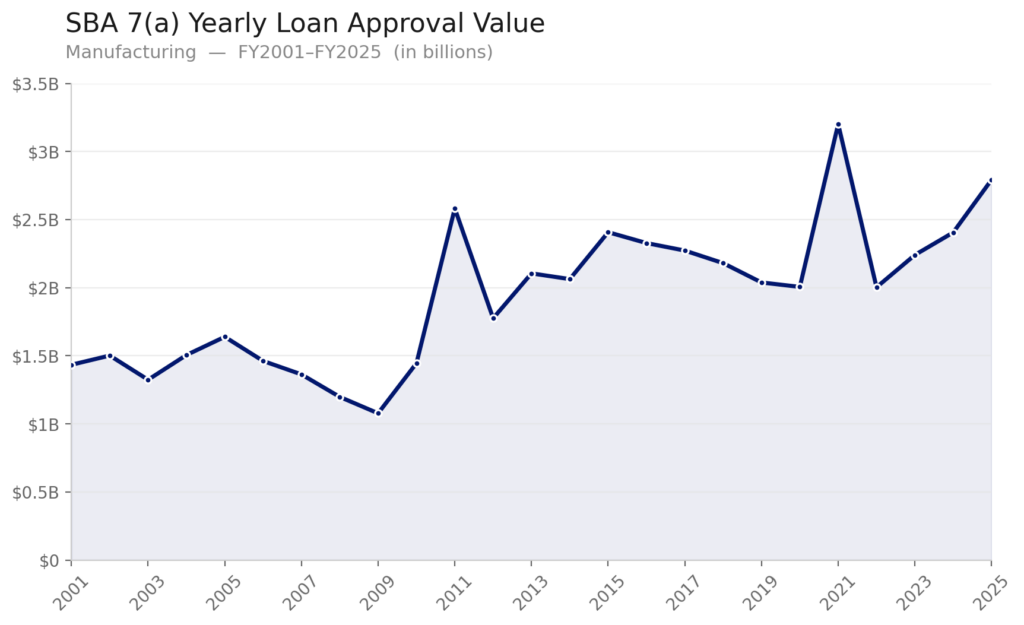
These are the year-by-year* statistics of SBA 7(a) manufacturing loans from fiscal year 2001 to today, including the number of 7(a) loans approved and total approval amount.
| Fiscal Year | Loans Approved | Approval Amount |
| 2001 | 4,784 | $1,434,325,405 |
| 2002 | 4,958 | $1,501,986,125 |
| 2003 | 6,309 | $1,324,231,356 |
| 2004 | 6,992 | $1,505,843,824 |
| 2005 | 7,787 | $1,639,524,445 |
| 2006 | 7,195 | $1,462,134,895 |
| 2007 | 6,993 | $1,363,530,364 |
| 2008 | 5,097 | $1,198,151,279 |
| 2009 | 3,574 | $1,077,876,475 |
| 2010 | 4,118 | $1,445,766,200 |
| 2011 | 5,171 | $2,582,409,700 |
| 2012 | 3,901 | $1,775,780,900 |
| 2013 | 3,964 | $2,105,351,900 |
| 2014 | 4,249 | $2,063,447,000 |
| 2015 | 4,847 | $2,407,872,200 |
| 2016 | 4,794 | $2,328,039,200 |
| 2017 | 4,549 | $2,272,893,600 |
| 2018 | 4,109 | $2,180,550,500 |
| 2019 | 3,531 | $2,038,628,700 |
| 2020 | 2,998 | $2,006,211,300 |
| 2021 | 3,750 | $3,201,680,800 |
| 2022 | 3,090 | $2,003,505,300 |
| 2023 | 3,437 | $2,240,776,300 |
| 2024 | 4,142 | $2,405,816,900 |
| 2025 | 4,456 | $2,792,822,500 |
Source: SBA, 7(a) & 504 FOIA
*U.S. Federal Government fiscal years
SBA 7(a) Manufacturing Loans On the Rise
The SBA 7(a) loan program has seen good recent growth in the manufacturing sector, with the annual total value of approved loans almost tripling since a low point in 2009. However, despite an overall upward trend, there have been several ups and downs over the last 25 years.