Fiscal Year 2025
345
Loans Approved
$434M
Total Value
An SBA 7(a) loan for veterinary practices can help a qualified doctor buy out a retiring owner, build a clinic, or replace equipment that is running past its service life. The SBA 7(a) program is the U.S. Small Business Administration’s primary business loan program, and proceeds can be used for real estate, construction, machinery and equipment, working capital, business acquisition, and eligible debt refinance.
An SBA 7(a) loan for a veterinary practice is issued by an SBA-approved lender, not by the SBA itself. The SBA provides a guaranty to the lender, which reduces the lender’s exposure and can make financing reachable for borrowers who would not fit a conventional credit box. For most 7(a) loans the guaranty is 85% on loans of $150,000 or less and 75% on loans above $150,000.
That guaranty matters more in veterinary medicine than in most industries, because of what a buyer is actually paying for. A companion animal practice is worth what its client list, its doctors, its reputation in the neighborhood, and its recurring wellness revenue are worth. Most of that doesn’t show up on a balance sheet. 7aSavvy helps veterinary borrowers get connected with SBA lenders who already understand how a practice is valued, so the goodwill component of an SBA veterinary practice loan is treated as a normal part of the file rather than as a reason to pass.
Why Veterinary Practices Consider SBA 7(a) Financing
Most veterinarians arrive at ownership carrying two things at once: a large student loan balance and no meaningful business collateral. Average educational debt for the 2025 DVM class was $212,499 among those who took out student loans. A conventional lender looking at that profile, then looking at a purchase price that is mostly goodwill, often wants an equity injection the buyer cannot produce without emptying the reserves the practice will need in its first year. That is the gap SBA financing for veterinary practices is built to close.
The other pressure is competition for the practices themselves. Corporate groups have been buying general practices for years, and the effect on price is not subtle: the going bid on a healthy multi-doctor practice has moved from roughly 60 to 70 percent of revenue to roughly 80 to 90 percent over the past five years. An associate who wants to buy the clinic where she already works is now bidding against a buyer with a checkbook and no financing contingency. SBA loans for veterinarians are frequently what makes an individual doctor’s offer credible in that room, because a 10 percent injection and a signed commitment letter close the gap that cash alone used to decide.
Uses of SBA 7(a) Loans for Veterinary Practices
An SBA 7(a) veterinary practice loan can cover nearly every line item involved in buying, starting, expanding, or modernizing a clinic. Because the program permits real estate, construction, equipment, furniture and fixtures, supplies, working capital, eligible debt refinance, and changes of ownership, one loan can carry a project that would otherwise be split across a practice lender, an equipment leasing company, and a commercial mortgage. These are the uses that come up most often.
Veterinary Practice Acquisition
Buying an existing practice is one of the most common reasons doctors look at SBA veterinary practice financing. The purchase price usually breaks into goodwill, the client and patient records, the equipment package, the pharmacy and retail inventory, and any leasehold improvements the seller paid for. General companion animal practices commonly trade at 70 to 85 percent of trailing twelve month revenue, emergency and critical care higher, and specialty hospitals higher still. Lenders who write these deals regularly know those ranges and will underwrite to the practice’s own history rather than to a projection.
Clinic Buildout and Facility Improvements
Veterinary buildings are expensive per square foot because of what has to go inside them. Surgery suites, dental stations with their own suction and scavenging, isolation wards with separate air handling, radiology rooms with lead shielding, treatment areas with medical gas, kennel runs with floor drains and coved flooring, and a controlled substance safe all have to be constructed to code and to inspection standards other retail tenants never encounter. Ground-up general practice construction commonly runs $250 to $450 per square foot, and tenant improvement buildouts $190 to $280, before equipment. An SBA 7(a) veterinary practice loan may be used to acquire, refinance, or improve real property and buildings, which covers a renovation of an existing clinic just as it covers a new one.
Veterinary Equipment and Technology
Equipment is where a lot of practice deals quietly get more expensive after closing. Buyers taking over an older clinic frequently spend $200,000 to $600,000 in the first three years replacing aging digital radiography, ultrasound, anesthesia and multiparameter monitoring, dental radiography, and in-house laboratory analyzers. SBA 7(a) proceeds may be used to purchase and install machinery and equipment along with furniture, fixtures, and supplies, so a known replacement schedule can be financed inside the acquisition instead of hitting the practice as a series of leases in year two.
Working Capital for Veterinary Practices
A practice changes hands and the payroll does not pause. Doctor and technician salaries, drug and supply accounts, laboratory and referral fees, cremation services, practice management software, insurance, and rent all continue through a transition in which some clients are deciding whether they want to stay. That decision is measurable: a handoff with no seller transition period typically retains 65 to 75 percent of clients, while a twelve month seller transition typically retains 88 to 93 percent. Working capital inside an SBA loan for a veterinary clinic is what covers the practice while the new owner earns the difference.
Business Debt Refinance
Many practice owners are carrying a short-term equipment note from a digital radiography purchase, a line of credit drawn during a slow quarter, or seller paper from an earlier partial buy-in. An SBA 7(a) loan may be used to refinance existing business debt where the refinance meets SBA and lender requirements, which can move a five-year equipment payment onto a longer amortization and return real monthly cash flow to a practice that is otherwise healthy.
Real Estate Purchase or Refinance
Some veterinarians use SBA financing for veterinary practices to buy a new building for the practice to operate in, while others use it to buy or refinance the owner-occupied building the clinic already sits in. Owning the property protects a location that clients have driven to for years, and it removes the risk of a landlord repricing a lease on a building fitted with kennels, drains, and a shielded radiology room that no other tenant particularly wants. Practices frequently buy the business first and the building later, and both can be financed under the same program.
Multiple-Purpose Veterinary Practice Loans
Real practice deals need several things at once. A doctor buying a two-doctor clinic may also want to replace the ultrasound, add a second dental station, repaint and re-floor the lobby, and hold cash after closing for the transition. A 7(a) loan can carry those purposes together, all with the same repayment term.
SBA 7(a) Loans for Veterinary Practices: Terms and Eligibility
How Much Can Veterinary Practices Borrow With an SBA 7(a) Loan?
The standard maximum for most SBA 7(a) loans is $5 million. In fiscal year 2025, 345 SBA 7(a) loans were approved for veterinary clinics with a total value of about $434 million, which puts the average deal near $1.25 million. That is a larger average than most SBA industries, and it reflects what practices actually sell for: small solo clinics commonly land between $600,000 and $1.5 million, mid-sized practices between $1.3 million and $3.4 million, and larger group practices above that.
What any individual borrower can support under an SBA 7(a) loan for veterinary practices comes down to the practice’s cash flow, the equity going in, the collateral, and the doctor’s own record.
SBA 7(a) Loan Repayment Terms for Veterinary Practices
Repayment terms on SBA loans for veterinarians follow the use of proceeds, and this is an area where the rules changed recently. A business acquisition, equipment, or working capital loan still comes with a term of ten years, and a real estate, construction, or renovation loan may still run up to 25 years. However, the earlier practice of stretching an entire real-estate-heavy deal to 25 years is gone, replaced with a blended term. For a veterinary practice acquisition that includes the building, for instance, the term will be blended between 10 and 25 years based on the proportions of each use of the loan.
Rates on 7(a) loans usually float against the prime rate plus a lender spread rather than sitting at a fixed number. Veterinary practice acquisition financing is commonly quoted around prime plus 2 to 3. The payment modeled at application is not necessarily the payment carried in year eight, and a practice budget should be built with that in mind.
SBA 7(a) Loan Qualifications for Veterinary Practices
The 7(a) program is built for eligible small businesses. In general the business must operate for profit, be located in the United States, meet SBA size standards, show a need for the credit, and put the proceeds toward a sound business purpose. Beyond that, a lender reviewing an SBA veterinary practice loan will work through:
- The doctor’s clinical and management experience, including years in practice and any leadership roles
- Personal credit and a complete personal financial statement
- Production reports from the borrower’s associate role, where the buyer is an employed DVM
- Practice revenue history, active client counts, and new client growth
- Business and personal tax returns plus interim financial statements
- Average client transaction, visit volume, and the mix of wellness, surgery, dentistry, diagnostics, and pharmacy revenue
- The purchase agreement, or the construction and equipment budget on a buildout
- Equipment age, condition, and expected replacement cost
- The lease, or real estate details and an appraisal where property is involved
- Doctor and staff retention, including whether associates and licensed technicians are staying
- The seller’s transition commitment and its length
- Working capital needs after closing
- Debt service coverage and overall repayment ability
Two rules applying to business acquisition loans under SOP 50 10 8.1 deserve planning time. The minimum debt service coverage ratio on an initial acquisition is 1.25, measured on the last fiscal year end or an average of the last two, and projections may no longer be used to satisfy it. Business purchases of $3 million or more, excluding real estate, require an independent quality of earnings report.
Important note: Meeting SBA eligibility does not guarantee approval. A veterinarian can satisfy every rule governing SBA 7(a) loans for veterinary practices and still need to clear an individual lender’s underwriting, and lender appetite in this industry is far more concentrated than most borrowers expect.
SBA 7(a) Loans for Veterinary Practices: Pros and Cons
A strong argument for a 7(a) loan in veterinary medicine is that it finances goodwill. A practice purchase is mostly intangible value, and there is no other loan product that treats a client list and a reputation as fundable collateral at this scale. Add the ability to fold equipment, working capital, and in many cases the building into the same request, and SBA veterinary practice financing takes a doctor from associate to owner with one closing instead of three.
The equity requirement is the second argument. Ten percent is the SBA minimum on a change of ownership, against the 20 to 30 percent a conventional practice lender asks for, usually at the top of that range when the purchase is goodwill-heavy. For a veterinarian who has been paying down education debt for a decade, that difference is frequently the whole decision.
There are real trade-offs. SBA loans carry a guaranty fee on most larger loans, and the documentation is heavier than a conventional file: a full credit memo, an independent business valuation, a site visit, and an appraisal and environmental review where real estate is involved. Rates float against prime, so a rising rate environment raises the payment. Personal guaranties are standard for any owner at 20 percent or more, and collateral generally extends to available business and personal assets. Timelines run longer than an equipment lease. A well-capitalized multi-site owner buying a stabilized hospital may still do better conventionally. For a first-time buyer, an SBA 7(a) veterinary practice loan is usually the route that actually closes.
SBA 7(a) Loans vs. Other Financing Options
SBA 7(a) vs. Conventional Veterinary Practice Loans
Both can fund a practice, and both draw on lenders who understand healthcare, but they are not built the same way and they do not ask the same questions.
A conventional practice loan generally wants more equity, commonly 20 to 30 percent and toward the upper end on a goodwill-heavy purchase, and it wants the borrower’s balance sheet and production history to carry the file. Some specialty practice lenders will go lower than that on a strong doctor with a strong practice, occasionally to full project financing on a startup. When a veterinarian qualifies that way, conventional financing can close faster, skip the SBA guaranty fee, and avoid some documentation.
The 7(a) program is what opens the door when the file is not that clean. It is more forgiving of a buyer whose net worth is negative on paper because of education debt, and more forgiving of a practice whose value is concentrated in goodwill. Under the program, the SBA guarantees 85 percent of loans of $150,000 or less and 75 percent above $150,000, with a standard maximum of $5 million. That guaranty is what allows a lender to advance against intangible value it could not otherwise take as collateral.
The comparison usually comes down to who the borrower is. An experienced owner-doctor adding a second location with cash in the bank should price both. An associate buying her first practice, a doctor building from the ground up, or a buyer competing against a corporate group will generally find that veterinary practice financing under 7(a) is the option that produces an actual commitment letter.
SBA 7(a) vs. SBA 504 Loans for Veterinary Practices
Both are SBA-backed, and both are commonly used for veterinary deals, but they are built for different jobs.
The 504 program funds major fixed assets: land, buildings, ground-up construction, and long-life machinery, structured as a bank loan alongside a Certified Development Company debenture, usually with 10 percent down. It cannot be used for working capital, inventory, or goodwill. That single restriction is why 504 rarely fits a practice purchase, since goodwill is usually the largest line on the page.
The 7(a) program covers the same real estate and equipment plus business purchases, working capital, and eligible debt refinance, all in one facility. The 504 program can support a larger total project, because the CDC debenture sits alongside a bank first mortgage that the program does not cap, while the 7(a) maximum is $5 million in total.
In practice the split is fairly clean. A doctor who already owns her practice and is building a new hospital on owned land often pencils better under 504, because the project is almost entirely construction and fixed equipment. A doctor buying an existing practice, with or without the building, is almost always looking at SBA 7(a) veterinary practice loans, because that is where the client list and the working capital can get funded. Plenty of owners use both programs across a career.
Case Study: Veterinary Practice Acquisition
Dr. Reyes had worked as an associate at a two-doctor companion animal practice for six years when the founding owner told her he wanted to retire within eighteen months. The practice did $2.1 million in revenue, held roughly 4,200 active client families, and operated out of a 4,800 square foot building the owner had bought in 2004. He owned both the practice and the property, and he preferred selling to her over listing with a broker, provided the price was defensible and the closing was straightforward.
The veterinary practice acquisition financing came together like this:
- Practice purchase, including goodwill, client records, equipment, and inventory: $1,640,000
- The building and land: $780,000
- Equipment replacement, covering dental radiography, a refurbished ultrasound, and anesthesia monitoring: $135,000
- Working capital for the transition: $95,000
- Total project: $2,650,000
The practice price came to about 78 percent of trailing twelve month revenue, inside the normal range for a general practice and supported by the independent valuation the lender ordered. Dr. Reyes injected $265,000, or 10 percent, and financed $2,385,000.
Her first two conversations were with banks that already held her personal accounts. One declined on the goodwill concentration. The other offered a conventional structure at 25 percent down, which she could not fund without giving up the working capital the transition needed. Through 7aSavvy she was matched with a lender that writes SBA veterinary practice loans as a regular part of its book and had funded associate buyouts before.
Because of the split between real estate and non-real-estate uses, the term was proportionally blended between 10 and 25 years, leading to a loan term of 14 years.
The loan was priced at prime plus 2.25, variable. At the rate in effect when the file closed the combined payment ran about $25,000 a month. The practice produced roughly $420,000 in cash flow available for debt service after normalizing the seller’s compensation to a market salary, giving a debt service coverage ratio of about 1.40. That is above the 1.25 minimum the current rules require and a ratio lenders are happy to fund.
The seller agreed to stay on two days a week for twelve months and to appear at client appointments through the first quarter. That transition commitment was written into the purchase agreement and mattered to the lender, because client retention is the primary risk in a practice acquisition and a documented handoff is the main thing that helps with it. The veterinary practice financing funded in 84 days.
This is an illustrative example based on typical SBA 7(a) loan terms and a realistic veterinary practice acquisition. Actual terms, timelines, and outcomes vary by borrower, practice, and lender.
SBA 7(a) Loan Program History
The 7(a) program has been part of small business lending for decades. It traces back to the Small Business Act of 1953, which created the U.S. Small Business Administration and established federal support for small business credit. SBA loans for veterinarians have been written under it for most of that history, first as small single-doctor clinics with a surgery table and a radiograph machine, and more recently as multi-doctor hospitals with in-house laboratories, digital imaging, and seven-figure valuations.
SBA 7(a) Veterinary Practice Loan Statistics
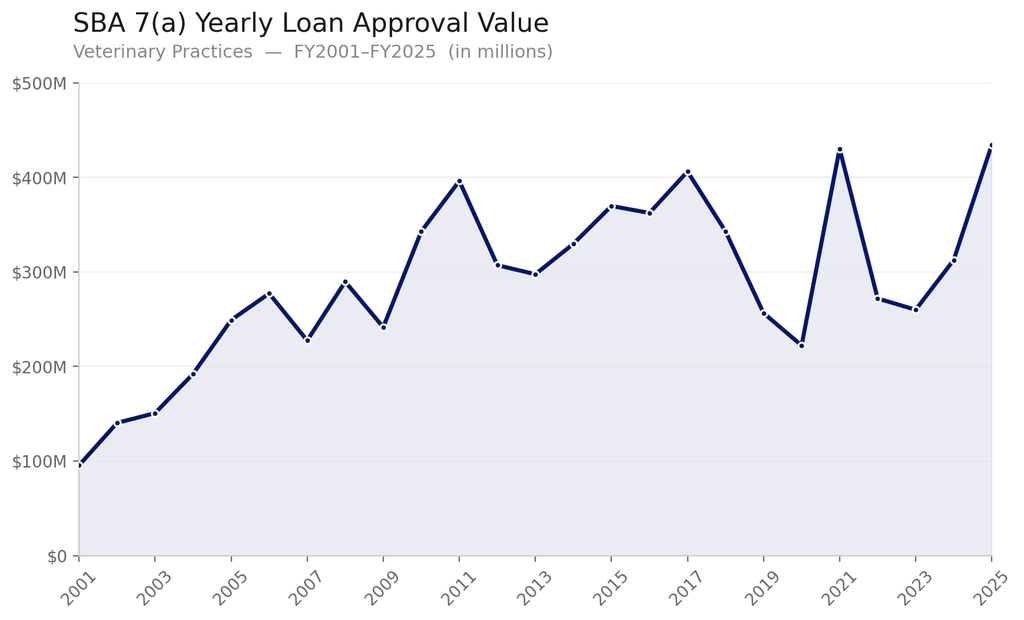
These are the year-by-year* statistics of SBA 7(a) Veterinary Practice loans from Fiscal Year 2001 to today, including the number of 7(a) loans approved and total approval amount.
| Fiscal Year | Loans Approved | Approval Amount |
| 2001 | 266 | $95,454,364 |
| 2002 | 363 | $140,338,889 |
| 2003 | 443 | $150,727,431 |
| 2004 | 467 | $192,228,112 |
| 2005 | 520 | $249,075,780 |
| 2006 | 484 | $277,227,813 |
| 2007 | 400 | $227,454,435 |
| 2008 | 418 | $289,638,288 |
| 2009 | 368 | $241,539,000 |
| 2010 | 522 | $342,876,500 |
| 2011 | 618 | $396,214,400 |
| 2012 | 469 | $307,128,700 |
| 2013 | 438 | $297,553,300 |
| 2014 | 450 | $329,728,700 |
| 2015 | 496 | $369,728,800 |
| 2016 | 488 | $362,342,400 |
| 2017 | 470 | $406,160,000 |
| 2018 | 372 | $342,884,700 |
| 2019 | 276 | $256,493,800 |
| 2020 | 238 | $222,270,600 |
| 2021 | 348 | $430,250,400 |
| 2022 | 236 | $271,963,800 |
| 2023 | 179 | $259,980,000 |
| 2024 | 246 | $312,633,600 |
| 2025 | 345 | $434,195,800 |
Source: SBA, 7(a) & 504 FOIA
*U.S. Federal Government fiscal years
Where Veterinary SBA Lending Is Concentrated
In fiscal year 2025, SBA-approved lenders funded 345 SBA 7(a) loans to veterinary clinics for a total of about $434 million, at an average interest rate near 8.90 percent. Eighty-three separate lenders participated. That sounds like a wide field until the volume is broken down: a single institution, Live Oak Banking Company, wrote 101 of those 345 loans and $244 million of the $434 million. One lender accounted for roughly 29 percent of the loans and 56 percent of the dollars in the entire category.
That concentration is the most useful thing a veterinary borrower can know before applying. Eighty-three lenders wrote at least one practice loan last year, but most of them wrote a handful, and a bank that has funded two veterinary deals in a year does not have a credit committee that is fluent in goodwill valuation, doctor production reports, or client retention risk. The same application can be routine at one institution and unfamiliar at another.
The average approved SBA veterinary practice loan of about $1.25 million also says something about the deals getting done. This is not a category of small equipment notes. These are practice purchases and buildouts, which is why lender fit and file preparation carry so much weight here.
Choosing the right lender is the work 7aSavvy does. We look at the practice, the structure, and the doctor first, then place SBA veterinary practice financing with a lender whose appetite already matches the deal, instead of letting a borrower receive a decline six weeks into an application.
SBA 7(a) Veterinary Practice Loans On the Rise
The SBA 7(a) loan program has seen good overall growth in the veterinary industry, with the annual total value of approved loans up over 4x since 2001. However, this has come with some ups and downs along the way.