Fiscal Year 2025
243
Loans Approved
$272M
Total Value
An SBA 7(a) loan can help qualified borrowers meet their car wash funding needs. The SBA 7(a) program is the U.S. Small Business Administration’s primary business loan program, and proceeds can be used for real estate, construction, machinery and equipment, working capital, business acquisition, debt refinancing, and construction. That range matters in this industry, because a car wash deal is almost never just a building or just a tunnel revamp. It is usually land, a structure built for one purpose, a conveyor and arch package, vacuums, a reclaim system, payment kiosks, signage, and enough cash to carry the site until the membership base rebuilds. Conventional lenders often want to split those pieces across separate facilities on separate terms. The 7(a) program lets a single loan carry them together, with the government guarantee giving the lender more room to approve a borderline deal, especially for a property that has few alternative uses.
Why Car Washes Consider SBA 7(a) Financing
Car washes are special-purpose real estate. A tunnel building, a reclaim pit, and thirty vacuum stations are worth a great deal to another wash operator and very little to anyone else, and conventional credit committees price that in. Some of the largest and most conservative national banks decline car wash paper as a category, no matter how strong the borrower is. That is one reason so many car wash operators end up looking at SBA financing: the guarantee changes the risk math for the lender, and a good loan can still get done on a site a commercial bank would not touch.
Uses of SBA 7(a) Car Wash Loans
An SBA 7(a) loan can cover most of the real cost of buying, building, converting, or expanding a wash. Because the program permits real estate, construction, equipment, furniture and fixtures, supplies, working capital, debt refinance, and ownership changes, one facility can fund a project that would otherwise need three loans. Below are the uses that come up most often in car wash financing.
Car Wash Acquisition
Buying an existing wash is the most common reason borrowers look at SBA loans. An acquisition can also include the real estate, the equipment package, the customer list and membership base, the brand, and the goodwill built up over years at a corner that already has traffic. Lenders will underwrite the site’s own history rather than a projection, which is usually good news for a buyer taking over a wash with a stable subscription program and bad news for one buying a tired site on the promise of a turnaround. Membership count and revenue per member carry real weight in that review.
Site Buildout and Tunnel Improvements
Car wash sites need work that other real estate does not. Conveyor pits, trench drains, water reclaim tanks, chemical storage rooms, equipment rooms, dryer bays, vacuum canopies, stacking lanes, license plate readers, and gate arms all have to be built or rebuilt around a specific wash package. A 7(a) loan can fund acquiring, refinancing, or improving buildings and real property, so a conversion from an older in-bay automatic to an express tunnel, or a re-tunnel of an aging site, can be financed alongside the property itself.
Wash Equipment and Technology
Equipment is often 30 to 50 percent of a car wash project. SBA 7(a) proceeds may be used to purchase and install machinery and equipment along with furniture, fixtures, and supplies, which covers conveyors, wraps and mitters, dryers, reclaim systems, chemical delivery, point of sale, RFID readers, and vacuum arches.
Working Capital for Car Washes
Washes are seasonal and weather-dependent, and a new owner usually inherits a payroll, a chemical account, and a utility bill before the first full month of memberships lands. Working capital inside an SBA car wash loan can carry labor, chemicals, utilities, insurance, marketing to relaunch a membership program, and the reserve a site needs through a slow winter or a rainy quarter. Lenders look more favorably on a request that names those uses than on a round number with no plan behind it.
Business Debt Refinance
Plenty of operators are carrying an equipment note from a re-tunnel, a short-term loan taken during a buildout, or a construction or acquisition loan with a high rate or upcoming balloon payment. An SBA 7(a) loan may be used to refinance existing business debt when the refinance meets SBA and lender requirements, which can move a five-year equipment payment onto a longer amortization and free up monthly cash flow.
Real Estate Purchase or Refinance
Many borrowers use SBA car wash financing to buy or refinance property. This is common when purchasing a wash, as the business and real estate tend to be sold together. It’s also common for a business that is renting to purchase the land the car wash sits on. Owning the site protects the one thing a wash cannot replace, which is the location. It also removes the risk of a landlord repricing a lease on a building that was purpose-built for the tenant’s own equipment.
Multiple-Purpose Car Wash Loans
Most real car wash deals need more than one thing at once. A buyer picking up a tunnel wash may also want new dryers, a fresh chemical package, updated payment kiosks, and working capital left over after closing. A 7(a) loan can carry several purposes in a single facility, with the repayment term blended across the uses.
SBA 7(a) Car Wash Loans: Terms and Eligibility
How Much Can Car Wash Entrepreneurs Borrow With an SBA 7(a) Loan?
The standard maximum for most SBA 7(a) loans is $5 million. That ceiling is not a promise, and it is not what most washes borrow. In fiscal year 2025, 243 SBA 7(a) car wash loans were approved for about $272.4 million, which works out to an average in the low seven figures and a median well below that. The amount any borrower can support comes down to the site’s cash flow, the collateral, the equity going in, and the borrower’s experience.
SBA 7(a) Car Wash Loan Repayment Terms
Repayment terms under the 7(a) program follow the use of proceeds. Real estate can amortize up to 25 years. Equipment terms generally track useful life, commonly seven to ten years. Business acquisitions and working capital sit at ten years. When a car wash loan mixes those uses, the lender blends the term across them. Rates on 7(a) loans float against the prime rate plus a spread rather than sitting at a fixed number, so the payment you model at application is not necessarily the payment you carry for 25 years.
SBA 7(a) Car Wash Loan Qualifications
The 7(a) program is built for eligible small businesses. In general, the business must operate for profit, be located in the United States, meet SBA size standards, show a need for the credit, and put the proceeds toward a sound business purpose. Beyond that, a lender reviewing a car wash loan will look at:
- The borrower’s ownership and operating experience, in car washes or in comparable retail
- Personal credit and the full personal financial statement
- Site revenue history, including membership counts and churn
- Business and personal tax returns and interim financial statements
- Cars per day, revenue per car, and seasonality at the site
- The purchase agreement or the construction and conversion budget breakdown
- Equipment condition, age, and replacement cost
- Real estate details, including a Phase I environmental site assessment where property is involved
- Working capital needs after closing
- Debt service coverage and overall repayment ability
One change worth planning around: under SOP 50 10 8.1, effective October 1, 2026, SBA made the minimum debt service coverage ratio on change of ownership transactions a hard 1.25 (no more projection deals), and purchases of $3 million or more require a quality of earnings report.
Meeting SBA eligibility does not guarantee approval. A car wash borrower can satisfy every program rule and still need to clear a specific lender’s underwriting, and lender appetite for this industry varies more than in almost any other industry we broker deals in.
SBA 7(a) Car Wash Loans: Pros and Cons
A strong argument for a 7(a) loan in this industry is that it finances the whole project. A car wash purchase that includes land, a building, a wash package, and post-closing cash can sit inside one loan with one closing and one payment, instead of a mortgage plus an equipment lease plus a line of credit that are all on different schedules. The equity requirement is usually lower than conventional financing asks for and the loans are fully amortized rather than ballooning in five years, which matters on an asset that takes time to stabilize its membership base.
The guarantee also opens doors. Because the SBA covers a large share of the lender’s exposure, a wash that a conventional credit committee would decline can still get financed.
There are real trade-offs. SBA loans carry a guarantee fee on larger loans, and the documentation is heavier than a conventional deal: a full credit memo, an independent business valuation on acquisitions, a site visit, and an environmental review on the real estate. Rates usually float against prime, so a rising rate environment raises the payment. Personal guarantees are standard for owners at 20 percent or more, and collateral generally extends to available business and personal assets. Loan timelines run longer than an equipment lease. For an operator with substantial cash and a long track record, a conventional loan can still be the cheaper, quicker route. For most people buying or building a wash, or for those with less money for a down payment or weaker financials, the flexibility and terms are worth the paperwork.
SBA 7(a) Loans vs. Other Car Wash Financing Options
SBA 7(a) vs. Conventional Car Wash Loans
Both can finance a wash, but they are not built the same way and they do not draw from the same pool of lenders. This is the difference that surprises first-time buyers most: several of the largest conservative national banks will not write car wash paper at all. It is not a credit decision about the borrower. It is a category the bank has decided to sit out, and the answer is the same whether the applicant has an 800 credit score or a 600. Regional banks and SBA lenders are where these deals actually get placed, and the roster of lenders comfortable with tunnel washes is much shorter than the roster comfortable with, say, a medical office.
Under the 7(a) program, SBA guarantees 85 percent of loans of $150,000 or less and 75 percent of loans above $150,000, with a standard maximum loan amount of $5 million. That guarantee is what lets a lender accept collateral with limited alternative use.
A conventional car wash loan usually asks for more equity, often 25 to 35 percent, and frequently balloons in five to ten years. It skips the SBA guarantee fee and can close faster, and it avoids some of the SBA documentation. For an experienced multi-site operator buying a stabilized wash with a large cash position, that is a fair trade. For a first-time buyer, a conversion project, or a site with a short operating history, the conventional route often ends in a decline or a worse rate. Knowing which lenders in the market actively want car wash deals, rather than finding out one application at a time, is most of the work.
SBA 7(a) vs. SBA 504 Loans for Car Washes
Both are SBA-backed, and both show up in car wash deals, but they are designed for different jobs. The 504 program funds major fixed assets: land, buildings, construction, and long-life machinery, structured as a bank loan plus a Certified Development Company debenture. For car washes, which are considered special-purpose properties, the minimum down payment is 15 percent. It cannot be used for goodwill, working capital, or inventory, so it does not fit a car wash loan where a meaningful share of the purchase price is the customer base and the brand.
The 7(a) program is much more flexible. It covers the same real estate and equipment plus business acquisition, working capital, and debt refinance, all in one loan. The 504 program allows a larger total loan ($11.25 million) because the CDC portion can reach $5 million for most projects and higher for some energy and manufacturing categories, while the 7(a) maximum is $5 million.
In practice, ground-up construction on owned land often pencils better under 504, because the project is almost entirely bricks and equipment and the fixed-rate debenture is attractive on a 25-year asset. Buying an existing site is different, and that is where car wash loans under the 7(a) program usually win. Where goodwill and a membership base are part of what you are paying for and you need cash after closing, the deal is usually a better fit for 7(a). Plenty of operators end up using both programs across a portfolio.
Case Study: Express Tunnel Car Wash Acquisition
Marcus had spent six years managing sites for a three-location wash chain before deciding to buy his own. He came to the car wash loan conversation with a specific site in mind: a single express tunnel on a commercial corridor with a signalized entrance, roughly 130 feet of tunnel, 24 vacuum stalls, an established unlimited plan with about 1,100 active members, and an owner ready to retire.
The project looked like this:
- Purchase of the business and the real estate: $2,850,000
- Equipment upgrades, including dryers and payment kiosks: $180,000
- Working capital after closing: $70,000
- Total project: $3,100,000
Marcus put in $310,000, or 10 percent, and financed $2,790,000. Due to the proportions of the loan between real estate and non-real estate-uses, the loan was written on a 24-year fully amortized term. The rate was prime plus 1.75, which came to 8.5 percent at closing. That produced a payment of roughly $22,740 a month. The site’s past financials supported a debt service coverage ratio of 1.41, comfortably above what the lender needed. The car wash financing took 74 days from application to funding.
This is an illustrative example based on typical SBA 7(a) loan terms and a realistic car wash acquisition. Actual terms, timelines, and outcomes vary by borrower, site, and lender.
SBA 7(a) Loan Program History
The 7(a) program has been part of small business lending for decades. It traces back to the Small Business Act of 1953, which created the U.S. Small Business Administration and set up federal support for small business credit. Car wash loans have been written under it for most of that history, first for small self-serve and in-bay sites, and more recently for the multimillion dollar express tunnels that dominate new construction.
SBA 7(a) Car Wash Loan Statistics
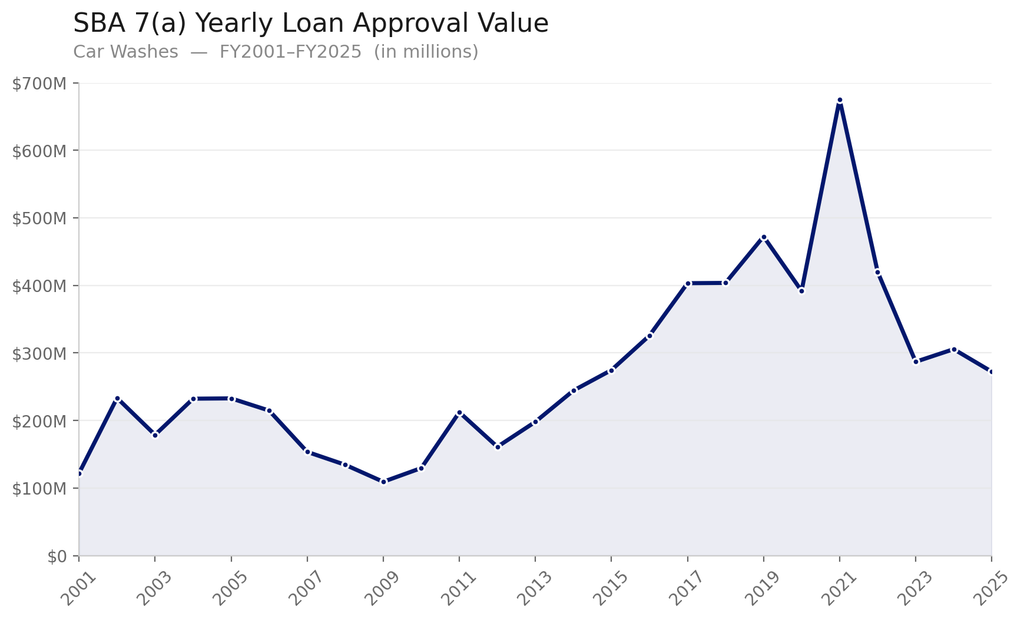
These are the year-by-year* statistics of SBA 7(a) car wash loans from Fiscal Year 2001 to today, including the number of 7(a) loans approved and total approval amount.
| Fiscal Year | Loans Approved | Approval Amount |
| 2001 | 252 | $121,979,510 |
| 2002 | 389 | $233,425,037 |
| 2003 | 368 | $178,790,032 |
| 2004 | 478 | $232,358,185 |
| 2005 | 434 | $232,818,108 |
| 2006 | 404 | $214,742,901 |
| 2007 | 367 | $153,623,200 |
| 2008 | 295 | $134,457,600 |
| 2009 | 190 | $109,331,098 |
| 2010 | 192 | $129,669,900 |
| 2011 | 217 | $212,324,800 |
| 2012 | 189 | $161,106,000 |
| 2013 | 203 | $198,113,600 |
| 2014 | 242 | $244,369,200 |
| 2015 | 281 | $274,694,000 |
| 2016 | 301 | $325,769,300 |
| 2017 | 306 | $403,329,900 |
| 2018 | 289 | $403,744,000 |
| 2019 | 286 | $472,434,500 |
| 2020 | 235 | $391,916,400 |
| 2021 | 391 | $675,586,600 |
| 2022 | 274 | $420,090,000 |
| 2023 | 236 | $287,010,300 |
| 2024 | 261 | $305,654,700 |
| 2025 | 243 | $272,359,800 |
Source: SBA, 7(a) & 504 FOIA
*U.S. Federal Government fiscal years
SBA 7(a) Car Wash Loan Dollars Rising, Then Falling
The SBA 7(a) loan program had seen solid growth in the car wash industry, with the annual total value of approved loans up almost 4x from 2001 to 2019. After Covid, though, the industry has seen a downturn in SBA funding (other than an outlier year in 2021).