
Fiscal Year 2025
2,218
Loans Approved
$1.1B
Total Value
Washington entrepreneurs are surrounded by opportunities, but they sometimes struggle to find the lender that will fund them. Buying out the retiring owner of a Yakima packing operation, a Bellevue dental group adding a third office, a Tacoma logistics company refinancing its yard, a Spokane brewery taking over the building it has leased for nine years, all of these are financeable. They just are not financeable everywhere. Send that packing-house file to a lender with no appetite for agriculture and the answer comes back no, and the no says nothing about the business. 7aSavvy exists to stop that from happening. We broker SBA 7(a) loans in Washington by reading the deal first, then pointing it at a lender that is ready to fund that kind of request.
An SBA 7(a) loan is not government money. It comes from a bank, a credit union, or a non-bank lender, and the U.S. Small Business Administration guarantees a portion of the balance so the lender carries less risk. That guarantee is why a lender will look twice at a file it would otherwise pass on. The guarantee generally runs to 85% on loans of $150,000 or less and to 75% above that, subject to SBA rules and the loan type, and the program caps an individual 7(a) loan at $5 million. As of July 4, 2026, a borrower can also stack up to $5 million of 7(a) and $5 million of 504 for a combined $10 million, which is new and which matters on larger Washington projects that used to hit a wall.
Note: 7aSavvy is an SBA 7(a) loan broker and matching service, not a lender. The lender pays us when your loan funds, so our help costs you nothing. Instead of approaching banks one at a time and hoping, you start with one route to the lenders most likely to say yes.
Uses of SBA 7(a) Loan Proceeds in Washington
One reason the program is worth the paperwork is that one loan can solve several problems at once. A Washington owner does not need a separate facility for the building, another for equipment, and a line of credit stapled on top. A single SBA 7(a) loan in Washington can cover a blend of eligible needs, which suits companies that are buying, growing, and re-tooling in the same year.
Proceeds are commonly used for:
- Acquiring an existing company
- Buying owner-occupied commercial property
- Purchasing machinery, vehicles, and other equipment
- Construction, renovation, and tenant buildouts
- Refinancing business debt
- Working capital, payroll, and inventory
- Opening a second location or funding other expansion
There is one hard line in the program and it is better to know it now. The financing goes to companies that actively run and occupy their space. Property bought primarily to rent out and hold does not qualify, so a building your own company will not occupy sits outside the rules.
Washington SBA 7(a) loans get matched differently depending on which of those uses is driving the request. A business purchase in Everett is a different underwriting exercise than a warehouse purchase in Kent, an equipment package for a Wenatchee orchard, or working capital for a Vancouver contractor heading into a busy season. We route each one on its own merits rather than sending everything to the same bank.
Buy
More Washington requests reach us for a purchase than for anything else, and they arrive in one of two forms. The first is purchasing a company that already has staff, customers, and a few years of returns a lender can actually read. The second is buying real estate for the business to operate in, so the owner stops writing a rent check to a landlord. Both are strong fits for the guarantee.
Acquisitions come through more often than real estate purchases do, partly because they are smaller and simpler, and partly because a buyer almost never has the cash to close one outright. An SBA 7(a) loan broker in Washington often earns its keep on exactly these deals, because acquisition lenders care enormously about the industry, the structure of any seller note, and whether the buyer has run something similar before.
Build
The construction bucket is wider than most owners assume. A Spokane Valley dentist adding two operatories, a Bellingham brewery building out a taproom, an Auburn fabricator expanding a shop floor, a franchisee remodeling to hit brand standards, all of it can sit inside SBA 7(a) financing in Washington.
Eligible project types include:
- Leasehold improvements
- Interior buildouts
- Facility renovations
- Building additions
- Ground-up construction for business use
- Improvements to owner-occupied commercial property
Construction requests carry more detail than a working capital ask. The lender will want a project budget, contractor information, a timeline, permits, collateral, financials, and a repayment story that holds up. Washington adds its own wrinkles here, since permitting pace and build costs differ sharply between King County, the Tri-Cities, and the coast. The lender you use should be comfortable running construction draws and should not be learning your market on your file.
Expand
Growth eats cash before it produces any, and that gap is where sound businesses stall out. Washington SBA 7(a) loans can bridge it.
Expansion requests we see include:
- Opening an additional location
- Increasing production or service capacity
- Hiring ahead of demand
- Buying inventory before a peak season
- Adding equipment or technology
- Funding seasonal working capital
- Steadying cash flow through a growth stretch
- Moving into a new market
Seasonality is a bigger factor in Washington than in most states, and it is worth mentioning. Agriculture, tourism, construction, and maritime all run on cycles, so a lender looking at months of down revenue may be looking at a perfectly healthy company in its slow quarter. Lenders that fund Washington deals regularly know this. Lenders that do not will read the same numbers and hesitate. Matching the request to the first group is most of the job.
SBA 7(a) Loan Industries in Washington
Washington runs on small companies. The state counts roughly 672,472 small businesses, about 99.5% of all employers, and they employ around 1.4 million people, close to half the state’s workforce. Underneath that number is a spread of industries wider than most states carry, which is why the requests crossing a Washington SBA 7(a) loan broker’s desk in a given month rarely look alike.
The requests we see most often in Washington fall into these categories:
- Restaurants, bars, coffee, and food service
- Hotels, lodges, and tourism-driven hospitality
- Convenience stores and fuel stations
- Medical, dental, and veterinary practices
- Auto repair, car washes, and service shops
- Franchise operations
- Trucking, warehousing, and freight
- Manufacturing, fabrication, and aerospace supply
- Food processing, packing, and cold storage
- Self-storage and other specialty property users
- Professional, trade, and construction firms
The shape of the state’s economy explains the mix. Health care and social assistance is the largest small-business employer in Washington at 196,327 people, followed by construction at 180,352 and accommodation and food services at 156,863. Aerospace, maritime, forest products, agriculture and food manufacturing, and information technology are all named by the state as key sectors, and tourism alone runs around $22.1 billion a year. Each of those anchors feeds a long tail of suppliers, contractors, and service companies, and those are often the businesses that eventually need acquisition, real estate, or equipment money.
Industry appetite is the part borrowers underestimate. Some of the largest national banks quietly avoid whole categories. One will not touch a car wash. Another wants every dollar of your deposits before it will consider the loan. Nobody publishes that list, which is a great argument for working with an SBA 7(a) loan broker in Washington rather than guessing your way through it.
SBA 7(a) Loan Qualifications in Washington
There are two separate tests here, and mixing them up can cause confusion.
The first test is the SBA’s. Your business has to be for-profit, operating in the United States or its territories, small enough under the size standard for its industry, owned entirely by U.S. citizens or nationals, and putting the money toward an approved purpose. Clear that and you are eligible to apply.
The following structures all qualify:
- Sole proprietorships
- Corporations
- Partnerships
- Limited liability companies
- Other eligible for-profit entities
The second test belongs to the lender, and that is the one that decides the loan. Once a Washington business is eligible, the lender goes into the substance: revenue and margins, business and personal credit, the equity you are putting in, collateral, your experience running this type of operation, and whether the numbers support repayment. The document stack shifts with the deal too, since an acquisition, a building purchase, and a refinance each require different paperwork. Getting SBA 7(a) loans approved in Washington is mostly a matter of landing that file in front of a lender whose credit standards you can actually meet.
What Washington’s B&O Tax and Wage Floor Do to Your Loan File
Here is something that shows up on Washington deals and almost nowhere else. Washington has no state income tax on businesses. It has a business and occupation tax, charged on gross receipts, with no deduction for labor, materials, or the other costs of doing business, spread across more than fifty classifications. That means a Washington company’s tax picture reads differently than an out-of-state underwriter expects, and the B&O line sits in a spot on the P&L that occasionally gets miscoded when a lender’s analyst is working quickly.
Labor is the other one. Washington’s state minimum wage moved to $17.13 an hour in 2026, up from $16.66, and it has been the highest state minimum in the country. Inside Seattle the figure is $21.30. For a restaurant, a hotel, a car wash, or a retail operation, that pushes payroll to a share of revenue that looks alarming to a lender used to underwriting the same business in a low-wage state. It is not alarming. It is Washington. A lender that funds here regularly reads those margins correctly and prices the deal accordingly.
Neither of these facts disqualifies anyone. They are simply two places where the right lender and the wrong lender reach different conclusions from identical numbers, which is a big reason lender fit matters more than lender size on SBA 7(a) loans in Washington.
SBA 7(a) Loans in Washington: Pros and Cons
For most owners the appeal is simple. SBA 7(a) financing makes deals possible that a conventional bank would wave off. Because the government absorbs part of the risk, a lender can stretch on requests with lighter collateral, a shorter history, or weaker cash flow. That flexibility is real. So are the tradeoffs, and both deserve a straight look.
What a qualified borrower generally gets:
- Longer repayment schedules than most conventional business loans offer
- The freedom to combine acquisition, real estate, equipment, construction, refinance, and working capital inside one loan
- Full amortization, with no balloon payment waiting at the end
- Competitive pricing for well-qualified borrowers and eligible uses
- Down payment requirements that usually run lighter than conventional financing
The advantage is structure as much as access. A longer amortization means security in the long-term, and folding several needs into one facility beats juggling three obligations with three different maturities. Rates on SBA 7(a) loans in Washington are typically quoted off prime plus a spread rather than as a fixed number, so the figure you are quoted today moves with the prime rate.
The limits on Washington SBA 7(a) loans are worth equal honesty. As of March 1, 2026, the business must be 100% owned by U.S. citizens or U.S. nationals, which is tighter than the rule the program carried for decades and closed a door that lawful permanent residents used to have. The $5 million per-loan ceiling can also feel snug on Puget Sound real estate, where a single owner-occupied building in Seattle or Bellevue can consume most of it, though the combined 7(a) and 504 limit that took effect in July 2026 gives larger projects more room than they had. And SBA files ask for more documentation than a quick conventional loan, which is one more argument for having someone experienced steering the request.
SBA 7(a) Loans vs. Other Types of Loans
SBA 7(a) Loans vs Conventional Loans
The clearest way to see the difference is to ask who carries the risk. On a conventional business loan the lender is exposed to the whole amount, so it wants seasoned cash flow, solid collateral, and a tidy story. Fall short anywhere and the answer is usually no.
An SBA 7(a) loan changes that arithmetic. The loan still comes from an approved lender, but the SBA guarantee absorbs part of the exposure, which frees the lender to approve files a conventional desk would decline, generally with a lower down payment and a longer, fully amortized term. The cost is a heavier document load and a slightly longer timeline.
For Washington borrowers the choice usually comes down to profile. A company with strong collateral, clean numbers, and one simple need may do fine conventionally and close faster. A buyer with less cash for a down payment, thinner collateral, or a mixed use of proceeds is often better served by an SBA 7(a) loan, and that call is one worth making before you apply anywhere.
SBA 7(a) Loans vs SBA 504 Loans
Both carry an SBA guarantee. They are built for different jobs.
Treat the 7(a) as the general-purpose option. It covers acquisitions, owner-occupied real estate, equipment, construction, working capital, eligible refinancing, and expansion, and it handles requests that mix several of those together.
The 504 does one thing. It finances long-term fixed assets, chiefly owner-occupied buildings and heavy equipment. It is structured as two loans, a bank piece plus a second loan through a non-profit Certified Development Company, and it reaches up to $11.25 million. Rates on a 504 are typically lower and fixed, where 7(a) pricing usually floats off prime.
Some terms look alike, including a common 10% down payment and a maximum 25-year term on real estate. The practical difference is scope and speed. Because a 504 is two loans stitched together, it moves slower and bends less. For a Washington business buying a single building and nothing else, the 504 deserves a look. For a buyer who also needs working capital, acquisition money, or a refinance folded in, SBA 7(a) financing in Washington usually wins on flexibility, and if you cannot tell which one fits, a short conversation sorts it faster than another comparison chart. Through our sister brands, 504Savvy and CRESavvy, we can also point a request toward 504 or conventional commercial real estate financing when that would be the better structure.
SBA 7(a) Loan Program History
The SBA 7(a) loan program has been financing small businesses for more than seventy years. It began with the Small Business Act of 1953, the law that created the U.S. Small Business Administration and set up a federal framework for widening access to capital.
The name comes from Section 7(a) of that Act, the provision authorizing the SBA to guarantee eligible business loans made by approved lenders. It has been the agency’s flagship lending program ever since.
For Washington owners that history is more than trivia. A Kirkland software services firm, a Walla Walla winery, a Federal Way medical practice, an Aberdeen equipment dealer, and a Pasco food processor can all have a strong plan and still need a lender willing to read the whole picture rather than a few key figures. Lenders have been doing exactly that under this program for seven decades, which is why an SBA 7(a) loan remains the most-used path to acquisition and expansion capital for Washington companies that a conventional credit box does not fit.
Washington SBA 7(a) Loan Program Statistics
Washington lending is growing, and the recent numbers show it. The SBA’s Seattle District, which covers all of Washington except the four southwest counties plus ten counties in northern Idaho, guaranteed 2,334 loans worth $1.2 billion in fiscal year 2025. That was a 14.6% increase in the number of loans and a 12.4% increase in dollars over the prior year, and the second straight year the district cleared a billion dollars.
The growth is not concentrated in one place either. King County accounted for 771 loans worth $403.5 million, up from 657 loans the year before. Snohomish County recorded 217 loans worth $159.9 million. Rural businesses across the district took 289 loans worth more than $135 million, a 20% jump. Small manufacturers picked up 125 loans worth nearly $68 million. More lenders funding more Washington deals is good news for borrowers, but it also widens the gap between the lender that fits your request and the lender that doesn’t. That gap is exactly what a Washington SBA 7(a) loan broker is for.
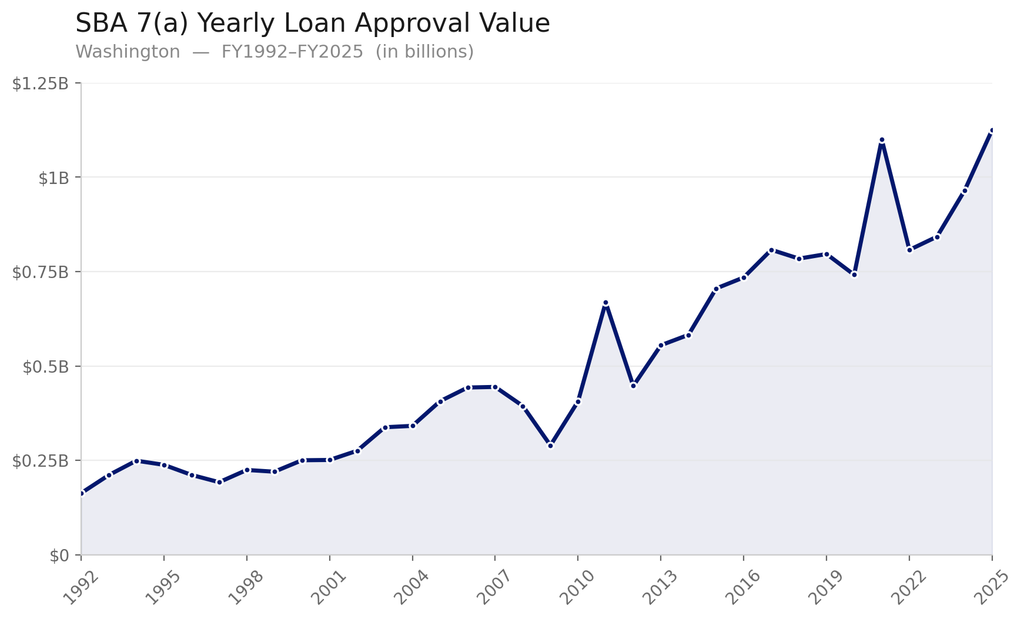
These are the year-by-year* statistics of the SBA 7(a) loan program in Washington from Fiscal Year 1992 to today, including the number of 7(a) loans approved and total approval amount.
| Fiscal Year | Loans Approved | Approval Amount |
| 1992 | 738 | $163,107,954 |
| 1993 | 894 | $210,842,025 |
| 1994 | 1,070 | $249,128,924 |
| 1995 | 1,592 | $238,125,575 |
| 1996 | 1,174 | $211,440,681 |
| 1997 | 960 | $192,162,331 |
| 1998 | 897 | $224,564,696 |
| 1999 | 904 | $219,949,523 |
| 2000 | 917 | $250,269,251 |
| 2001 | 920 | $251,015,812 |
| 2002 | 1,108 | $275,488,924 |
| 2003 | 1,721 | $337,646,304 |
| 2004 | 1,965 | $341,368,049 |
| 2005 | 2,152 | $406,557,416 |
| 2006 | 2,452 | $442,848,910 |
| 2007 | 2,463 | $444,476,487 |
| 2008 | 1,939 | $393,989,775 |
| 2009 | 1,191 | $289,591,070 |
| 2010 | 1,334 | $406,382,000 |
| 2011 | 1,410 | $668,334,800 |
| 2012 | 1,148 | $447,129,300 |
| 2013 | 1,269 | $554,837,800 |
| 2014 | 1,390 | $582,417,400 |
| 2015 | 1,624 | $705,144,800 |
| 2016 | 1,698 | $734,390,800 |
| 2017 | 1,553 | $807,626,200 |
| 2018 | 1,574 | $784,211,700 |
| 2019 | 1,511 | $796,434,400 |
| 2020 | 1,229 | $741,407,600 |
| 2021 | 1,460 | $1,099,792,200 |
| 2022 | 1,252 | $807,398,800 |
| 2023 | 1,415 | $842,393,200 |
| 2024 | 1,869 | $964,657,100 |
| 2025 | 2,218 | $1,125,781,900 |
Source: SBA, 7(a) & 504 FOIA
*U.S. Federal Government fiscal years
SBA 7(a) Loans On the Rise
The SBA 7(a) loan program has seen great growth in Washington, with the annual total value of approved loans up almost 7x since 1992.
About 7aSavvy
7aSavvy is an SBA 7(a) loan broker and lender-matching service for Washington business owners. We are not a lender and we are not the SBA. We do not fund loans, set rates, or approve anything.
What we do is narrower and, for most borrowers, more useful. We read your request the way a lender would, work out which lenders really want that kind of deal, and make the introduction. Because the lender compensates us when the loan closes, the matching costs you nothing and it does not come out of your loan amount or your rate.
Our team carries decades of SBA lending experience, led by founder and CEO Brett Smith, who has worked on over $1 billion of SBA loans and spent 15+ years on both the lending and the brokering side of the table. Our matching runs on current lender appetite rather than a stale directory. We concentrate on the larger end of the market, generally requests between $350,000 and the $5 million ceiling, which is the lane most fintech lenders skip entirely.
A Washington Company Brokering Washington Deals
Most brokers writing about Washington have never worked a deal here. We live here, and our team members have worked on hundreds of loans here. 7aSavvy’s official address is in Spokane, and our principals work out of the Seattle area, which puts us on both sides of the Cascades and inside the markets we are placing loans in.
That matters in ordinary, practical ways. We know that a Spokane deal and a Bellevue deal do not price the same, that eastern Washington lenders think about agricultural collateral differently than a Puget Sound commercial bank does, and that the West Coast corridor of Washington, Oregon, and California is where our deepest lender relationships sit. When a Washington borrower calls about an SBA 7(a) loan in Washington, we are not looking things up – we know the SBA loan landscape here like the back of our hand.
How 7aSavvy Works
Step 1: Give us the outline. The Get Connected form takes a few minutes and asks for the basics: what the money is for, roughly how much, the industry, and where in Washington you operate.
Step 2: We underwrite it in our heads before anyone else sees it. We look at the use of proceeds and the details a credit officer will stop on, so the request is understood before it is placed.
Step 3: We make the introduction. You get a named decision-maker at vice president level or higher inside a lender that funds your type of deal, rather than a general application queue.
Step 4: We stay with it. If the first lender stalls or passes, we re-route the file to another one, and we keep going until the loan closes.
Case Study
Here is an anonymized example of the kind of deal that we work on.
A family had run a well-regarded restaurant in a Washington coastal town for eighteen years, leasing the building the whole time. When the landlord decided to sell, the purchase and a modest kitchen refresh came to about $2.4 million, and they had roughly 10% to put down. Their longtime bank liked them personally but did almost no hospitality real estate, and the file drifted for five weeks before quietly dying.
That is precisely the request a Washington SBA 7(a) loan broker can get moving quickly. It goes to a lender that funds restaurant and owner-occupied property deals, that understands seasonal coastal revenue, and that has closed this exact structure before, rather than leaving the owners to knock on doors one bank at a time.