Fiscal Year 2025
429
Loans Approved
$353M
Total Value
SBA 7(a) grocery store loans can help qualified operators fund a variety of capital needs. The SBA 7(a) program is the U.S. Small Business Administration’s primary business loan program, and proceeds may be used for eligible purposes such as buying a store, purchasing owner-occupied real estate, replacing refrigeration and equipment, refinancing eligible business debt, changing ownership, and covering working capital.
The loan comes from an SBA-approved lender, not from the SBA itself. What the SBA provides is a guaranty to that lender, which reduces the lender’s exposure and can make financing reachable for borrowers who would not clear a conventional credit box. For most 7(a) loans, the guaranty runs to 85% on loans of $150,000 or less and to 75% above that.
7aSavvy is an SBA 7(a) loan broker, and our job on a grocery deal is to get the borrower in front of lenders that actually understand food retail. Grocery is not a vertical every bank is experienced with. Margins are thin, inventory turns fast, and a large share of the purchase price often sits in goodwill and fixtures rather than hard collateral. Our lender matching for SBA 7(a) grocery store loans is built to skip the bank by bank guessing and start the conversation with lenders who have funded stores like yours.
Why Grocery Store Borrowers Consider SBA 7(a) Financing
Food retail runs on volume, not margin. The Food Industry Association reported a net profit margin of 1.6% for the industry in its Food Retailing Industry Speaks 2024 report, the lowest reading since 2019. A store can move eight million dollars of product a year and still have very little slack in the checking account when the compressor on the dairy case fails.
That math is part of why SBA 7(a) financing is a commonly considered option for grocery store borrowers. The program is built for one loan to cover several eligible purposes at once, so a buyer does not have to stack an acquisition loan, an equipment lease, and a line of credit on top of each other and then hope the payments fit.
A conventional bank loan is still worth comparing, especially for an established operator with multiple profitable years and a simple request. But grocery deals are often not simple. They involve inventory, refrigeration, leasehold improvements, a seller transition, and a cash cushion for the first few months. When the request has that many moving parts, an SBA 7(a) loan tends to be the more workable structure.
Uses of SBA 7(a) Grocery Store Loans
SBA 7(a) loans can be used across most of the major costs involved in buying, running, expanding, or modernizing a food retail business. Because the program permits real estate, equipment, working capital, debt refinance, furniture, fixtures, supplies, and ownership changes, it fits a business where those needs tend to arrive together.
Grocery Store Acquisition
Buying an existing store is one of the most common reasons borrowers look at SBA 7(a) financing. The purchase price is rarely the whole story. A grocery acquisition can include shelving and fixtures, walk-in coolers and freezers, the point of sale system, delivery vehicles, liquor or lottery licenses where applicable, goodwill built over decades in a neighborhood, and the opening inventory that has to be on the shelves the day the doors reopen under new ownership.
Grocery ownership changes are frequently partial. A long time partner retires, a son or daughter buys in over several years, or two families that have run a store together decide to separate. SBA 7(a) financing may be used for partial changes of ownership as well as complete.
Store Buildout, Remodel, and Expansion
Remodels are one of the most common reasons grocery operators reach for SBA 7(a) financing. Food retail spaces get tired. Aisles get reset, the deli and prepared foods area gets expanded, the front end gets self-checkout lanes, and the floor plan gets rearranged to push shoppers past higher margin perimeter departments. An SBA 7(a) loan may be used for improving real estate and buildings when the project fits program requirements, which typically covers most or all of what a store remodel actually involves.
Refrigeration, Equipment, and Technology
Refrigeration is usually the single largest equipment line in a grocery store, and it is also the one that ages worst. Plenty of operators come to us about an SBA 7(a) loan for that reason alone. SBA 7(a) proceeds may be used for purchasing and installing machinery and equipment along with furniture, fixtures, and supplies. For an operator, that can mean replacing open cases with doored units, upgrading rack systems, adding a backup generator, or moving off a point of sale platform that no longer talks to the inventory system.
Working Capital for Grocery Stores
Working capital is one of the quieter ways grocery store owners use SBA 7(a) loans, but one of the most important. Grocery working capital is not a “nice to have”. Payroll runs weekly, vendors expect terms that are shorter than the terms most industries enjoy, shrink and spoilage never fully go away, and a slow month in the perimeter departments shows up in the bank balance fast. SBA 7(a) loans may be used for both short term and long term working capital, which matters most during an ownership change, a remodel, or a store’s first year under a new name.
Inventory Purchase
Inventory is a grocery specific problem, and it is where an SBA 7(a) grocery store loan often earns its place. A buyer stepping into a store often has to buy the stock on the shelves and in the coolers at closing, and that number can run into the hundreds of thousands of dollars before the register rings once. Because SBA 7(a) loan proceeds may be used for supplies and working capital, the inventory purchase can often be folded into the same request as the acquisition rather than financed separately.
Business Debt Refinance
Plenty of independent grocers are carrying equipment paper, a working capital loan taken during a rough stretch, or an older expansion note with a term that no longer suits the store. An SBA 7(a) loan may be used to refinance current business debt when the refinance meets SBA and lender requirements.
Real Estate Purchase or Refinance
Location is much of the business in food retail. Owning the building removes the risk of a landlord repricing the lease on a store that has spent twenty years building its customer base. An SBA 7(a) loan may be used for acquiring, constructing, refinancing, or improving owner-occupied business real estate.
Multiple-Purpose Grocery Store Loans
Most real grocery projects refuse to sit in one category. A buyer purchasing a store also needs the inventory, wants the refrigeration replaced before the first summer, and needs cash on hand while the customer base gets used to a new owner. The SBA 7(a) program allows multiple-purpose loans, which is a large part of why 7(a) loans keep coming up in these conversations.
SBA 7(a) Grocery Store Loans: Terms and Eligibility
How Much Can Grocery Store Entrepreneurs Borrow With an SBA 7(a) Loan?
The standard maximum loan amount for most SBA 7(a) loans is $5 million. That ceiling is not a promise. What a specific store can borrow depends on the borrower, the store’s financials, the use of funds, repayment ability, lender underwriting, and SBA eligibility.
For food retail, that ceiling leaves real room. Independent supermarket acquisitions, owner-occupied real estate, full refrigeration replacements, and combined requests can all land inside it. As of July 4, 2026, the SBA also doubled the cumulative limit across the 7(a) and 504 programs to $10 million, allowing up to $5 million under each program, which gives operators in capital intensive industries such as food production and retail more room to combine long term asset financing with a business acquisition, inventory, and working capital.
How Lenders Read Grocery Store Cash Flow
Underwriters look at a grocery store differently than they look at most retail, and that shapes how SBA 7(a) financing gets approved. They want to see department level performance, not just a top line. Perimeter departments such as produce, meat, deli, and bakery usually carry the gross margin, while center store volume carries the traffic, so a store that is heavy on packaged goods and light on fresh often reads as thinner than its sales suggest.
They also want to see how much of the purchase price is inventory and fixtures versus goodwill, what shrink looks like, whether vendor terms are current, and whether the seller’s add-backs hold up. The debt service coverage ratio is the number that decides it. Most lenders are looking for at least 1.25, and grocery files that clear comfortably usually do so because the store’s fresh departments and its labor model are both in order.
We do not push borrowers toward the biggest name on a lender list. The best SBA 7(a) lender for you may or may not be a household name, and on grocery deals it usually is not. Fit beats brand recognition every time.
The 90% Grocery Guarantee and What It Means for Food Retail Borrowers
This is the one piece of SBA policy that is specific to your industry rather than to small business generally, and it is recent enough that many borrowers have not heard of it.
In March 2026 the SBA announced the Grocery Guarantee, delivered through the 7(a) International Trade Loan program, and eligibility took effect on May 1, 2026. It raises the federal guaranty to 90% for businesses across roughly twenty NAICS groups in the domestic food supply chain, from farming and fishing through wholesale food distribution, refrigerated warehousing, and specialized freight, and it includes retail grocers under NAICS 445110, supermarkets and other grocery retailers.
The practical effect on SBA 7(a) grocery store loans is felt on the lender side of the table. A 90% guaranty instead of the standard 75% means the lender is carrying a much smaller unguaranteed piece, which tends to loosen up appetite for exactly the deals grocery borrowers bring: inventory heavy, goodwill heavy, and light on hard collateral. On June 3, 2026, the SBA reported that more than $30 million across 19 loans had been approved under the program in its first month.
Eligibility, permitted uses, and lender participation under this program are still settling, and not every SBA lender is originating under it yet. That is precisely the sort of thing worth asking about before you apply. When we match a grocery borrower, part of the work is knowing which lenders are actively doing food retail loans right now and under which program.
SBA 7(a) Grocery Store Loan Qualifications
The 7(a) program is meant for eligible small businesses. Broadly, a business needs to operate for profit, be located in the United States, meet SBA size standards, show a need for the credit, and use the proceeds for a sound business purpose.
For an SBA 7(a) grocery store loan, that is only the entry ticket. Lenders will also look at:
- Retail or grocery operating experience, including management roles
- Personal credit and financial profile
- Store revenue, gross margin, and department mix
- Tax returns and financial statements, usually three years
- Inventory turns and shrink history
- Purchase agreement, valuation basis, and goodwill share
- Refrigeration and equipment condition and replacement cost
- Real estate details, if property is part of the deal
- Vendor terms and any outstanding trade debt
- Working capital needed after closing
- Debt service coverage and overall repayment ability
On an acquisition, a 7(a) grocery store loan file will usually also cover seller financials, the transition plan, staff retention, and whether the buyer can realistically run the store once the seller is gone. On a remodel or expansion, expect contractor bids, a project timeline, and projections that show the store can carry the payment before the new space is fully productive.
Important note: Meeting SBA eligibility does not guarantee approval. A grocery store owner can satisfy every program rule and still need to clear the lender’s own underwriting.
SBA 7(a) Grocery Store Loans: Pros and Cons
One big argument for SBA 7(a) loans for grocery stores is structural. One approved loan can carry an acquisition, the inventory on the shelves, a refrigeration replacement, leasehold work, and a working capital cushion, instead of four separate obligations with four different maturities.
That flexibility matters more in food retail than in most industries, because grocery costs arrive in clusters. A store purchase almost always drags equipment and inventory along with it. An expansion drags construction, cases, racking, and payroll for staff hired before the new departments are producing.
Attainability at advantageous terms is the second argument for SBA 7(a) loans for grocery stores. The SBA guaranty behind the loan, 85% on loans of $150,000 or less and 75% above that, is what makes many of these deals possible in the first place. It allows lenders to take chances on deals that don’t pencil out conventionally, and allows borrowers with less collateral and less money for a down payment to get a loan with a long, fully amortized term and a competitive interest rate.
The tradeoff is time and paperwork. SBA 7(a) grocery store loans are not quick approvals. Expect documentation, preliminary lender review, underwriting, and closing, generally 45 to 90 days from start to finish. The $5 million standard maximum is real, and some larger real estate deals may not fit under it. And a strong operator with clean financials and a simple request may find a conventional loan priced better, which is worth checking before committing to the SBA route.
SBA 7(a) Loans vs. Other Grocery Store Financing Options
SBA 7(a) vs. Conventional Grocery Store Loans
Both can fund a store. They are underwritten from different starting points.
A conventional grocery store loan suits a borrower with strong credit, several years of stable operating history, real collateral coverage, and a request that fits a bank’s standard box. Some operators prefer it because it avoids SBA program requirements and can close faster.
An SBA 7(a) loan tends to win when the deal is multi-purpose or when cash or collateral is short. That describes most store acquisitions. Conventional lenders often discount inventory heavily, treat used refrigeration as scrap value, and get uncomfortable when goodwill is a large share of the price. The SBA guaranty is what closes that gap. For most 7(a) loans, the SBA guarantees 85% of loans of $150,000 or less and 75% of loans above $150,000, and the standard maximum loan amount is $5 million.
Down payment is often what decides it. Conventional grocery financing frequently asks for a 20% to 30% equity injection. SBA 7(a) financing commonly works at a 10% injection, and that difference is often the entire reason a first time store buyer can do the deal at all.
7aSavvy connects grocery borrowers with lenders experienced in food retail acquisitions through our SBA 7(a) loan brokering, so the first conversation is with someone who has funded a store before.
SBA 7(a) vs. SBA 504 Loans for Grocery Stores
Both are SBA backed, but they are built for different jobs.
The 7(a) program is the flexible one, and it is the program behind most SBA 7(a) grocery store loans. Proceeds may go toward business acquisition, real estate, working capital, equipment, furniture, fixtures, supplies, eligible business debt refinance, ownership changes, and combinations of those.
SBA 504 loans are aimed at major fixed assets: buying land or a building, constructing or improving a facility, and purchasing long term machinery or equipment. Notably for grocery, 504 proceeds cannot be used for working capital or inventory, which rules them out for a large part of a typical store deal.
Structure differs too. SBA 504 loans are delivered partly through Certified Development Companies, while SBA 7(a) loans come entirely from conventional lenders such as banks and credit unions. The standard 7(a) maximum is $5 million against $11.25 million for 504.
For a grocery operator, the decision is usually simple. Buying the building your store already occupies, with nothing else in the request, points toward 504. Buying the store itself, with inventory, refrigeration, and a working capital cushion attached, points toward 7(a).
Case Study: Grocery Store Acquisition
Maria had spent twelve years in food retail, the last five running a regional chain store as general manager. She wanted to buy an independent full service grocery store in a suburban market where the owner was retiring after twenty eight years. The store did about $8.6 million in annual sales with roughly $331,000 in adjusted cash flow, had a strong meat and produce reputation, and operated in leased space with nine years left on the lease. That profile is typical of the borrowers who come to us about SBA 7(a) grocery store loans.
The total project cost was $1,850,000:
- Business purchase price including goodwill, fixtures, and existing refrigeration: $1,250,000
- Opening inventory at closing: $260,000
- Refrigeration replacement and LED retrofit: $185,000
- Working capital for the first 90 days: $155,000
Maria had $185,000 available, a 10% injection, and needed financing for the remaining $1,665,000.
She approached two conventional lenders first, before looking at an SBA 7(a) loan. One asked for 25% down. The other discounted the inventory and the used refrigeration so heavily as collateral that the loan they were willing to write left a gap she could not fill, and they were uneasy about goodwill representing a large share of the purchase price.
Through 7aSavvy, Maria was matched with an SBA 7(a) lender that had funded independent grocery acquisitions before and was actively doing grocery store loans that year. That lender already knew how to read department level margins, how to value refrigeration that still has useful life, and why a store’s inventory position at closing is not optional.
Loan Details:
- Total project cost: $1,850,000
- Down payment: $185,000 (10%)
- Loan amount: $1,665,000
- Interest rate: Prime + 2.25 (9.0% at the time of closing)
- Term: 10 years, fully amortized
- Estimated monthly payment: approximately $21,100
The structure is ordinary for SBA 7(a) grocery store financing. With roughly $331,000 in annual cash flow against about $253,000 in annual debt service, the deal penciled at a debt service coverage ratio near 1.31, above the 1.25 most lenders target. Maria’s operating background, the store’s steady sales history, and a seller who agreed to stay on for sixty days all helped the file move.
The loan closed in 78 days. Because the acquisition, the inventory, the refrigeration work, and the working capital all sat inside one loan, Maria was not servicing an equipment lease and a short term inventory facility alongside her acquisition note. The 10% injection also left her with reserves for a first year that included a rebranding and two new hires in the deli.
This is an illustrative example based on typical SBA 7(a) loan terms and a realistic grocery store acquisition scenario. Actual loan terms, timelines, and outcomes vary based on the borrower, the store, and the lender.
SBA 7(a) Loan Program History
The 7(a) program traces back to the Small Business Act of 1953, which created the U.S. Small Business Administration and set up federal support for small business lending. The name comes from Section 7(a) of that law. Seventy years later it is still the SBA’s primary business loan program, and the channel through which most SBA grocery loans are made.
2025 SBA 7(a) Grocery Store Loan Statistics
These are fiscal year 2025 figures for SBA 7(a) lending to supermarkets and other grocery retailers.
| Measure | Fiscal Year 2025 |
| Loans approved | 429 |
| Total approval amount | $353,400,000 |
| Average loan size | $824,000 |
| Average interest rate | 10.14% |
| Lenders funding at least one grocery store loan | 131 |
| Existing businesses, two years or more | 226 loans |
| Business acquisitions | 74 loans |
| Newer businesses, under two years | 69 loans |
| Startups | 59 loans |
| Leading state by volume | California, 70 loans, $60,300,000 |
Source: SBA, 7(a) & 504 FOIA
*U.S. Federal Government fiscal years
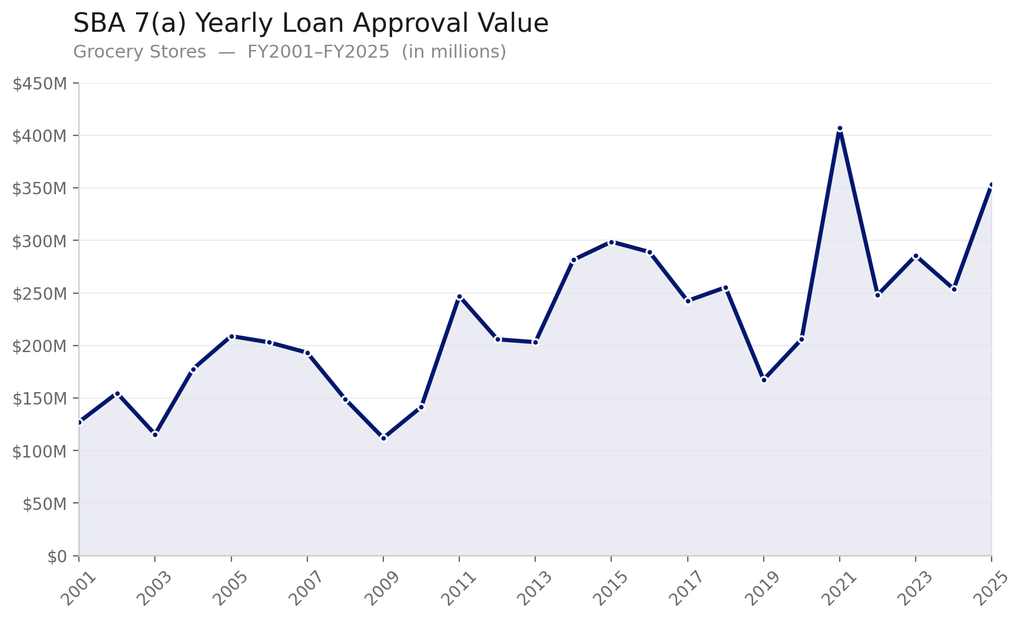
Yearly SBA 7(a) Grocery Store Loan Statistics
These are the year-by-year* statistics of SBA 7(a) grocery store loans from Fiscal Year 2001 to today, including the number of 7(a) loans approved and total approval amount.
| Fiscal Year | Loans Approved | Approval Amount |
| 2001 | 439 | $127,193,694 |
| 2002 | 516 | $154,728,004 |
| 2003 | 543 | $115,504,369 |
| 2004 | 817 | $177,718,101 |
| 2005 | 1,015 | $208,956,540 |
| 2006 | 988 | $202,985,718 |
| 2007 | 939 | $193,180,300 |
| 2008 | 569 | $148,921,028 |
| 2009 | 333 | $111,931,507 |
| 2010 | 340 | $141,526,300 |
| 2011 | 430 | $246,986,400 |
| 2012 | 374 | $205,893,100 |
| 2013 | 364 | $203,156,000 |
| 2014 | 415 | $281,514,400 |
| 2015 | 457 | $298,769,300 |
| 2016 | 432 | $288,994,700 |
| 2017 | 412 | $242,460,500 |
| 2018 | 373 | $255,372,900 |
| 2019 | 299 | $167,429,200 |
| 2020 | 288 | $206,000,600 |
| 2021 | 397 | $407,362,100 |
| 2022 | 323 | $248,093,000 |
| 2023 | 428 | $285,474,300 |
| 2024 | 393 | $253,796,800 |
| 2025 | 429 | $353,412,600 |
Source: SBA, 7(a) & 504 FOIA
*U.S. Federal Government fiscal years
SBA 7(a) Grocery Store Loans On the Rise
The SBA 7(a) loan program has seen decent growth in the grocery industry, with the annual total value of approved loans up almost 3x since 2001.