Fiscal Year 2025
6,158
Loans Approved
$3B
Total Value
SBA 7(a) loans for restaurants give a borrower one loan that can be spread across several needs at once, which is a large part of why food-service operators keep coming back to it. The same approval can help you buy a location, pay for the buildout, cover the kitchen equipment, and leave some working capital in the account for the slow first months, rather than forcing you to line up three or four separate loans. For an industry that runs on thin margins and a lot of upfront cash, that flexibility tends to matter more than almost anything else about the program.
Why Restaurants Consider SBA 7(a) Financing
Restaurants sit in an awkward spot with most conventional lenders. The margins are thin, a good share of the value is in equipment and leasehold work that a bank will not treat as strong collateral, and failure rates in the sector are high enough that a lot of banks simply pass.
The SBA 7(a) program was built to fill that kind of gap. Because the government guarantees a large portion of the balance, a lender can say yes to a restaurant deal that would not clear on conventional terms, and the owner gets a longer repayment schedule and a smaller down payment than a standard commercial loan would ask for. It tends to make the most sense when you need money for more than one purpose and you would rather carry a single loan with a longer runway than juggle several shorter ones.
Uses of SBA 7(a) Loans for Restaurants
An SBA 7(a) loan is a general-purpose business loan, so the list of things it can pay for in a restaurant is fairly wide. Most borrowers use it for one or more of the following.
Restaurant or Bar Acquisition
If you are buying an existing restaurant, whether it is a single independent spot or a franchise, a 7(a) loan can fund the purchase, including goodwill and the value of an established customer base. Buying a business that is already operating and already has revenue is one of the more common reasons owners come to this program, since the existing cash flow gives a lender something concrete to underwrite against.
Buildout, Renovation, and Fit-Out
New concepts and relocations usually need a lot of construction before a single plate goes out, and leasehold work is one of the things 7(a) money is well suited for. That covers the dining-room build, the bar, restrooms, flooring, the front-of-house design, and the back-of-house layout, as well as bringing an older space up to current code. Because this is often the single largest line item in opening a restaurant, folding it into the same loan as everything else keeps the financing simpler.
Kitchen Equipment and Technology
Ranges, ovens, walk-in coolers and freezers, hood and ventilation systems, dishwashers, prep stations, and the point-of-sale and back-office systems that tie it all together can all be financed with a 7(a) loan. Equipment tends to be paid back over a term that lines up with how long the equipment is expected to last, which keeps the monthly payment lower than a short equipment lease would.
Working Capital for Restaurants
A new or newly acquired restaurant almost always burns cash before it turns a profit, and 7(a) proceeds can be used for working capital to carry payroll, food and beverage inventory, marketing for the opening, and the everyday operating costs during the ramp-up period. Having that cushion built into the loan is often what keeps an otherwise healthy opening from running short in its first quarter.
Business Debt Refinance
If a restaurant is carrying high-cost debt, for example a short-term online loan or equipment financing at a steep rate, a 7(a) loan can often be used to refinance it into one balance with a longer term and a lower payment. The refinance has to leave the borrower better off, and there are eligibility conditions, but for an operator who took on expensive money to get open, this can free up a meaningful amount of monthly cash flow.
Real Estate Purchase or Refinance
If the plan is to own the building rather than lease it, a 7(a) loan can finance the purchase of a new property, the purchase of the property the restaurant operates in, or the refinance of a mortgage that is already on it. Real estate gets the longest repayment term the program offers, up to 25 years, which keeps the payment manageable on what is usually the biggest single number in the deal.
Multiple-Purpose Restaurant Loans
The real strength of the program is that most of the uses above can be combined into one loan. An owner buying a restaurant, for example, can wrap the purchase price, a partial remodel, some new equipment, and a working-capital reserve into a single 7(a) loan with one payment and one term, instead of stitching together separate financing for each piece.
SBA 7(a) Loans for Restaurants: Terms and Eligibility
How Much Can Restaurant Owners Borrow?
The SBA 7(a) program caps out at $5 million per borrower, and the SBA itself guarantees up to $3.75 million of that. What you actually qualify for is a separate question and comes down to the restaurant’s cash flow, the collateral available, your credit, and the amount of equity you are putting into the deal. Plenty of restaurant loans land well below the ceiling, and the average full-service restaurant loan runs closer to the mid-hundreds of thousands, but the $5 million limit gives room for larger acquisitions, real estate deals, and ground-up projects.
SBA 7(a) Loan Repayment Terms
Repayment length depends on what the money is for. Loans used to buy, refinance, or construct real estate can run as long as 25 years, while loans for equipment, working capital, or a business acquisition are available up to 10 years. When a single loan includes both real estate and other purposes, the term is blended based on the proportion of the loan used for real estate vs. non-real estate purposes. Interest rates can be fixed or variable, and variable rates are commonly quoted in the range of prime plus 1.0% to prime plus 3.0%, within the maximums the SBA allows for a given loan size.
SBA 7(a) Loan Qualifications
Meeting the SBA’s basic eligibility rules is only the starting point, because the lender still underwrites the deal on its own. When a lender looks at a restaurant application, the factors that tend to carry the most weight are the following:
- The restaurant’s cash flow and whether it comfortably covers the proposed loan payment
- Your personal credit history, with most lenders wanting to see a score around 650 or higher
- How much equity you are putting into the deal, with a typical minimum of 10%
- Your experience running a restaurant or a comparable food-service operation
- The strength of the specific concept and location
- Available collateral, including equipment, real estate, and, in a purchase, the business being bought
- The purchase price or project budget relative to what a valuation or appraisal supports
- Any existing debt the business is already carrying
- The completeness of the business plan and financial projections
- Whether all required licenses and permits, including any liquor license, are in place or clearly in progress
SBA 7(a) Loans for Restaurants: Pros and Cons
One of the main advantages of a 7(a) loan for a restaurant is flexibility, since one loan can cover the purchase, the buildout, the equipment, and a working-capital cushion instead of several separate loans. The down payment is usually lighter than conventional financing asks for, starting around 10%, and the repayment terms are longer and fully amortized, which means long-term security in the loan. The government guaranty, which is 85% on loans of $150,000 or less and 75% on larger loans, is also what makes a lender willing to approve a restaurant deal that might not clear on conventional terms in the first place.
The tradeoffs are real and worth being upfront about. The process takes longer than a fast online loan, commonly 45 to 90 days from first contact to funding and sometimes longer on a complicated deal, so it does not suit an owner who needs cash next week. The paperwork is heavier, owners with a 20% or greater stake have to sign a personal guarantee, all owners must be U.S. citizens or nationals, and the $5 million ceiling can be a limit for a large acquisition or real estate purchase. For most restaurant owners the flexibility, attainability, longer runway, and lower down payment are worth the extra time, but it is a real choice rather than an automatic one.
SBA 7(a) Loans vs. Other Financing Options
SBA 7(a) vs. Conventional Restaurant Loans
A conventional restaurant loan comes straight from a bank with no government guaranty behind it, so the bank is carrying all of the risk itself. In a sector with high failure rates and equipment-heavy collateral, that often means a larger down payment, a shorter term, a higher bar to qualify, or a flat no. A 7(a) loan changes the math for the lender, because the SBA guaranty absorbs much of the loss if the loan goes bad, which is what lets a lender extend a longer term and a smaller down payment to a borrower a conventional loan would turn away.
Conventional financing can still be the better route for an established, well-capitalized restaurant with strong numbers and real estate to pledge, since it can sometimes close faster with less paperwork and a better rate. For a first location, a newer operator, or a deal that leans on goodwill and leasehold improvements rather than hard collateral, the 7(a) program is usually the more realistic path. Because the fit depends on the specific deal, 7aSavvy focuses on matching each restaurant with a lender that regularly works with the program and understands food-service borrowers, rather than leaving you to guess which banks say yes to restaurants like yours.
SBA 7(a) vs. SBA 504 Loans for Restaurants
The SBA also runs the 504 program, and the two are built for different jobs. A 504 loan is meant for major fixed assets, mainly commercial real estate and large, long-lived equipment, and it cannot be used for business acquisitions, working capital, or inventory. So if you are buying the building your restaurant operates in and not much else, a 504 loan can be a strong fit and can reach a larger total amount, since the a 504 project can run past the $5 million 7(a) limit.
The 7(a) program is the more flexible of the two, because it can cover the softer costs a restaurant borrower actually needs, such as a business acquisition, working capital, and a buildout, all in one loan. A lot of restaurant deals lean toward 7(a) for exactly that reason, since a restaurant loan is rarely only for fixed assets. When a project is almost entirely property and/or expensive equipment, it is worth comparing the two, and the right answer depends on how much of your funding is going toward fixed assets versus everything else.
SBA 7(a) Loan Program History
The 7(a) program traces back to the Small Business Act of 1953, which created the Small Business Administration and, with it, the loan program that carries its name. The “7(a)” is simply a reference to the section of that law that authorizes it. Over the decades it has grown into the SBA’s largest and most widely used lending program, and it has become one of the main ways American restaurants get financed, since so many food-service deals fit the program’s multi-purpose design.
SBA 7(a) Restaurant Loan Statistics
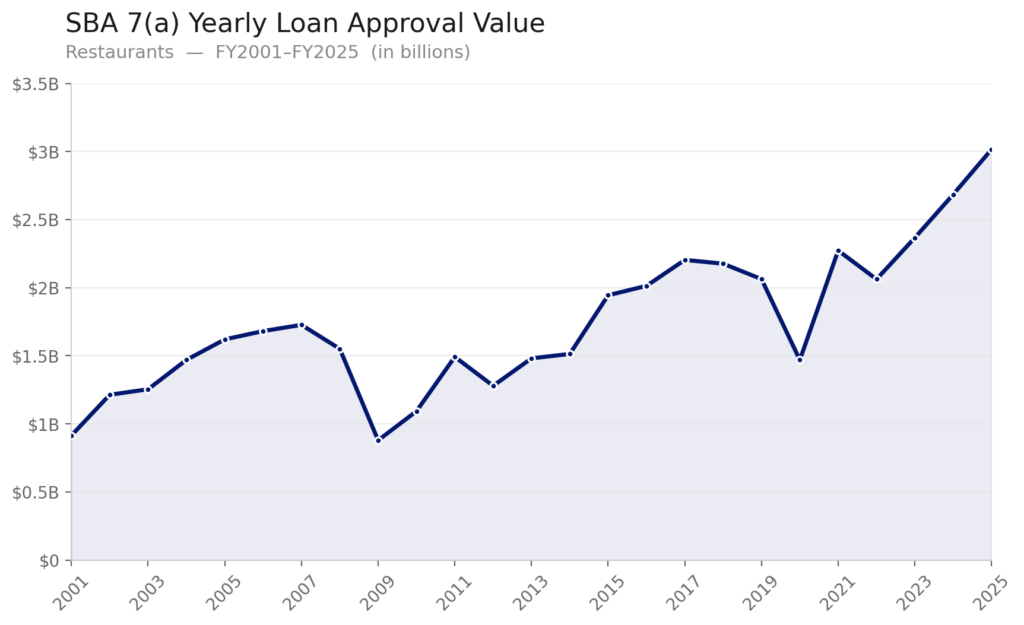
These are the year-by-year* statistics of SBA 7(a) restaurant loans from fiscal year 2001 to today, including the number of 7(a) loans approved and total approval amount.
| Fiscal Year | Loans Approved | Approval Amount |
| 2001 | 4,339 | $915,385,474 |
| 2002 | 5,452 | $1,214,058,077 |
| 2003 | 6,551 | $1,254,534,486 |
| 2004 | 7,583 | $1,470,120,577 |
| 2005 | 8,436 | $1,620,581,374 |
| 2006 | 8,498 | $1,681,662,550 |
| 2007 | 8,615 | $1,727,365,303 |
| 2008 | 6,559 | $1,551,271,377 |
| 2009 | 3,580 | $879,603,645 |
| 2010 | 3,924 | $1,093,381,600 |
| 2011 | 4,540 | $1,492,411,600 |
| 2012 | 3,910 | $1,279,840,300 |
| 2013 | 4,084 | $1,481,515,600 |
| 2014 | 4,480 | $1,513,788,100 |
| 2015 | 5,421 | $1,944,930,600 |
| 2016 | 5,661 | $2,013,866,100 |
| 2017 | 5,716 | $2,204,354,400 |
| 2018 | 5,672 | $2,176,618,200 |
| 2019 | 4,852 | $2,063,303,200 |
| 2020 | 3,358 | $1,469,729,800 |
| 2021 | 3,748 | $2,273,474,300 |
| 2022 | 3,914 | $2,062,337,000 |
| 2023 | 4,899 | $2,367,288,700 |
| 2024 | 5,569 | $2,684,968,900 |
| 2025 | 6,158 | $3,015,997,100 |
Source: SBA, 7(a) & 504 FOIA
*U.S. Federal Government fiscal years
SBA 7(a) Restaurant Loans On the Rise
Restaurant lending through the 7(a) program has trended solidly upward over the past 25 years, in line with the program’s overall growth.