Fiscal Year 2025
5,300
Loans Approved
$1.83B
Total Value
Small business owners in New York rarely fit into one mold, and the same is true with their financing needs. A deli owner in Queens, a manufacturer near Buffalo, a dental group on Long Island, and a software services firm in Manhattan can all reach for the same SBA program and end up using it very differently. That flexibility is part of what makes the SBA 7(a) loan one of the more practical financing tools available to qualified New York businesses. The harder part is usually figuring out which lender actually fits the deal, and that is where the early process tends to stall.
When a business does not slot neatly into conventional bank lending, an SBA-backed structure becomes worth a closer look. The 7(a) program is regularly used to acquire an existing business, purchase owner-occupied commercial property, finance equipment, fund renovations, refinance eligible debt, or shore up working capital. Across those uses, 7aSavvy works as an SBA 7(a) loan broker built to help New York borrowers understand where their request fits and reach lending options aligned with the industry of the business and purpose of the loan.
Most 7(a) loans carry a maximum of $5 million. The SBA’s guarantee to the lender generally reaches up to 85% on loans of $150,000 or less and up to 75% on larger loans, with the agency’s total guaranteed exposure to a single borrower capped at $3.75 million. Those figures matter less as headline numbers and more as the reason a lender may be willing to consider a request that they wouldn’t consider otherwise.
Note: 7aSavvy is an SBA 7(a) loan broker, not a lender. We are paid by the lender, so our help is free to you. Instead of approaching banks one at a time and hoping for a fit, you start with one focused path to the lenders most likely to fund your request.
How New York Businesses Use SBA 7(a) Loan Proceeds
The reason the 7(a) program shows up in so many different conversations is that it’s capable of so much, and especially that a single approved loan can do several jobs at once. A borrower might fold a real estate purchase, a buildout, and a cushion of working capital into one request rather than chasing three separate financing sources. In a market as layered as New York – five boroughs, dense suburban corridors in Westchester and on Long Island, and distinct upstate economies around Buffalo, Rochester, Syracuse, and Albany – that breadth is genuinely useful, because what a business needs in Tribeca might look nothing like what it needs in the Southern Tier.
Our platform helps New York owners line their loan up with lenders whose appetite matches that purpose. Eligible uses commonly include:
- Acquiring an operating business
- Purchasing owner-occupied commercial real estate
- Buying equipment or machinery
- Funding construction, renovations, or leasehold improvements
- Refinancing eligible business debt
- Covering working capital needs
One boundary is worth stating plainly: 7(a) financing is meant for active operating businesses. It is not designed for passive investment plays, such as buying commercial or residential property that the business itself will not primarily occupy and use.
Buy
For a New York buyer, an acquisition loan is often the most compelling use of the 7(a) program, because purchasing a company that already has customers, revenue, staff, and a track record is a different proposition than building from zero. The same logic applies to buying the building a business already operates from, or financing the equipment that keeps daily operations running.
Acquisition requests also tend to be the most document-heavy. A lender will usually want a clear view of the buyer’s relevant experience, the seller’s financials, a defensible valuation, the cash flow that will service the debt, the purchase agreement, and whatever collateral is on the table. 7aSavvy helps borrowers get those pieces into shape early and points them toward SBA lending options suited to acquisition deals. That tends to beat cold-calling banks one at a time and hoping one of them happens to like the transaction and be experienced with that type of acquisition.
Build
When the need is a better space rather than a new company, 7(a) proceeds can fund improvements tied to an operating business. That covers a wide range of physical work:
- Leasehold improvements and interior buildouts
- Facility upgrades and equipment installation
- Renovations to an existing location
- Building additions
- Ground-up construction for business use
- Improvements to owner-occupied commercial property
A construction or renovation request asks more of everyone involved than a straightforward working capital draw. Lenders generally want to see the project budget, info about the contractor, a realistic timeline, the relevant permits, the collateral, and a clear line from the finished project back to repayment. For New York borrowers juggling those moving parts, our platform helps organize the request before it reaches a lender and connects owners with 7(a) options based on the project’s scope, location, and structure.
Expand
Growth tends to arrive faster than a business’s cash reserves can comfortably support, and that gap is exactly where 7(a) financing earns its place. Rather than draining working capital or leaning on short-term debt, an owner can fund the next stage of the business more deliberately. New York companies commonly use 7(a) proceeds to:
- Open an additional location
- Increase operating capacity
- Hire and onboard staff
- Build inventory
- Add equipment, vehicles, or technology
- Smooth out seasonal or growth-driven cash flow
- Invest in the systems a larger operation requires
Expansion rarely looks the same twice. A restaurant group eyeing a second dining room, a medical practice that needs both equipment and a buildout, a trades contractor adding vehicles and crew, a retailer stocking up before a busy stretch, each is a different request with a different ideal lender. 7aSavvy helps New York borrowers explore 7(a) options tied to the real use of funds rather than treating every deal as interchangeable.
SBA 7(a) Loans Across New York Industries
The 7(a) program supports a broad cross-section of for-profit businesses, which is one reason it travels so well across New York’s varied economy. From the hospitality density of Manhattan to manufacturing and logistics upstate, owners look for 7(a) lending that can be matched to their industry, model, and funding purpose.
Businesses that frequently turn to 7(a) financing include:
- Restaurants, cafés, bakeries, and other food service operations
- Hotels, motels, and lodging businesses
- Convenience stores, bodegas, and delis
- Gas stations and car washes
- Retail and specialty shops
- Self-storage facilities
- Professional service firms
- Medical, dental, and other healthcare practices
- Franchise operations
- Manufacturing companies
- Distribution and logistics businesses
- Owner-operated businesses with real estate needs
The funding story shifts with the sector. A restaurant owner may be combining kitchen equipment with working capital; a healthcare practice may be financing an acquisition or a buildout; a hotel may need capital for property improvements; a franchisee may be opening a new unit or buying an existing one. Our platform helps connect each of these requests with SBA lending options that understand the industry behind the numbers.
SBA 7(a) Loan Qualifications in New York
Eligibility starts with the program’s baseline requirements. In broad terms, the business needs to be a for-profit company operating in the United States or its territories and to fall within the SBA size standards that apply to its industry. The program recognizes several common structures, including:
- Sole proprietorships
- Limited liability companies
- Partnerships
- Corporations
- Other eligible for-profit entities
Clearing those baseline rules is only the start. From there, a lender evaluates the full picture – the business itself, the borrower, the use of proceeds, repayment ability, credit profile, collateral, the industry, and how the transaction is put together. 7aSavvy helps New York borrowers approach that stage with more order, mapping out what lenders tend to scrutinize before an application goes in and helping borrowers prepare for it.
Important note: meeting the basic 7(a) requirements does not guarantee approval. Final eligibility rests on the lender’s underwriting, the type of business, the borrower’s credit, the use of funds, repayment capacity, available collateral, and the SBA’s program rules.
SBA 7(a) Loans in New York: Pros and Cons
For many New York borrowers, the appeal of the 7(a) program is access to flexible financing with reasonable terms. This allows for significant moves without leaning on short-term capital or a conventional bank loan.
Advantages borrowers often weigh include:
- Longer repayment terms than most other small business financing options
- Competitive interest rates for eligible business purposes
- Flexible use of proceeds across approved needs
- Coverage for acquisitions, expansion, equipment, real estate, refinancing, and working capital
- Fully amortized repayment structures
- Lighter equity injection requirements
The practical upsides are working capital and cash flow. Lower down payment requirements mean more attainable financing and keeping more working capital for other uses. Longer amortization can ease monthly payment pressure, and flexible use-of-proceeds rules mean a single request can cover more than one need at once, which is often the difference between a deal that pencils out and one that does not.
No financing tool is the right answer for every situation. The first common hurdle is eligibility, especially regarding citizenship and loan size. All owners of the business must be U.S citizens or nationals to qualify for SBA 7(a) financing, and SBA 7(a) loans are only available up to $5 million. If you tick those boxes, the trade-offs tend to show up as documentation and timeline: SBA-backed deals carry more paperwork and a longer process than a routine conventional loan, and not every business will want that. A well-established company with strong cash flow, ample collateral, and a simple ask may move faster elsewhere. The honest version of this comparison is the useful one, and it is the lens our platform brings to a request from the start, matching the deal to the program that actually fits rather than assuming 7(a) is always the answer.
SBA 7(a) Loans vs. Other Types of Loans
SBA 7(a) Loans vs Conventional Loans
A conventional business loan is funded and underwritten by the lender alone, with no SBA guarantee behind it. Because the lender carries the full risk, the bar sits higher – stronger collateral, a longer operating history, healthier cash flow, or a cleaner transaction. A 7(a) loan, by contrast, includes a partial government guarantee that absorbs some of that risk for the lender, which opens the door for qualified borrowers who do not check every conventional box.
For New York owners, the decision usually turns on the financials and the shape of the request. A seasoned company with strong financials and a simple need may do well with conventional financing. A borrower with more middling financials, less collateral, a shorter operating history, or multiple desired uses of proceeds will often find the 7(a) route worth a serious look.
SBA 7(a) Loans vs SBA 504 Loans
Both are SBA-backed, but they aim at different targets. The 7(a) program is the more versatile of the two – working capital, acquisitions, owner-occupied real estate, equipment, construction, eligible refinancing, and expansion all live under one roof, which suits businesses with broader or multi-purpose needs. The 504 program is narrower by design, built around long-term fixed assets like major equipment or owner-occupied commercial real estate, and it tends to come into play when a business is financing a large fixed-asset purchase tied to growth.
A New York business that only needs to buy property or heavy equipment may want to compare both. A borrower who also needs working capital, acquisition funding, refinancing, or a more flexible structure usually finds the 7(a) program the better fit.
Case Study: Franchise Restaurant Opening in Brooklyn
Kevin had spent 10 years in the restaurant industry, including three years as a district manager for a national quick-service brand. When a fast-casual franchise opportunity opened up in a high-traffic Brooklyn neighborhood, Kevin was ready to make the jump from operator to owner. The location was a ground-floor retail space on a busy commercial corridor. The space was raw, and it needed a full restaurant buildout from the ground up.
The total project cost was $875,000:
- Franchise fee: $50,000
- Leasehold improvements and buildout (kitchen construction, plumbing, HVAC, electrical, signage): $450,000
- Equipment (commercial kitchen equipment, POS system, furniture, fixtures): $200,000
- Initial inventory and supplies: $25,000
- Working capital for the first six months of operations: $150,000
Kevin had $87,500 available for a down payment (10%) and needed financing for the remaining $787,500.
Financing a new franchise location is harder than financing an acquisition of an existing business. There’s no operating history and no existing cash flow to point to. Kevin approached two conventional lenders. One declined outright, as the bank didn’t lend to new restaurant locations. The other was willing to discuss it but wanted 25% down and would only offer a five-year term.
Through 7aSavvy, Kevin was matched with an SBA 7(a) lender that had experience funding franchise deals and understood how to underwrite a new location. The lender was comfortable evaluating projected cash flow rather than existing business history, and was willing to finance the entire project in a single loan.
Loan Details:
- Total project cost: $875,000
- Down payment: $87,500 (10%)
- Loan amount: $787,500
- Interest rate: Prime + 2.5 (9.25% at the time of closing)
- Term: 10 years, fully amortized
- Monthly payment: $10,100
Projections showed the location generating annual stabilized cash flow of $160,000, giving it a projected DSCR of 1.32. Kevin’s decade of restaurant management experience, the strength of the franchise system, and the quality of the Brooklyn location all supported the approval.
The loan closed in 65 days. The 10-year term applied because the deal involved no real estate. By bundling the franchise fee, buildout, equipment, inventory, and working capital into one SBA 7(a) loan, Kevin avoided piecing together multiple financing sources for what was already a complex enough project.
This is an illustrative example based on typical SBA 7(a) loan terms and a realistic franchise restaurant scenario in New York. Actual loan terms, timelines, and outcomes vary based on the borrower, franchise, location, and lender.
SBA 7(a) Loan Program History
The program traces back to the Small Business Act of 1953, which created the U.S. Small Business Administration and gave the federal government a defined role in helping small businesses access capital. The “7(a)” label simply refers to the section of that Act authorizing the program. In the decades since, it has grown into one of the primary channels through which eligible small businesses pursue financing from approved lenders, with the SBA’s partial guarantee lowering the risk a lender takes on.
That design speaks directly to a recurring small business problem: owners often have real growth potential but do not fit cleanly inside a conventional lending box, while lenders still have to manage risk responsibly. By guaranteeing a portion of eligible loans, the program lets approved lenders consider requests that might otherwise be hard to approve. For a New York borrower looking to buy a company, purchase property, expand, invest in equipment, refinance eligible debt, or build working capital, that structure can be the more workable path. Today the program continues to support businesses across the state, from restaurants and hotels to healthcare practices, franchises, retailers, professional services, manufacturers, and transportation companies.
New York SBA 7(a) Loan Program Statistics
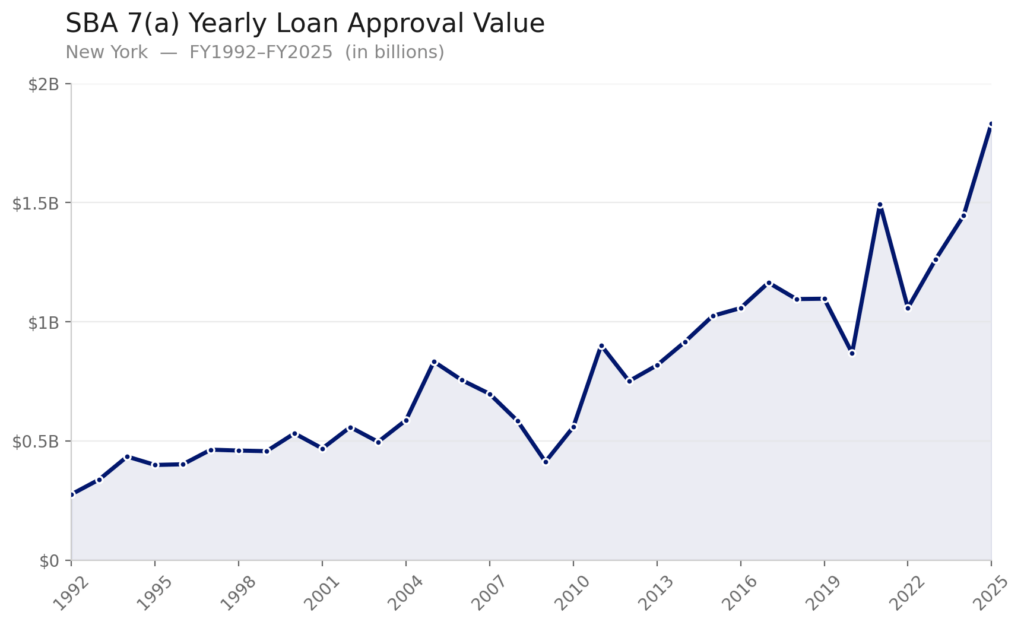
These are the year-by-year* statistics of the SBA 7(a) loan program in New York from fiscal year 1992 to today, including the number of 7(a) loans approved and total approval amount.
| Fiscal Year | Loans Approved | Approval Amount |
| 1992 | 1,506 | $276,191,367 |
| 1993 | 1,747 | $338,609,593 |
| 1994 | 2,120 | $434,769,696 |
| 1995 | 2,925 | $434,769,696 |
| 1996 | 2,989 | $402,303,766 |
| 1997 | 3,035 | $463,603,957 |
| 1998 | 2,804 | $459,918,185 |
| 1999 | 2,897 | $457,285,324 |
| 2000 | 3,443 | $532,088,892 |
| 2001 | 2,980 | $468,577,875 |
| 2002 | 3,130 | $558,362,947 |
| 2003 | 3,616 | $496,206,975 |
| 2004 | 4,645 | $587,498,843 |
| 2005 | 7,869 | $833,143,299 |
| 2006 | 7,871 | $755,585,098 |
| 2007 | 7,789 | $697,626,766 |
| 2008 | 5,076 | $584,093,933 |
| 2009 | 2,374 | $412,653,504 |
| 2010 | 2,850 | $558,779,200 |
| 2011 | 3,436 | $901,523,600 |
| 2012 | 2,955 | $751,214,700 |
| 2013 | 2,791 | $817,713,800 |
| 2014 | 3,151 | $915,690,300 |
| 2015 | 3,761 | $1,025,022,900 |
| 2016 | 4,137 | $1,057,907,500 |
| 2017 | 4,443 | $1,164,481,000 |
| 2018 | 4,385 | $1,095,611,900 |
| 2019 | 3,404 | $1,097,055,000 |
| 2020 | 2,135 | $868,932,200 |
| 2021 | 2,450 | $1,494,745,800 |
| 2022 | 2,710 | $1,058,666,700 |
| 2023 | 4,094 | $1,263,044,000 |
| 2024 | 4,816 | $1,446,373,400 |
| 2025 | 5,300 | $1,833,500,700 |
Source: SBA, 7(a) & 504 FOIA
*U.S. Federal Government fiscal years
SBA 7(a) Loans On the Rise
The SBA 7(a) loan program has seen excellent growth in New York, with the annual total value of approved loans up almost 7x since 1992.