Fiscal Year 2025
6,295
Loans Approved
$4.1B
Total Value
Texas business owners often need flexible financing to buy real estate, acquire a business, purchase equipment, refinance existing debt, or support day-to-day working capital. An SBA 7(a) loan can be one of the most useful financing options for qualified small businesses, but finding the right lender and understanding the process can take time.
For Texas businesses that may not be an ideal fit for conventional bank financing, the structure and flexibility of SBA loans can make SBA-backed financing worth exploring. The SBA 7(a) program is commonly used for business acquisitions, owner-occupied commercial real estate, equipment purchases, working capital, expansion projects, eligible debt refinancing, and other approved business purposes.
The maximum SBA 7(a) loan amount is generally $5 million. For standard SBA loans, the SBA guarantee covers up to 85% for loans of $150,000 or less and up to 75% for loans above $150,000.
Note: 7aSavvy is an SBA 7(a) loan broker, not a lender. We are paid by the lender, so our help is free to you. Instead of approaching banks one at a time and hoping for a fit, you start with one focused path to the lenders most likely to fund your request.
Uses of SBA 7(a) Loan Proceeds in Texas
SBA 7(a) financing can give Texas business owners a practical way to fund important business moves, whether the goal is to purchase a company, invest in commercial property, buy equipment, improve a facility, refinance eligible debt, or strengthen working capital.
For many small businesses, the value of the SBA 7(a) program comes from its flexibility. A single financing request may support growth, ownership transitions, operational improvements, or long-term investment in business assets. That flexibility can be especially useful in a large and diverse market like Texas, where business needs can vary widely by city, industry, and stage of growth.
As an SBA 7(a) loan brokering platform, 7aSavvy helps Texas borrowers make sense of how this loan program may fit their plans and connect with lending options that match the purpose of the request. A business owner may be looking to acquire a company in Houston, purchase owner-occupied commercial real estate in Dallas, finance equipment in Austin, renovate a location in San Antonio, or secure working capital for a growing operation in El Paso. Our platform is built to help make the SBA lending process easier to approach from the beginning.
SBA 7(a) loan proceeds may commonly be used for:
- Buying an existing business
- Purchasing owner-occupied commercial real estate
- Financing equipment or machinery
- Funding construction, renovations, or leasehold improvements
- Refinancing eligible business debt
- Supporting working capital needs
These possible uses make SBA 7(a) loans a strong financing option for Texas companies that want to grow, improve cash flow, invest in long-term assets, or create a more stable financial foundation.
SBA 7(a) loans are designed for active operating businesses. They are generally not intended for passive investment activity, such as purchasing commercial or residential investment property that is not primarily occupied and used by the business itself.
Buy
Texas entrepreneurs and business owners can use SBA 7(a) financing to purchase assets that support ownership, growth, and long-term business value. This may include acquiring an existing business, buying owner-occupied commercial property, or purchasing equipment needed for daily operations.
For buyers looking to acquire a business in Texas, an SBA 7(a) loan may be especially useful because it can support acquisition opportunities across a wide range of eligible industries. Instead of starting from scratch, a buyer may be able to purchase a company that already has revenue, customers, employees, systems, and market presence.
This type of transaction often requires careful preparation. Lenders may want to review the buyer’s experience, the seller’s financials, business valuation, cash flow, purchase agreement, collateral, and repayment ability. 7aSavvy helps bring more structure to that early financing process by helping borrowers understand what may be needed and connecting them with SBA lenders that fit the transaction.
Our SBA 7(a) loan brokering platform can be useful for Texas buyers who want a clearer path toward funding instead of contacting lenders one at a time without knowing which ones may be a fit.
Build
SBA 7(a) financing can also help Texas businesses fund improvements tied to an active operating company. For businesses that need a better location, more usable space, updated facilities, or property improvements, loan proceeds may be used for eligible construction or renovation-related costs.
Eligible projects may include:
- Leasehold improvements
- Interior buildouts
- Facility upgrades
- Renovations to an existing business location
- Building additions
- Ground-up construction for business use
- Improvements to owner-occupied commercial property
A construction or renovation loan request can be more detailed than a basic working capital request. Lenders may need to understand the project budget, contractor information, timeline, permits, collateral, business financials, and how the completed project will support repayment.
For Texas borrowers, 7aSavvy helps make those moving pieces easier to organize before the loan request reaches a lender. Our platform helps connect business owners with SBA 7(a) lending options based on the purpose of the funds, the business location, and the structure of the project.
Expand
When a Texas business is ready to grow, access to the right financing can make a major difference. SBA 7(a) loan proceeds can help business owners move forward with expansion plans without relying only on short-term funding or using all available cash reserves.
Texas businesses may use SBA 7(a) financing to:
- Open an additional location
- Increase operating capacity
- Hire employees
- Purchase inventory
- Add equipment, vehicles, or technology
- Improve cash flow
- Support seasonal or growth-related working capital needs
- Invest in systems that help the business scale
Expansion financing can look different depending on the business. A restaurant may need funds for a second location, a medical practice may need equipment and buildout capital, a contractor may need vehicles and working capital, and a retail company may need inventory and leasehold improvements.
7aSavvy connects Texas borrowers with SBA 7(a) lenders that are experienced with the actual use of funds. Instead of treating every loan request the same, our platform helps match business owners with SBA lending options based on the details of the transaction, the borrower’s goals, and the type of financing needed.
SBA 7(a) Loan Industries in Texas
SBA 7(a) loans can support a wide range of for-profit businesses in Texas. Because the program allows several approved uses of funds, it can be a useful financing option for business owners who need capital for acquisitions, expansion, owner-occupied real estate, equipment, refinancing eligible debt, or working capital.
Texas has a broad business landscape, from hospitality and food service to healthcare, retail, transportation, construction, manufacturing, and franchise operations. That variety is one reason many borrowers look for SBA 7(a) lending options that are experienced with their industry, business model, and funding purpose.
Common industries that may use SBA 7(a) business loans include:
- Convenience stores
- Hotels, motels, and other lodging businesses
- Gas stations
- Restaurants, cafés, and food service businesses
- Retail stores
- Self-storage facilities
- Car washes
- Professional service businesses
- Medical, dental, and healthcare practices
- Franchise businesses
- Manufacturing companies
- Distribution and logistics businesses
- Owner-operated businesses with real estate needs
For Texas businesses, SBA 7(a) financing can help fund a major purchase. A restaurant owner may need equipment and working capital. A healthcare practice may need financing for an acquisition, buildout, or expansion. A hotel or lodging business may need capital for property improvements. A franchise operator may need funds to open a new location or acquire an existing one.
SBA 7(a) Loan Qualifications in Texas
Qualifying for an SBA 7(a) loan in Texas begins with the basic eligibility requirements for the program. In general, the business must be a for-profit company operating in the United States or its territories and must meet applicable SBA size and eligibility standards.
SBA 7(a) financing may be available to several common business structures, including:
- Sole proprietorships
- Corporations
- Partnerships
- Limited liability companies
- Other eligible for-profit business entities
These requirements are only the starting point. After basic eligibility is considered, lenders review the full loan request, including the business, borrower, use of proceeds, repayment ability, credit profile, collateral, industry, and overall transaction structure.
7aSavvy helps Texas borrowers approach this step with more organization. Our SBA 7(a) loan brokering platform is designed to help business owners understand what lenders will evaluate before they apply and connect with lending options that may be a better fit for their goals.
Important Note:
Meeting the basic SBA 7(a) loan requirements does not guarantee approval. Final eligibility and approval depend on the lender’s underwriting standards, the type of business, the borrower’s credit profile, the intended use of funds, repayment ability, and SBA program rules.
SBA 7(a) Loans in Texas: Pros and Cons
For Texas business owners, an SBA 7(a) loan can provide access to flexible financing for major business needs without relying only on short-term capital or conventional bank financing. Whether the goal is to buy a business, purchase owner-occupied commercial real estate, invest in equipment, refinance eligible debt, or support working capital, the 7(a) program can offer a more practical structure for qualified borrowers.
Key benefits to SBA 7(a) financing include:
- Longer repayment terms than most other business financing options
- Competitive interest rates
- Flexible use of proceeds for approved business needs
- Financing for acquisitions, expansion, equipment, real estate, refinancing, and working capital
- Fully amortized loan terms – no balloon payments
- Lower equity injection requirements than conventional loans
- Greater access to financing due to the SBA guarantee
These features can make SBA 7(a) loans useful for Texas small businesses that need capital while also protecting day-to-day cash flow. Longer loan terms may help reduce monthly payment pressure, lower down payments free up capital for other uses, and more flexible use-of-proceeds rules can give business owners room to fund multiple needs through one financing request.
But it’s not all gumdrops and roses, there are also some downsides to SBA 7(a) loans. The first is the loan size limit. $5 million is enough to cover most uses, but for larger real estate transactions it may not be enough. The second is the recently-enacted citizenship requirement. If you’re a lawful permanent resident, you have to look elsewhere. The third is the speed of the loan process. The SBA 7(a) loan process is faster than it used to be, and is not much longer than that of a comparable conventional loan (as long as you’re using an experienced 7(a) lender). However, that bit of extra time and extra few documents can be a concern for some borrowers, especially if on a strict timeline.
SBA 7(a) Loans vs. Other Types of Loans in Texas
SBA 7(a) Loans vs Conventional Loans
A conventional business loan is funded and underwritten by the lender without an SBA guarantee. Because the lender carries the full risk of the loan, approval requirements at comparable rates are typically stricter. Borrowers may need stronger collateral, a longer operating history, higher cash flow, or a simpler transaction structure.
An SBA 7(a) loan includes a partial government guarantee, which helps reduce risk for the lender. This may make SBA 7(a) financing more accessible for many borrowers who may not meet every requirement for a conventional bank loan.
For Texas business owners, the difference often comes down to the strength and purpose of the loan request. A well-established company with strong cash flow, substantial collateral, and a straightforward funding need may be a good candidate for conventional financing. A borrower without all of those things may find that an SBA 7(a) loan is a better option.
SBA 7(a) Loans vs SBA 504 Loans
SBA 7(a) loans and SBA 504 loans are both SBA-backed financing options, but they are typically used in different ways.
SBA 7(a) loans are more flexible. They may be used for working capital, business acquisitions, owner-occupied commercial real estate, equipment, construction, eligible refinancing, and expansion. This makes the 7(a) program useful for Texas businesses with broader financing needs or transactions that involve more than one use of funds.
SBA 504 loans are more focused on long-term fixed assets, such as major equipment or owner-occupied commercial real estate. They are commonly used when a business is financing a large fixed-asset purchase tied to growth and long-term operations.
For a Texas business that only needs to purchase property or major equipment, both programs may be worth reviewing. For a borrower who also needs working capital, acquisition financing, eligible refinancing, or a more flexible structure, SBA 7(a) financing provides a better fit.
Example Scenario: Medical Practice Buyout in Dallas
James had been a physical therapist for 12 years, the last four as managing partner of his practice in the Dallas-Fort Worth area. When his senior partner decided to retire, James wanted to buy out his ownership stake and purchase the building the practice had been leasing. The landlord was willing to negotiate a sale directly to James as the sitting tenant.
The total project cost was $2,400,000:
- Partner buyout (50% ownership stake, including goodwill, patient base, and equipment): $800,000
- Real estate (6,200-square-foot building with parking, currently occupied by the practice): $1,200,000
- Renovations (two additional treatment rooms, updated reception area, ADA improvements): $200,000
- New equipment (therapy tables, ultrasound units, electrical stimulation devices): $100,000
- Working capital: $100,000
James had $240,000 available for a down payment (10%) and needed financing for the remaining $2,160,000.
He approached two conventional lenders. One was willing to finance the real estate but wouldn’t include the partner buyout in the same loan. The other had limited experience with healthcare practice transactions and was unsure how to evaluate them. Neither could offer a single loan covering everything James needed.
Through 7aSavvy, James was matched with an SBA 7(a) lender in Texas that had experience with medical practice buyouts and understood how to underwrite them. The lender was comfortable combining the partner buyout, real estate purchase, renovations, equipment, and working capital into one loan.
Loan Details:
- Total project cost: $2,400,000
- Down payment: $240,000 (10%)
- Loan amount: $2,160,000
- Interest rate: Prime + 1.5 (8.25% at the time of closing)
- Term: 25 years, fully amortized
- Monthly payment: $17,031
The practice was generating annual cash flow of $290,000, giving it a DSCR of 1.42. James’s four years managing the practice and the clinic’s steady patient volume gave the lender confidence in the deal.
The loan closed in 76 days. Combining the separate needs into a single SBA 7(a) loan gave James one monthly payment instead of juggling several financing arrangements. The 25-year term gave him long-term security in his practice, the renovations and equipment allowed him to add capacity, and the working capital gave him a cushion for the transition.
This is an illustrative example based on typical SBA 7(a) loan terms and a realistic medical practice transaction scenario in Texas. Actual loan terms, timelines, and outcomes vary based on the borrower, practice, and lender.
SBA 7(a) Loan Program History
The SBA 7(a) loan program has a long history in small business financing. Its foundation comes from the Small Business Act of 1953, which created the U.S. Small Business Administration and gave the federal government a formal role in helping small businesses access capital.
The “7(a)” name comes from the section of the Small Business Act that authorizes the program. Since then, SBA 7(a) financing has become one of the main ways eligible small businesses can pursue funding, with the SBA providing a partial guarantee that helps reduce lender risk.
For Texas business owners, that structure is important. Many small businesses have strong growth potential but may not fit perfectly into a conventional lending box. A company may need capital to buy another business, purchase property, expand operations, invest in equipment, refinance eligible debt, or support working capital. In those situations, SBA 7(a) financing may offer a more practical path than traditional financing alone.
The program was built around a common small business challenge: owners often need access to capital, but lenders must also manage risk. By backing a portion of eligible loans, the SBA 7(a) program can help approved lenders consider financing requests that they would otherwise reject.
Today, SBA 7(a) loans continue to support Texas businesses across many industries, including restaurants, hotels, healthcare practices, franchises, retail stores, professional services, manufacturing companies, construction businesses, transportation companies, and other owner-operated businesses.
Texas SBA 7(a) Loan Program Statistics
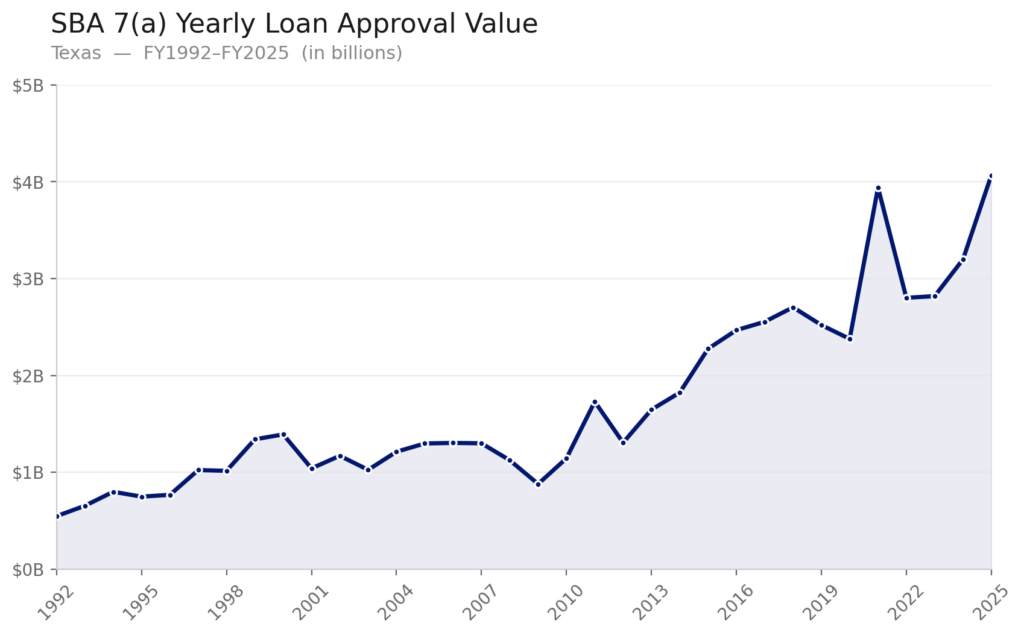
These are the year-by-year* statistics of the SBA 7(a) loan program in Texas from fiscal year 1992 to today, including the number of 7(a) loans approved and total approval amount.
| Fiscal Year | Loans Approved | Approval Amount |
| 1992 | 2,225 | $547,045,203 |
| 1993 | 2,580 | $654,142,924 |
| 1994 | 4,511 | $798,277,389 |
| 1995 | 5,114 | $748,303,664 |
| 1996 | 3,988 | $766,909,576 |
| 1997 | 3,849 | $1,022,622,002 |
| 1998 | 3,775 | $1,014,963,814 |
| 1999 | 4,256 | $1,340,185,529 |
| 2000 | 4,036 | $1,390,715,597 |
| 2001 | 3,271 | $1,039,982,388 |
| 2002 | 3,806 | $1,170,037,441 |
| 2003 | 5,207 | $1,024,836,532 |
| 2004 | 6,471 | $1,211,955,905 |
| 2005 | 6,665 | $1,297,358,425 |
| 2006 | 6,960 | $1,303,029,770 |
| 2007 | 7,525 | $1,298,928,172 |
| 2008 | 5,108 | $1,123,794,388 |
| 2009 | 2,984 | $879,063,307 |
| 2010 | 3,524 | $1,144,158,600 |
| 2011 | 4,089 | $1,729,160,000 |
| 2012 | 3,493 | $1,305,919,300 |
| 2013 | 3,397 | $1,646,236,600 |
| 2014 | 3,951 | $1,822,864,600 |
| 2015 | 4,845 | $2,274,982,400 |
| 2016 | 5,271 | $2,467,396,900 |
| 2017 | 5,034 | $2,554,060,300 |
| 2018 | 4,452 | $2,703,370,300 |
| 2019 | 3,733 | $2,520,320,000 |
| 2020 | 3,027 | $2,377,158,800 |
| 2021 | 4,115 | $3,940,084,000 |
| 2022 | 3,502 | $2,801,311,100 |
| 2023 | 4,096 | $2,818,721,800 |
| 2024 | 5,233 | $3,198,401,800 |
| 2025 | 6,295 | $4,067,228,500 |
Source: SBA, 7(a) & 504 FOIA
*U.S. Federal Government fiscal years
SBA 7(a) Loans On the Rise
The SBA 7(a) loan program has seen outstanding growth in Texas, with the annual total value of approved loans up over 7x since 1992.