Fiscal Year 2025
1,685
Loans Approved
$1.0B
Total Value
Most Houston business owners who look into an SBA 7(a) loan don’t get stuck on whether the program could work for them. They get stuck on the question that comes right after that one. Out of the hundreds of banks and non-bank lenders that make these loans, which one is going to fund this particular deal, for this particular business, at this particular size? The program itself is federal, and its rules do not change as you move from one lender to the next. What does change, and changes a lot, is how willing a given lender is to say yes to a given request. That gap is where a financing search can frustrate and waste time.
That matching problem is where our platform does its work. 7aSavvy operates as an SBA 7(a) loan broker for Houston borrowers, and the job is less about selling anyone on the program and more about lining a real request up with the lenders most likely to approve it. The 7(a) program is used regularly to buy a business, purchase owner-occupied property, finance equipment, pay for renovations, refinance qualifying debt, or cover working capital, and across all of those situations a Houston owner is usually better served by starting with the right lender than by knocking on the door of the nearest one.
A few numbers set the boundaries. Most 7(a) loans top out at $5 million. The SBA backs up to 85% of a loan of $150,000 or less and up to 75% of anything above that, limiting its total guaranteed exposure to a single borrower to $3.75 million. Those figures are easy to skim past, but they explain a lot, because the guarantee behind the loan is the reason a lender can approve a Houston borrower it might otherwise have to decline.
Note: 7aSavvy is an SBA 7(a) loan broker, not a lender. We are paid by the lender, so our help is free to you. Instead of approaching banks one at a time and hoping for a fit, you start with one focused path to the lenders most likely to fund your request.
How Houston Businesses Use SBA 7(a) Loan Proceeds
Part of what makes the program worth a Houston borrower’s attention is that one approved loan can carry several jobs at once. Instead of stacking a real estate loan on top of an equipment loan on top of a working capital line, a borrower can often bring the whole plan into a single 7(a) request. In a region this large and this varied, where the energy and engineering work clusters in the western suburbs and the freight and warehousing runs toward the port, that ability to combine purposes means 7(a) loans are a great option for businesses all over Greater Houston.
Our platform helps Houston owners connect the dots between what they are actually trying to do and the lenders ready to fund it. Eligible uses of 7(a) proceeds generally cover:
- Purchasing an operating business
- Buying owner-occupied commercial property
- Financing equipment and machinery
- Paying for construction, renovations, or leasehold improvements
- Refinancing qualifying business debt
- Funding working capital
There is one limit worth being upfront about. A 7(a) loan is meant to support a business that is actually operating, so it cannot be used as a passive real estate play, such as buying a building the company will rent out rather than occupy and run its operations from.
Buy
For a lot of Houston borrowers, the most powerful use of the program is buying something that already exists. Taking over a company with established customers, steady revenue, and a few years of history is a more grounded proposition than launching from scratch, and the same reasoning extends to purchasing the building a business runs out of or the equipment it depends on day to day.
Acquisitions also carry the most paperwork, since a lender is underwriting both the buyer and the thing being bought. Expect questions about the buyer’s background, the seller’s financials, the valuation, the cash flow that has to cover the new debt, the purchase agreement, and whatever collateral supports the deal. Our platform helps Houston buyers pull those pieces together early and reach lenders that handle acquisition financing as a matter of routine, which works out a good deal better than calling banks at random and hoping one of them is a good fit for the transaction.
Build
When the need is space, 7(a) money can pay for physical work tied to an operating business. That spans a fairly wide range, including:
- Interior buildouts and leasehold improvements
- Facility upgrades and equipment installation
- Renovating an existing location
- Adding on to a building
- Ground-up construction for business use
- Improving owner-occupied commercial property
Construction and renovation requests demand more from everyone than a simple working capital draw. A lender generally wants the project budget, the contractor, a credible timeline, the permits, the collateral, and a clear path from the finished work back to repayment. For Houston borrowers trying to keep all of that straight, our platform helps shape the request before it reaches a lender and points owners toward 7(a) options that suit the scope, the location, and the way the project is structured.
Expand
Growth has a way of outrunning the cash a business has on hand, and that is a gap the 7(a) program is built to close. Rather than draining the operating account or piling on short-term debt, an owner can fund the next move on terms that fits them and their business. Houston companies often put 7(a) proceeds toward:
- Opening another location
- Adding operating capacity
- Hiring and onboarding staff
- Stocking up on inventory
- Buying equipment, vehicles, or technology
- Evening out seasonal or growth-driven cash flow
- Putting in the systems a larger operation requires
No two expansions look alike. A restaurant group adding a second room in Montrose, a dental practice that needs equipment and a buildout at the same time in Pasadena, a trades company taking on more trucks and crew in Spring, a Sugar Land wholesaler loading up ahead of a busy season, each is a separate request that suits a different lender. 7aSavvy helps Houston borrowers find the 7(a) options that fit the real use of the money rather than treating every growth plan as the same.
SBA 7(a) Loans Across Houston Industries
One reason the program travels so well across Houston is that it works for nearly any for-profit business. From the service firms that orbit the energy sector to the medical practices around the Texas Medical Center to the trade and logistics outfits feeding the port, borrowers look for 7(a) financing that can be matched to their industry, their business model, and the purpose of the funds.
Businesses that commonly use 7(a) loans include:
- Restaurants, cafes, bakeries, and other food service
- Hotels, motels, and lodging
- Convenience stores and neighborhood markets
- Gas stations and car washes
- Retail and specialty shops
- Self-storage operators
- Professional service firms
- Medical, dental, and other healthcare practices
- Franchises
- Manufacturers
- Energy services and oilfield support businesses
- Freight, distribution, and logistics companies
- Owner-operated businesses with commercial real estate needs
The shape of the request shifts with the sector. A restaurant owner might be pairing kitchen equipment with working capital, a healthcare practice might be financing an acquisition or a buildout, an energy services firm might need equipment and real estate with a yard, and a franchisee might be opening a unit or buying one that already exists. Our platform helps connect each of those requests with SBA lending options that understand the business behind the numbers, not just the numbers themselves.
SBA 7(a) Loan Qualifications in Houston
The starting point is the program’s own baseline. In general terms, a business has to be for-profit, has to operate in the United States or its territories, and has to come in under the SBA size standards that apply to its industry. The program works with the usual entity types, including:
- Sole proprietorships
- Limited liability companies
- Partnerships
- Corporations
- Other eligible for-profit entities
Meeting those rules gets a request to the door but not through it. From there a lender underwrites the whole file, and the real weight lands on the cash flow that has to service the debt, the credit history of the owners, the collateral on the table, the use of the funds, the borrower’s experience, and the way the transaction is put together. Our platform helps Houston owners understand how those pieces apply to their own situation and connects them with lenders inclined to say yes to that kind of request.
Important note: Clearing the baseline 7(a) requirements is not the same as an approval. The final decision rests on the business’s financials, the borrower’s credit, the use of proceeds, the repayment capacity, and the available collateral.
SBA 7(a) Loans in Houston: Pros and Cons
For a lot of Houston borrowers, the draw of the program is getting access to flexible, long-term financing for a significant move without relying entirely on short-term capital or a conventional bank loan. The SBA guarantee and guidelines allow borrowers to get funding more easily, and on better terms, than they’d be able to otherwise.
Advantages owners tend to weigh include:
- Longer repayment terms than most other options, with real estate-secured 7(a) loans commonly amortized over 25 years
- Competitive interest rates for eligible business purposes
- Flexible use of proceeds across approved needs
- Coverage that spans acquisitions, expansion, equipment, real estate, refinancing, and working capital
- Repayment structures that can follow the purpose of the loan
- Lighter equity injection than non-SBA business loans
The practical payoff is cash flow. Stretching the amortization can ease the monthly payment, and the flexible use-of-proceeds rules let one request cover more than one need, which is frequently what separates a deal that works on paper from one that does not.
That said, no single financing tool fits every case. The 7(a) program is at its best when a Houston business has more marginal cash flow, is in an industry conventional lenders aren’t interested in, or needs a lower down payment, flexibility, a longer term, or a structure a conventional lender would not touch. The cost of the SBA 7(a) loan’s advantages is paperwork and patience, because an SBA-backed loan involves more documentation and a longer review than a routine bank loan, and plenty of businesses will not need to take that on. A well-seasoned company with strong cash flow, solid collateral, and a simple request may well move faster somewhere else. Being honest about that comparison is more useful than pretending otherwise, and it is the approach our platform takes from the first conversation, matching a deal to the program that actually fits rather than assuming 7(a) is always the answer.
Additionally, restrictive citizenship requirements and size maximums can restrict the borrowers and projects that can receive an SBA 7(a) loan. All owners of the business must be U.S. citizens or nationals, meaning that lawful permanent residents and all others are excluded. And the maximum loan size for 7(a) loans is $5 million, meaning the program may not be the best fit for larger real estate acquisitions or construction projects.
SBA 7(a) Loans vs. Other Types of Loans
SBA 7(a) Loans vs Conventional Loans
A conventional business loan is made and underwritten entirely by the lender, with no SBA guarantee involved. Since the lender absorbs all of the risk, it sets a higher bar for approval, which might mean more collateral, a longer track record, stronger cash flow, or a cleaner deal. A 7(a) loan puts a partial federal guarantee behind the loan, and by taking some of that risk off the lender’s books, it can make room for a qualified borrower who does not check every conventional box.
For a Houston borrower, the choice usually comes down to the nature of the request. A mature company with strong financials and a simple need may be perfectly well served by conventional financing. A business that is newer, with weaker cash flow, or needing flexibility in how the money is used will more often find the 7(a) route worth pursuing.
SBA 7(a) Loans vs SBA 504 Loans
Both are SBA-backed, but they are pointed at different things. The 7(a) program is the broader of the two, covering business acquisitions, owner-occupied real estate, equipment, construction, working capital, eligible refinancing, and expansion under one umbrella, which suits a business with mixed or multi-purpose needs. The 504 program is more specialized, built specifically around long-term fixed assets such as owner-occupied commercial property or major equipment, and it tends to come up when a business is financing a large fixed-asset purchase tied to growth.
A Houston business that only needs to buy a building or a heavy piece of equipment may want to look at both. A borrower who also needs working capital, acquisition funding, refinancing, or a more adaptable structure usually lands on the 7(a) program as the better fit.
Example: Warehouse Purchase Near the Port of Houston
Ray ran a freight and logistics company serving importers and distributors in the Houston area. The business had been operating out of leased warehouse space, but rising rents and a lack of dock capacity were limiting growth. When a 15,000-square-foot warehouse with four loading docks came on the market near the Port of Houston, Ray saw a chance to move operations into an owned facility.
The total project cost was $2,100,000:
- Real estate (15,000-square-foot warehouse with loading docks, yard space, and office): $1,800,000
- Equipment (forklifts, pallet racking, dock levelers): $200,000
- Working capital for the move and transition: $100,000
Ray had $210,000 available for a down payment (10%) and needed financing for the remaining $1,890,000.
He approached two conventional lenders. One required 25% down, which Ray couldn’t meet without pulling capital out of daily operations. The other was unfamiliar with freight and logistics businesses and wasn’t comfortable with the revenue model.
Through 7aSavvy, Ray was matched with an SBA 7(a) lender that understood logistics businesses and the Houston freight market. The lender was comfortable financing the real estate, equipment, and working capital in a single loan.
Loan Details:
- Total project cost: $2,100,000
- Down payment: $210,000 (10%)
- Loan amount: $1,890,000
- Interest rate: Prime + 2.0 (8.75% at the time of closing)
- Term: 25 years, fully amortized
- Monthly payment: $15,500
The business was generating annual cash flow of $250,000, giving it a DSCR of 1.34. Ray’s six years of operating history, stable client relationships, and the property’s proximity to the port all supported the approval.
The loan closed in 72 days. Owning the warehouse eliminated the lease uncertainty and gave Ray the dock capacity to take on the larger contracts he had been turning down. The working capital covered the costs of the move and kept operations running smoothly during the transition.
This is an illustrative example based on typical SBA 7(a) loan terms and a realistic freight business scenario in Houston. Actual loan terms, timelines, and outcomes vary based on the borrower, business, and lender.
SBA 7(a) Loan Program History
The program dates to the Small Business Act of 1953, the law that established the U.S. Small Business Administration and wrote a federal role into helping small businesses reach capital. The name is purely administrative, since “7(a)” refers to the section of that Act that created the program. Over the decades it has become one of the main routes through which eligible small businesses get financing from approved lenders, with the SBA’s partial guarantee lowering the risk a lender carries.
The design answers a problem that has not gone away. A great many owners have real potential without fitting neatly inside a conventional lending box, and lenders, for their part, still have to manage risk responsibly. Guaranteeing a huge chunk of an eligible loan gives an approved lender room to consider a request that would otherwise be hard to approve. For a Houston borrower looking to buy a company, purchase property, expand, invest in equipment, refinance qualifying debt, or build up working capital, that arrangement is often the more workable path. The program supports businesses across the region, state, and country, from restaurants and hotels to healthcare practices, franchises, retailers, professional service firms, manufacturers, and transportation companies.
Houston SBA 7(a) Loan Program Statistics
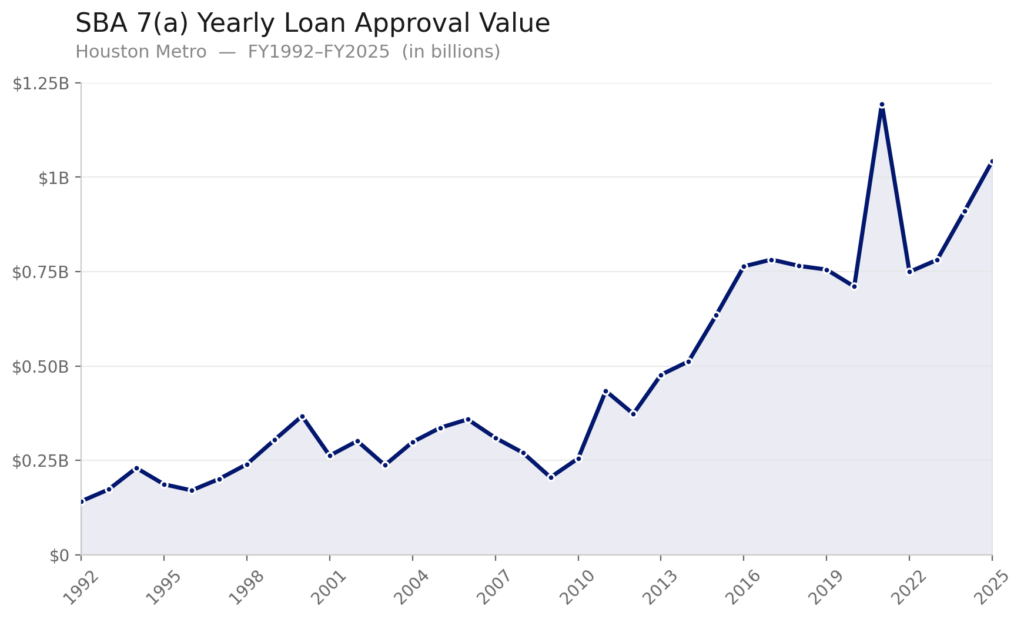
These are the year-by-year* statistics of the SBA 7(a) loan program in Greater Houston from fiscal year 1992 to today, including the number of 7(a) loans approved and total approval amount.
| Fiscal Year | Loans Approved | Approval Amount |
| 1992 | 534 | $141,690,499 |
| 1993 | 642 | $173,151,729 |
| 1994 | 1,177 | $229,875,605 |
| 1995 | 1,164 | $186,598,264 |
| 1996 | 852 | $170,420,162 |
| 1997 | 754 | $200,833,769 |
| 1998 | 786 | $239,723,039 |
| 1999 | 965 | $304,042,455 |
| 2000 | 1,027 | $367,276,638 |
| 2001 | 823 | $262,443,625 |
| 2002 | 952 | $301,331,789 |
| 2003 | 1,181 | $237,297,055 |
| 2004 | 1,786 | $298,294,598 |
| 2005 | 1,830 | $336,214,796 |
| 2006 | 2,086 | $358,672,366 |
| 2007 | 2,168 | $309,637,841 |
| 2008 | 1,365 | $270,236,195 |
| 2009 | 631 | $205,109,000 |
| 2010 | 778 | $255,134,800 |
| 2011 | 1,011 | $433,927,500 |
| 2012 | 896 | $372,965,700 |
| 2013 | 876 | $476,567,800 |
| 2014 | 1,121 | $512,176,000 |
| 2015 | 1,387 | $634,493,500 |
| 2016 | 1,524 | $763,698,200 |
| 2017 | 1,455 | $781,747,800 |
| 2018 | 1,268 | $764,975,500 |
| 2019 | 1,113 | $755,122,500 |
| 2020 | 841 | $710,207,100 |
| 2021 | 1,169 | $1,194,059,100 |
| 2022 | 969 | $749,186,500 |
| 2023 | 1,117 | $780,847,100 |
| 2024 | 1,423 | $910,356,600 |
| 2025 | 1,685 | $1,042,411,600 |
Source: SBA, 7(a) & 504 FOIA
*U.S. Federal Government fiscal years
SBA 7(a) Loans On the Rise
The SBA 7(a) loan program has seen significant growth in Houston, with the annual total value of approved loans up 5x since 1992.