
Fiscal Year 2025
1,584
Loans Approved
$687M
Total Value
Minnesota entrepreneurs often have a real opportunity in front of them, and the harder part is finding an SBA 7(a) lender that is willing to fund the deal. A lot of owners here run good, steady companies, and they still get turned away or slowed down because the first bank they walked into does not do their kind of loan.
7aSavvy is a brokering platform, which means we are not the bank and we are not the SBA. What we do is read the details of your request, look at the lenders who are actually funding SBA 7(a) deals in Minnesota right now, and point you toward the ones that are the best fit for what you are trying to do. That could be buying a company, purchasing a commercial building, financing equipment, refinancing eligible business debt, or putting working capital in place for a growth push.
The goal is simple, which is to get your request in front of a lender who is likely to say yes instead of having you knock on doors one at a time.
Uses of SBA 7(a) Loan Proceeds in Minnesota
Minnesota borrowers usually need financing that can move with them, whether the plan is to acquire a business, buy equipment, improve a facility, purchase owner-occupied commercial real estate, refinance eligible business debt, or shore up working capital. SBA 7(a) loans are built to cover that range of needs, which is a big part of why they are a practical option for qualified small businesses across the state.
Because we work as a brokering platform, we help Minnesota owners understand where SBA-backed financing fits their situation and then connect them with a lender that is a reasonable match. A restaurant buyout in Minneapolis is not underwritten the same way as an owner-occupied building purchase in Rochester, a piece of equipment financed in St. Cloud, or a working capital line for a company up in Duluth, and matching to the right lender early tends to save weeks of back and forth.
Common eligible uses include the following:
- Buying an existing business or a partner’s ownership share
- Purchasing owner-occupied commercial real estate
- Buying equipment, machinery, or vehicles
- Construction, renovation, or buildout of a business location
- Refinancing eligible business debt
- Working capital for day to day operations
- Expansion into new locations or new lines of business
SBA 7(a) loans are meant for active operating businesses, and they are not intended for passive real estate investment. The three uses below are the ones we see most often from Minnesota entrepreneurs.
Buy
A lot of Minnesota borrowers use SBA 7(a) financing to buy an existing company, to buy out a business partner who is stepping away, or to purchase commercial real estate for their business. This is one of the more common reasons people come to us, because acquisition financing has a lot of moving parts and not every lender is comfortable with every deal.
The lender is going to look closely at the business or property being purchased, including its history, the reason the seller is selling, and whether the numbers support paying the loan back. If you are buying a company you already work at or one in an industry you know well, that experience helps your case.
We match these requests to lenders that actively fund acquisitions in the borrower’s industry, which matters because a lender that does a lot of manufacturing buyouts may not be the same one that likes funding a dental practice or a franchise.
Build
SBA 7(a) proceeds can also go toward construction, renovation, and improvement work that is tied to an operating business. That might mean building out a new restaurant space, renovating a clinic, adding capacity to a shop floor, or fixing up a building you are purchasing so it actually works for how you run things.
Projects like this usually involve a few extra steps, which can include contractor bids, a project timeline, and sometimes a draw schedule so funds are released as the work gets done.
Common build-related uses include:
- Interior buildout and tenant improvements for a leased or owned space
- Renovating an existing facility to expand capacity
- Ground-up construction
- Combining a real estate purchase with the improvement costs into one request
Expand
Growth usually costs money before it pays anything back, and that is the gap SBA 7(a) financing is often used to fill. If you are opening a second location in the Twin Cities metro, hiring ahead of a busy season, buying inventory for a bigger contract, or adding equipment so you can take on more work, you frequently need the capital in hand before the added revenue shows up. That is a normal part of running a business, and it is one of the reasons the flexible use of proceeds on a 7(a) loan is useful.
When we look at an expansion request, we try to match it to a lender that is comfortable with the size of the loan and the story behind it. Expansion financing tends to work best when the owner can show why the growth makes sense and how the business will handle the added debt, and lenders look for things such as:
- A clear reason for the expansion and how the funds will be used
- Financials that show the business can carry the new payment
- Some track record in the industry or the specific location
SBA 7(a) Loan Industries in Minnesota
SBA 7(a) loans can be used by many kinds of for-profit businesses, and that flexibility is a big reason the program works for so many Minnesota owners. Whether a company needs capital to buy another business, open a second location, purchase equipment, refinance eligible debt, or cover working capital, SBA 7(a) financing can offer a path forward as long as the request meets both SBA rules and the lender’s requirements.
Minnesota has a broad small business base, and it does not lean on any one sector. Healthcare and social assistance, retail, and manufacturing are three of the largest parts of the state economy, and small businesses account for the large majority of all companies here.
Some of the businesses we see financed through the program include:
- Restaurants, cafes, and food service businesses
- Medical, dental, veterinary, and other healthcare practices
- Manufacturing and machine shops
- Hotels, resorts, and other hospitality businesses tied to the state’s tourism and lake country
- Breweries, taprooms, and specialty food producers
- Convenience stores and gas stations
- Retail stores and specialty shops
- Franchise businesses
- Auto repair, car washes, and related service businesses
- Trades and home services companies such as HVAC, plumbing, and electrical
- Professional service firms
- Storage facilities
For a lot of Minnesota companies, getting SBA 7(a) financing is about more than whether the bank could theoretically lend to you. You first have to find a lender that understands the industry, the way the money will be used, and the repayment story behind the request to have a good chance of approval. A lender that is comfortable funding a Duluth hotel may not be the one that likes financing a St. Paul manufacturer, and lining that up correctly at the start is a large part of what makes the process go smoothly.
SBA 7(a) Loan Qualifications in Minnesota
Qualifying for an SBA 7(a) loan starts with meeting the basic eligibility rules for small business borrowers. As a general matter, the business has to be a for-profit company, it has to operate in the United States or its territories, it has to meet the SBA size standards for its industry, and the loan proceeds have to go toward an eligible business purpose. Eligible business structures include sole proprietorships, corporations, partnerships, limited liability companies, and other qualifying for-profit entities.
Those basic requirements are only the starting point. Once a Minnesota business clears the general eligibility framework, the lender reviews the whole request. That review can include the company’s financial performance, its credit profile, the ownership structure, the industry, available collateral, the use of proceeds, the owner’s management experience, and the ability to repay the loan. Different kinds of requests come with different documentation. An acquisition is reviewed differently from an owner-occupied real estate purchase, which is reviewed differently from equipment financing or a debt refinance, and a restaurant loan does not read the same to a lender as a medical practice, a franchise, or a manufacturing operation.
Important note: Meeting the general SBA eligibility requirements does not guarantee that a lender will approve your loan. Each lender applies its own credit standards on top of the SBA rules, so two lenders can look at the same request and reach different answers. This is one of the main reasons matching to the right lender matters.
SBA 7(a) Loans in Minnesota: Pros and Cons
An SBA 7(a) loan can give Minnesota entrepreneurs access to flexible financing for a range of needs, from buying a company to expanding operations, purchasing equipment, refinancing eligible debt, or investing in owner-occupied commercial real estate. Like any financing, it comes with tradeoffs, so it helps to look at both sides before you decide it is the right tool.
Some of the benefits borrowers point to include:
- Longer repayment terms than most conventional business loans
- Flexible use of proceeds across several business purposes
- The ability to combine more than one need into a single loan, such as a building purchase plus working capital
- Fully amortized repayment structures, so there is no large balloon payment at the end
- Competitive interest rates, with the Minnesota average running below the national average in recent reporting
- Lower down payment requirements than most conventional financing
There are limitations to keep in mind as well. As of 2026, the business has to be 100% owned by U.S. citizens or nationals for the request to be eligible, which is a change from prior years that affected some owners who used to qualify. The 7(a) program also has a maximum loan amount of $5 million, so very large capital needs may run past what a single 7(a) loan can cover. The application also requires a fair amount of documentation, and the process usually takes longer than a quick conventional loan, so it is not the right fit if you need money in a few days.
SBA 7(a) Loans vs. Other Types of Loans
SBA 7(a) Loans vs Conventional Loans
The main difference between an SBA 7(a) loan and a conventional business loan comes down to the government guarantee. With a conventional loan, there is no SBA guarantee sitting behind it, so the lender is carrying the full credit risk on its own. That often pushes conventional lenders toward larger down payments, shorter repayment terms, and stricter collateral requirements, because they have less protection if the loan goes bad.
An SBA 7(a) loan works differently, because the SBA guarantees a portion of it, and that guarantee gives the lender more room to approve deals that might be tougher to fund conventionally. For Minnesota owners, that higher approval rate comes with a longer term and a smaller down payment.
A conventional loan can still be the better choice when a borrower has strong collateral, a simple request, and wants to close as quick as possible, so it is worth comparing both.
SBA 7(a) Loans vs SBA 504 Loans
People often mix up the SBA 7(a) and the SBA 504 programs, but they are built for different jobs.
An SBA 7(a) loan is the more flexible of the two. It can be used for working capital, business acquisitions, owner-occupied commercial real estate, equipment, construction, eligible refinancing, and expansion, up to $5 million, which is why it is the one most borrowers reach for when a request has more than one purpose.
An SBA 504 loan is more narrow, and it is focused on major fixed assets such as owner-occupied real estate and large, long-life equipment, with financing that can go up to $11.25 million. The 504 program is structured through a bank plus a Certified Development Company, and it can offer fixed-rate terms on real estate, which some owners prefer for a large building purchase.
The short version is that if you are only buying real estate or heavy equipment and want a fixed rate, the 504 is worth a hard look, and if your request mixes several uses or includes a business acquisition or working capital, the 7(a) is usually the more workable option. If you are not sure which one fits, that is a normal question to bring to us before you apply.
SBA 7(a) Loan Program History
The SBA 7(a) loan program has been supporting small business lending for a long time. Its roots go back to the Small Business Act of 1953, which created the U.S. Small Business Administration and set up a framework for the government to back loans to small companies that might not get funded otherwise. The basic idea has stayed the same over the decades, which is that the SBA guarantees part of the loan so that private lenders are more willing to lend to small businesses, and the program has grown into one of the main ways owners across the country access capital for buying, building, and expanding their companies. Minnesota businesses have used the program more and more over the years, across just about every industry the state has.
Minnesota SBA 7(a) Loan Program Statistics
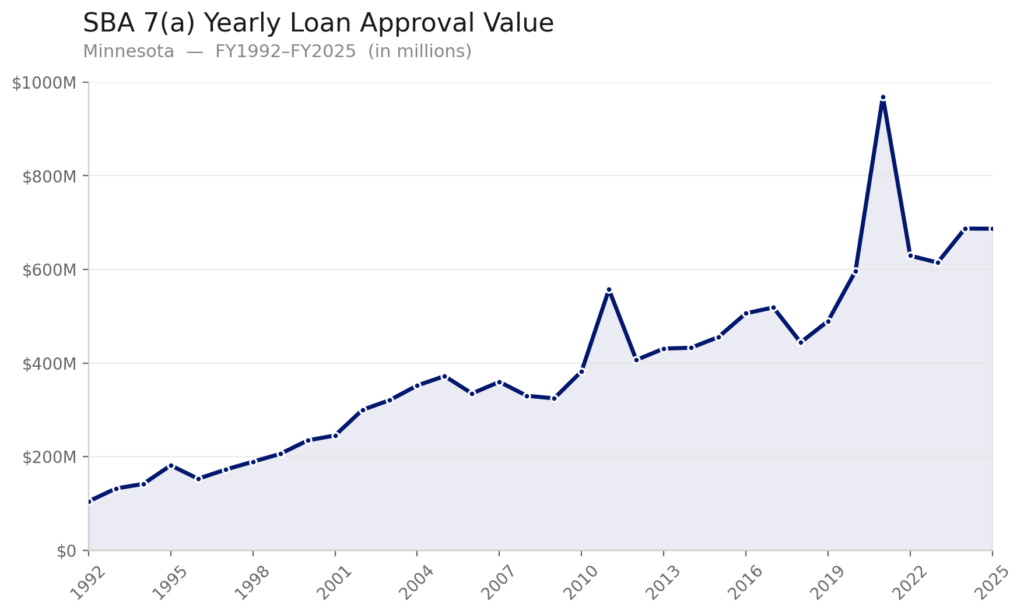
These are the year-by-year* statistics of the SBA 7(a) loan program in Minnesota from fiscal year 1992 to today, including the number of 7(a) loans approved and total approval amount.
| Fiscal Year | Loans Approved | Approval Amount |
| 1992 | 405 | $104,438,909 |
| 1993 | 473 | $132,059,729 |
| 1994 | 637 | $141,742,682 |
| 1995 | 1,599 | $181,342,236 |
| 1996 | 1,222 | $152,789,514 |
| 1997 | 1,186 | $172,279,255 |
| 1998 | 1,193 | $189,165,980 |
| 1999 | 1,150 | $205,928,611 |
| 2000 | 1,141 | $234,623,624 |
| 2001 | 1,161 | $245,299,383 |
| 2002 | 1,246 | $299,922,053 |
| 2003 | 1,519 | $320,753,684 |
| 2004 | 1,811 | $351,948,056 |
| 2005 | 2,142 | $372,099,809 |
| 2006 | 2,182 | $334,920,718 |
| 2007 | 2,226 | $359,764,543 |
| 2008 | 1,778 | $330,018,730 |
| 2009 | 1,536 | $324,469,936 |
| 2010 | 1,551 | $382,136,700 |
| 2011 | 1,676 | $557,058,700 |
| 2012 | 1,370 | $406,484,500 |
| 2013 | 1,384 | $430,740,000 |
| 2014 | 1,506 | $432,621,700 |
| 2015 | 1,668 | $455,532,400 |
| 2016 | 1,674 | $506,033,900 |
| 2017 | 1,632 | $518,680,300 |
| 2018 | 1,504 | $443,924,700 |
| 2019 | 1,445 | $489,635,700 |
| 2020 | 1,571 | $596,032,300 |
| 2021 | 1,953 | $968,903,600 |
| 2022 | 1,489 | $629,263,400 |
| 2023 | 1,563 | $614,465,600 |
| 2024 | 1,616 | $687,160,200 |
| 2025 | 1,584 | $686,781,100 |
Source: SBA, 7(a) & 504 FOIA
*U.S. Federal Government fiscal years
SBA 7(a) Loans On the Rise
The SBA 7(a) loan program has seen good growth in Minnesota, with the annual total value of approved loans up almost 7x since 1992.
About 7aSavvy
7aSavvy is an SBA 7(a) loan broker for Minnesota entrepreneurs.
We are not a lender and we are not the SBA, and we do not fund loans or set rates. What we do is sit on the borrower’s side of the table and help you find the lender most likely to fund your specific deal, which saves you from applying to one bank at a time and hoping you picked the right one.
There is no cost to the borrower for getting matched.
How 7aSavvy Works
The process is meant to be straightforward, and it usually runs in four steps.
Step 1. Share the deal. You tell us the basics of what you are trying to do, including the use of proceeds, the rough loan amount, and a little about the business and your background.
Step 2. We review it. We look at the request the way a lender would, and we figure out which lenders are a realistic fit based on industry, deal size, and how they underwrite.
Step 3. We match you. We point your request toward the lender or lenders most likely to fund it, so your application lands with someone who actually wants deals like yours.
Step 4. We help it move. We stay involved as the request works its way toward closing, and we help keep things moving when questions come up.
Case Study
Dan ran a heating and cooling company in the Twin Cities suburbs and had a chance to buy out a competitor whose owner was retiring. The deal was around $1.9 million, and it combined the acquisition with a small amount of working capital to carry the two crews through the first busy season under one roof. Dan had already been turned down by his own bank, which did not have experience with acquisition lending in the trades, and he was close to walking away from the deal. We looked at his numbers and matched him with a lender that regularly funds home services acquisitions and was comfortable with the industry. The request was approved and funded in 74 days, and Dan kept both crews working through the winter. This example is anonymized, and it is shown to illustrate a typical situation rather than a guaranteed result.