Fiscal Year 2025
680
Loans Approved
$1.1B
Total Value
An SBA 7(a) loan for gas stations can give qualified borrowers a way to pay for the larger purchases that fuel retail usually involves, whether that means buying an existing site, building a new one, replacing tanks and dispensers, or covering the working capital that keeps a store stocked. The 7(a) program is run by the U.S. Small Business Administration, and a share of every loan is guaranteed by the government, which is one of the reasons lenders are willing to fund a business that a conventional bank often treats as too risky or specialized. The proceeds can be applied to real estate, fuel equipment, the convenience store side of the operation, a business acquisition, and debt refinancing, and in most situations those needs can be combined into one loan rather than handled through several separate agreements.
Why Gas Stations Consider SBA 7(a) Financing
Fuel retail is a capital heavy business, and the costs rarely arrive one at a time. A borrower who is buying a station may also need money for the underground storage tanks, the point of sale system inside the store, the first fuel load, and several weeks of payroll before the site is running the way it should. A conventional lender will often look at a gas station and see a special use property that is harder to resell than a plain retail building, and that view tends to lead to a larger down payment, a shorter term, or a decline. The SBA 7(a) program was built for exactly this kind of gap, because the government guarantee gives the lender more room to say yes.
The other reason owners look at the 7(a) program is the advantageous terms. It requires a lower down payment and has a repayment schedule that is longer than what conventional lenders offer, all at competitive interest rates. It is not the fastest money available, and the paperwork is heavier than other loan options, but for a purchase or a build out the terms are hard to match.
Uses of SBA 7(a) Loans for Gas Stations
Gas Station Acquisition
Buying an existing station is the most common reason borrowers apply. A 7(a) loan can fund the purchase of the real estate, the fuel equipment, the convenience store inventory, and the goodwill of the business, whether the site is branded under a major fuel supplier or runs as an unbranded independent. Because a gas station carries environmental risk, an acquisition loan almost always includes an environmental review of the property before closing, and the cost of that review and other third-party reports, such as business valuations, are folded into the deal.
Site Buildout and Station Improvements
The program can pay for the work that keeps a site competitive, such as a new canopy, resurfacing the forecourt, adding or upgrading fuel dispensers, remodeling the store, or building out a quick service restaurant, a car wash, or a coffee area to bring in more inside sales. Improvements that are needed to meet accessibility rules or local code can be rolled in as well, so an owner does not have to fund those separately.
Fuel Equipment and Technology
Underground storage tanks, dispensers, tank monitoring and leak detection systems, canopy lighting, price signs, and the store point of sale system can all be financed. This category also covers the equipment that owners are being pushed toward now, including chip enabled payment at the pump and, in a growing number of markets, electric vehicle charging stalls that sit alongside the fuel islands.
Working Capital for Gas Stations
Fuel retail ties up a lot of cash in inventory, and a fuel load has to be paid for well before it sells through. A 7(a) loan can provide working capital for the first inventory purchases, payroll, utilities, and the card processing float that builds up when customers pay at the pump. Seasonal swings in traffic are common at many sites, and a working capital cushion helps an owner get through the slower stretches without straining the business.
Business Debt Refinance
Owners who took on a seller note, a short term equipment loan, or high rate financing during a purchase can often refinance that debt into a 7(a) loan with a longer term, provided the existing debt meets the program rules. Moving from a two or three year payback or higher rate to a much longer schedule or more reasonable rate lowers the monthly payment and frees up cash that the business can put back into operations.
Real Estate Purchase or Refinance
A 7(a) loan can also be used to purchase the land a station sits on or refinance the mortgage that is already on it. Real estate is the loan use that qualifies for the longest repayment term, which is why many gas station deals are structured with the property as the anchor and the shorter lived items financed alongside it.
Multiple Purpose Gas Station Loans
One of the main advantages of the 7(a) program for fuel retail is that a single loan can carry several purposes at once. A borrower buying a station can combine the real estate, the goodwill, the tanks and dispensers, the store fixtures, the opening inventory, and a working capital reserve into one loan with one payment, rather than stacking a mortgage, an equipment lease, and a line of credit on top of each other.
SBA 7(a) Loans for Gas Stations: Terms and Eligibility
How Much Can Gas Station Owners Borrow With an SBA 7(a) Loan?
The 7(a) program has a maximum loan amount of $5 million, and that ceiling applies to the total SBA financing a borrower has outstanding, not to each loan on its own. For many single site purchases the loan lands well under that figure, but the cap is high enough to cover a larger site or a deal that pairs the real estate with a full equipment package. The amount a lender will actually approve depends on the cash flow of the business, the value of the property and equipment being pledged, and the experience of the buyer, so the maximum and the approved amount are often two different numbers.
SBA 7(a) Loan Repayment Terms for Gas Stations
Repayment terms are tied to what the money is used for. Real estate and construction can be financed for up to 25 years, while equipment, working capital, inventory, and goodwill are generally financed for up to 10 years. When a single loan covers more than one purpose and includes real estate, the maximum is a blended term that reflects the mix. There is no prepayment penalty for any loan with a term under 15 years. Rates on 7(a) loans are variable in most cases and are set as the prime rate plus a spread that the SBA caps, so the payment can move over the life of the loan as prime changes.
SBA 7(a) Loan Qualifications for Gas Stations
To qualify, the business has to be a for profit operation based in the United States, and it has to fit within the SBA size standards for its industry code, which for fuel retail usually falls under the gas station categories in NAICS 447. Lenders look closely at the buyer’s experience, and an applicant who has not run a fuel site before will usually need to show a credible plan to hire or retain experienced management. Reasonable personal credit, a down payment in the normal range, and enough projected cash flow to cover the payment with room to spare are all part of the review. Anyone who owns 20% or more of the business is required to guarantee the loan personally, and because these are gas stations, the lender will also require proof that the tanks and other equipment meet current environmental and compliance rules before the loan can close.
SBA 7(a) Loans for Gas Stations: Pros and Cons
The strongest argument for a 7(a) loan is flexibility paired with a lower down payment and longer payback. One loan can fund the property, the fuel equipment, the store, the inventory, and a working capital reserve, the down payment is lower than a conventional lender would ask for on a special use property, which makes a loan much more attainable, and the longer term gives long-term security in the loan.
The tradeoffs are real and worth planning around. A 7(a) application asks for more documentation than a quick working capital product. The rate is usually variable, so the payment can rise if prime goes up, and every major owner has to sign a personal guarantee, which puts personal assets behind the loan. There is also a lien on the business assets and often on the real estate, so the collateral is committed for the life of the loan.
For most entrepreneurs the decision comes down to timing and purpose. If the goal is to buy, build, or refinance and they can wait out a closing that may run up to three months, the 7(a) terms are hard to beat. If the need is fast, short term cash, a different product is usually a better fit even though it costs more.
SBA 7(a) Loans vs. Other Financing Options
SBA 7(a) vs. Conventional Gas Station Loans
A conventional gas station loan comes straight from a bank without an SBA guarantee behind it, and that difference shapes almost everything about the deal. Because the bank is carrying all of the risk on a property that is harder than average to resell, it tends to ask for a larger down payment, often in the range of 25% to 35%, and it usually offers a shorter term than the 7(a) program does. For a borrower with a lot of cash and a strong track record in fuel retail, that can still be the cheaper route, since a conventional loan avoids the SBA guarantee fee, can come with a lower rate, and can sometimes close faster.
The 7(a) program tends to win when the borrower does not have a very large down payment, when the deal needs to fold several purposes into one loan, or when the property’s special use status is making conventional lenders nervous. The guarantee gives the lender cover to approve a borrower it might otherwise pass on, and the down payment on a 7(a) loan is generally lower, especially considering the special use adjustment. The cost of that access is the guarantee fee and the heavier paperwork, so the choice usually comes down to the strength of the business, how much equity the borrower has, and how quickly they need the money.
Both routes require the same environmental due diligence, so that step is not a point of difference. Where they part ways is on structure and reach: a conventional loan is often simpler and cheaper for a well capitalized buyer, while the 7(a) loan opens the door for buyers and deals that would not clear a conventional credit box.
SBA 7(a) vs. SBA 504 Loans for Gas Stations
The 504 program is the other main SBA option, and it is built specifically for real estate and other fixed assets. A 504 loan is put together in two pieces, a bank loan for part of the cost and a loan through a Certified Development Company for another part, with the owner putting in the rest as a down payment. For a larger deal that is mostly real estate and long-lived equipment, the 504 program can offer a lower fixed rate on the CDC portion, which gives an owner a lower payment and more certainty than the variable rate that comes with most 7(a) loans.
The 7(a) program is usually the better fit when the deal includes things the 504 program does not cover well, such as working capital, inventory, and the goodwill of the business. Because a gas station purchase almost always involves inventory and operating cash on top of the real estate and equipment, many buyers find that a single 7(a) loan handling everything is simpler than running a 504 structure and then arranging separate financing for the working capital piece.
On the down payment, the two programs are close for a special use property like a gas station, since both tend to ask for around 10-15%. The deciding factors are usually the size of the deal and the mix of what is being financed. A big, real estate heavy purchase where a fixed rate matters often points to 504, while a purchase that blends property, equipment, store fixtures, and working capital under one payment usually points to 7(a).
SBA 7(a) Loan Program History
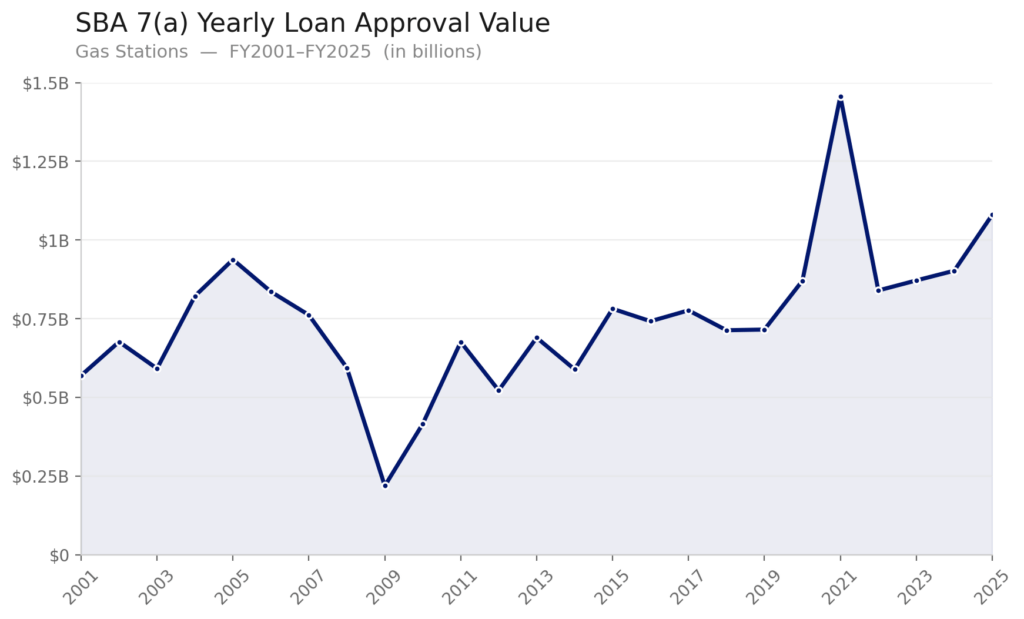
The 7(a) program traces back to the Small Business Act of 1953, the law that created the Small Business Administration and gave it the job of helping small firms get access to credit they could not always find on their own. The program works by guaranteeing a portion of loans made by private lenders, so the government does not usually fund the loan directly but instead reduces the lender’s risk enough to make the loan happen. Over the decades the program has grown into the main federal channel for small business lending, and gas stations and convenience stores have become one of the larger categories within it because fuel retail is capital heavy and often struggles to find conventional financing. The figures below show how the overall program has moved in recent years.
SBA 7(a) Gas Station Loan Statistics
These are the year-by-year* statistics of SBA 7(a) gas station loans from fiscal year 2001 to today, including the number of 7(a) loans approved and total approval amount.
| Fiscal Year | Loans Approved | Approval Amount |
| 2001 | 1,092 | $569,436,301 |
| 2002 | 1,208 | $676,453,615 |
| 2003 | 1,227 | $591,605,185 |
| 2004 | 1,657 | $822,135,354 |
| 2005 | 1,785 | $937,906,535 |
| 2006 | 1,700 | $835,916,360 |
| 2007 | 1,497 | $761,675,863 |
| 2008 | 1,002 | $594,073,689 |
| 2009 | 401 | $218,845,331 |
| 2010 | 631 | $415,696,400 |
| 2011 | 830 | $676,097,900 |
| 2012 | 641 | $522,069,100 |
| 2013 | 739 | $689,686,200 |
| 2014 | 661 | $588,857,000 |
| 2015 | 783 | $781,581,300 |
| 2016 | 684 | $741,918,600 |
| 2017 | 690 | $776,512,300 |
| 2018 | 598 | $713,341,300 |
| 2019 | 628 | $715,446,200 |
| 2020 | 613 | $870,567,000 |
| 2021 | 983 | $1,456,468,500 |
| 2022 | 533 | $839,732,200 |
| 2023 | 517 | $871,516,300 |
| 2024 | 580 | $902,484,700 |
| 2025 | 680 | $1,080,065,400 |
Source: SBA, 7(a) & 504 FOIA
*U.S. Federal Government fiscal years
SBA 7(a) Gas Station Loans On the Rise
The SBA 7(a) loan program has seen solid growth in the gas station industry. It saw a downslide in the mid to late 2000’s, but has recovered and then some, with the annual total value of approved loans up almost 5x from the low point of 2009.