Fiscal Year 2025
748
Loans Approved
$561M
Total Value
An SBA 7(a) loan for a liquor store can help a qualified buyer or owner purchase a package store, buy the building it operates in, stock the shelves, or remodel the floor. The SBA 7(a) program is the U.S. Small Business Administration’s primary business loan program, and proceeds may be used for real estate, leasehold improvements, machinery and equipment, inventory, working capital, business acquisition, and eligible debt refinance.
The loan is issued by an SBA-approved lender, not by the SBA itself. The SBA provides a guaranty to the lender, which reduces the lender’s exposure and can make financing reachable for borrowers who do not fit a conventional credit box. For most 7(a) loans the guaranty is up to 85% on loans of $150,000 or less and up to 75% on loans above $150,000.
That guaranty carries more weight in beverage retail than it does in most industries, because of what a buyer is actually paying for. A large share of the purchase price in these deals is inventory sitting on a shelf and a license issued by a state agency, and a conventional lender is rarely comfortable advancing against either one. 7aSavvy helps liquor store borrowers get connected with SBA lenders that already lend to this category, so a license-gated closing and a heavy inventory position are handled as normal parts of the file rather than as reasons to pass.
Why Liquor Store Borrowers Consider SBA 7(a) Financing
Owners weigh SBA 7(a) loans for liquor stores for a plain reason: the economics of a package store make conventional financing awkward. Blended gross margins in beverage retail commonly run in the low-to-mid twenties as a percentage of sales, with beer near the bottom at roughly 18% to 22%, spirits around 22% to 28%, and wine the strongest at roughly 28% to 38%. Net operating margin before owner compensation typically lands somewhere between 5% and 12%. Those are workable numbers for an owner-operator and thin numbers for a bank that wants a large equity cushion. SBA financing for liquor stores exists for exactly that gap.
The second pressure is the shape of the balance sheet. Inventory frequently represents a substantial portion of a store’s total asking price, and a mid-size store doing $1.5 million in sales commonly carries $150,000 to $300,000 of product at cost. A buyer who empties personal reserves to fund a down payment has nothing left to buy the next truckload. An SBA 7(a) liquor store loan can carry the purchase, the opening inventory position, and the working capital behind it in one request instead of three.
Then there is the license. Depending on the state, a retail beverage license can be routine paperwork or the single most valuable asset in the transaction. Quota states are where that shows up most sharply. Recent Indiana permit transfers have ranged from about $10,000 in a small town to roughly $1,000,000 in a community where permits are scarce, with several in the $350,000 to $625,000 range in between. A buyer paying six figures for a permit before a single bottle is sold needs a lender and loan structure that recognize what is being bought.
Uses of SBA 7(a) Loans for Liquor Stores
SBA 7(a) loans for liquor stores can cover nearly every line item involved in buying, opening, expanding, or modernizing a store. Because the program permits real estate, construction, equipment, furniture and fixtures, inventory, working capital, eligible debt refinance, and changes of ownership, one facility can carry a project that would otherwise be split across a business lender, an inventory line, and a commercial mortgage. These are the uses that come up most often.
Liquor Store Acquisition
Buying an existing store is the most common reason entrepreneurs look at SBA liquor store financing. The price usually breaks into the goodwill and customer base, the salable inventory, the coolers and fixtures, the point-of-sale system, and in many states the license or permit itself. Sold-transaction benchmarks put the median liquor store sale price around $420,000 against median revenue near $994,000 and median owner earnings near $149,000, at an average earnings multiple of about 3.4. Those are medians, and many of the deals that need real financing sit well above them. Independent stores commonly trade between 2.5 and 4 times seller’s discretionary earnings, with inventory added at cost on top of that number.
The 7(a) program also covers partial changes of ownership, though the structure, the equity behind it, and any continuing seller involvement all get close attention. Ownership in this industry often transfers inside a family or between partners rather than on the open market. A son or daughter buying out a parent or one partner buying out another after a decade are common to see.
Store Buildout and Remodels
Beverage retail is a merchandising business, and the floor decides a lot of it. An SBA 7(a) loan for liquor stores may be used to acquire, refinance, or improve real property and buildings, which covers walk-in cooler expansion, refrigerated door lines, shelving and gondola replacement, a tasting or growler station, lighting, security and camera systems, flooring, checkout redesign, exterior signage, and parking work. Adding cooler doors is usually the highest-return project in the category because cold single-serve beer is what pulls impulse trips.
Coolers, POS, and Store Equipment
Equipment in a package store is unglamorous and expensive to replace all at once. Walk-in compressors, reach-in cases, ice machines, shelving, security systems, age-verification scanners, and a point-of-sale platform that actually reports by category all have real cost and real service lives. SBA 7(a) proceeds may be used to purchase and install machinery and equipment along with furniture, fixtures, and supplies, so a known replacement schedule can be financed inside the deal rather than arriving as a string of equipment leases in year two.
Inventory and Working Capital
This is where liquor store financing differs most from other retail categories. Much of the store’s value is on the shelf, and the shelf has to be refilled before the next weekend. A store doing $1.5 million a year at a 30% gross margin while carrying $350,000 of average inventory is turning roughly three times a year, or about 122 days of product on hand. That’s a lot of cash, and it is the reason working capital belongs in the original loan request. SBA 7(a) loans may be used for both short-term and long-term working capital as well as for inventory purchases.
Business Debt Refinance
Plenty of store owners looking at SBA 7(a) loans for liquor stores are carrying a short-term note from a cooler replacement, a drawn line of credit from a slow winter, or seller paper from an earlier partial buy-in. An SBA 7(a) loan may be used to refinance existing business debt where the refinance meets SBA and lender requirements, which can move a three-year equipment payment onto a longer amortization and hand real monthly cash flow back to a store that is otherwise healthy.
Real Estate Purchase or Refinance
Many owners use SBA financing for liquor stores to buy or refinance the owner-occupied building the store sits in. Ownership protects a location that customers have driven past for twenty years, and it removes the risk of a landlord repricing a lease on a space fitted with walk-in coolers and a license tied to that exact address. Owning the property also changes how the deal underwrites, which is covered further down this page.
Multiple-Purpose Liquor Store Loans
Real transactions rarely need just one thing. A buyer taking over a store may also want to add four cooler doors, replace the point-of-sale system, buy the building from the seller’s family trust, and keep cash on hand for the first inventory cycle. A 7(a) loan can carry those purposes together, with the repayment term set according to the proportions of the proceeds.
SBA 7(a) Loans for Liquor Stores: Terms and Eligibility
How Much Can Liquor Store Owners Borrow With an SBA 7(a) Loan?
The standard maximum for most SBA 7(a) loans is $5 million. What any individual borrower can actually support comes down to the store’s cash flow, the equity going in, the collateral behind the request, and the buyer’s own record.
Size is worth thinking about honestly here. The median package store sale is a modest number, and a small store bought without its building often does not require much financing at all. The deals that truly need an experienced liquor store lender are the larger ones: a multi-store operator adding a second or third location, a high-volume store in a strong trade area, a purchase that includes the real estate, or a transaction in a quota state where the permit alone carries six figures of value. A liquor store SBA loan of $350,000 or more is where lender fit starts to matter, and it is the range 7aSavvy is built for.
Total capital need is also larger than the headline price in this category. Inventory is often quoted separately from the asking price, and it is common to see a store advertised at one number with $200,000 or $300,000 of product excluded from it. Budget the loan request against the full amount required to open the doors on day one, not against the listing.
SBA 7(a) Loan Repayment Terms for Liquor Stores
Repayment terms follow the use of proceeds, and this is an area where the rules recently changed. As before, 7(a) loans for business acquisition, working capital, equipment, and inventory come with a term of up to 10 years, while 7(a) loans for real estate purchase, construction, and renovations come with a term up to 25 years. Under SOP 50 10 8.1, effective October 1, 2026, loans with both uses always come with a blended term. The blend is based on the proportions of the loan proceeds. For example, if a loan involves a real estate purchase and business acquisition, and the real estate value makes up 80% of the value of the loan, the term will be much closer to 25 years. If the business acquisition value make up 80%, the term will be much closer to 10 years. As always, the terms are fully amortized, meaning no balloon payment at the end of the term.
Rates on 7(a) loans usually float against a base rate plus a lender spread rather than sitting at a fixed number. A payment modeled at application is not necessarily the payment carried in year seven, and a store budget should be built with that in mind. Anyone quoting a fixed rate on an SBA 7(a) liquor store loan before a lender has been selected is guessing.
SBA 7(a) Loan Qualifications for Liquor Stores
The 7(a) program is built for eligible small businesses. In general the business must operate for profit, be located in the United States, meet SBA size standards, show a need for the credit, and put the proceeds toward a sound business purpose. Beyond that, a lender reviewing SBA loans for liquor stores will work through:
- The buyer’s retail or management experience, including any prior beverage or convenience operating history
- Personal credit and a complete personal financial statement
- Business and personal tax returns plus interim financial statements
- Point-of-sale reports broken out by category, ideally three years of them
- Bank deposits reconciled against reported sales
- Gross margin by category and how it has moved over time
- Inventory at cost, its age, and how fast it turns
- Lottery, tobacco, and any food or deli revenue reported separately from beverage sales
- The license or permit, its class, its transferability, and the compliance record behind it
- Rent as a percentage of sales, or the property details and an appraisal where real estate is involved
- The purchase agreement and how inventory is treated inside it
- Working capital needed after closing
- Debt service coverage and overall repayment ability
Two items under SOP 50 10 8.1 deserve planning time. The minimum debt service coverage ratio on an initial acquisition is 1.25, measured using EBITDA, and post-closing projections may no longer be used to satisfy it. Purchases of $3 million or more, excluding owner-occupied real estate, require an independent quality of earnings report commissioned by the lender.
The cash question deserves its own line on any liquor store SBA loan. This is an industry where some sellers have historically run revenue that never reached a tax return, and every experienced lender knows it. Underwriting will be built on what the returns, the deposits, and the point-of-sale data agree on. A seller who wants credit for unreported sales will not get it, and a buyer who builds an offer around that number is building on nothing. Clean reporting for the three years before a sale is the single most valuable thing a selling owner can do for their own price.
Important note: Meeting SBA eligibility requirements does not guarantee approval. A liquor store owner can satisfy every program rule and still need to clear an individual lender’s underwriting standards.
SBA 7(a) Loans for Liquor Stores: Pros and Cons
The strongest argument for an SBA 7(a) loan for liquor stores is that it finances the whole store. Goodwill, inventory, fixtures, the license value where state law permits it, the building, and the working capital behind all of it can sit inside one facility with one closing. There is no conventional product that does that for a beverage retailer, and assembling the same money from three lenders means three sets of terms and three sets of conditions that have to close on the same day.
The equity requirement is the second argument. Ten percent is the SBA minimum on a change of ownership, against the 20% to 30% a conventional lender commonly asks for on a retail purchase where much of the value is inventory and intangible. For a buyer who has spent years managing someone else’s store, that difference is frequently the entire decision.
The trade-offs are real. SBA liquor store loans carry a guaranty fee on most larger loans, and the documentation is heavier than a conventional file: a full credit memo, an independent business valuation, a site visit, and an appraisal plus environmental review where real estate is involved. Rates float, so a rising rate environment raises the payment. Personal guaranties are standard for any owner at 20% or more, and collateral generally extends to available business and personal assets. Timelines run longer than a conventional loan, and in this category the license transfer often runs longer than the loan does. A well-capitalized multi-store operator buying a small store outright may still do better paying cash. For a first-time buyer, SBA 7(a) liquor store financing is usually the route that actually closes.
SBA 7(a) Loans vs. Other Liquor Store Financing Options
SBA 7(a) vs. Conventional Liquor Store Loans
Both can fund a store, and both draw on lenders who understand retail, but they do not ask the same questions.
A conventional loan generally wants more equity, commonly 20% to 30%, and it wants the borrower’s balance sheet and operating history to carry the file. Some banks will go further for an established multi-store operator with property and a long deposit relationship. When an owner qualifies that way, conventional financing can close faster, skip the SBA guaranty fee, and avoid some documentation.
The 7(a) program is what opens the door when the file is not that clean. It is more forgiving of a first-time buyer, more forgiving of a business whose value is concentrated in inventory and a license, and more forgiving of a store whose reported earnings look thin next to its revenue. Under the program, the SBA can guarantee up to 85% of loans of $150,000 or less and up to 75% above $150,000, with a standard maximum of $5 million. That guaranty is what allows a lender to lend to a borrower it would struggle to fund normally.
The comparison usually comes down to who the borrower is. An experienced operator with cash and property should price both. A manager buying her first store, a buyer competing for a store with the building attached, or an owner adding a second location with a short history will generally find that an SBA loan for a liquor store is the option that produces a commitment letter.
SBA 7(a) vs. SBA 504 Loans for Liquor Stores
Both are SBA-backed, and both show up in this industry, but they are built for different jobs.
The 504 program funds major fixed assets: land, buildings, ground-up construction, and long-life machinery, structured as a bank loan alongside a Certified Development Company debenture. It cannot be used for working capital, inventory, or goodwill. For a package store, that restriction is decisive, because inventory and goodwill are usually much of what is being bought.
The 7(a) program covers the same real estate and equipment plus changes of ownership, inventory, working capital, and eligible debt refinance, all in one facility. The 504 program can support a larger total project, because the CDC debenture sits alongside a bank first mortgage that the program does not cap, while the 7(a) maximum is $5 million in total. The standard maximum 504 loan amount is $11.25 million.
In practice the split is clean. An owner who already has the business and is purchasing or building a new freestanding store on land she owns, or who is just renovating their store or upgrading equipment, often pencils better under 504. A buyer purchasing an existing store, with or without the building, is almost always looking at SBA 7(a) loans for liquor stores, because that is where the inventory and the working capital can live. Plenty of operators use both programs over a career.
Case Study: Liquor Store Acquisition
Marcus had managed a high-volume package store in a suburban area for nine years when the owner, then in his seventies, told him he wanted out within a year. The store did $2.4 million in annual sales, held a Class A off-premise license, and operated out of a 6,200 square foot building the owner had bought in 1998. He owned both the business and the property and preferred selling to Marcus over listing it, provided the price held up and the closing did not drag.
The total project cost was $2,350,000. The business price came to roughly 3.3 times seller’s discretionary earnings, inside the normal range for an independent store and supported by the independent valuation the lender ordered. Marcus injected $235,000, or 10%, and financed $2,115,000.
The liquor store acquisition financing came together like this:
- Business purchase, covering goodwill, fixtures, coolers, and the point-of-sale system: $985,000
- The building and land: $840,000
- Inventory at cost, counted the night before closing: $315,000
- Cooler expansion, adding six doors, plus new shelving on the wine wall: $120,000
- Working capital for the first two inventory cycles: $90,000
His first two conversations were with banks that held his personal accounts. One passed on the category outright. The other offered a conventional structure at 20% down and would not include the inventory, which would have left him buying $315,000 of product with money he did not have. Through 7aSavvy he was matched with a lender that writes SBA liquor store loans as a regular part of its book and had funded package store acquisitions with real estate before.
Considering the proportions of the split between real estate and non-real-estate uses, the loan term was 14 years. The loan was priced at a floating rate over the base rate, and at the rate in effect when the file closed the payment ran about $23,400 a month. The store produced roughly $370,000 in cash flow available for debt service after normalizing the seller’s compensation to a market salary, giving a debt service coverage ratio of about 1.32, above the 1.25 minimum the current rules require.
The license transfer ran on its own calendar. The application went in the week the purchase agreement was signed, the state posted notice at the premises, and the transfer cleared in 74 days with no protest filed. The loan was ready before the license was, which is a typical order of events in this category. The SBA liquor store financing closed once the transfer went through, with a process of 81 days in total.
This is an illustrative example based on typical SBA 7(a) loan terms and a realistic liquor store acquisition. Actual terms, timelines, and outcomes vary by borrower, business, and lender.
SBA 7(a) Loan Program History
The 7(a) program has been part of small business lending for decades. It traces back to the Small Business Act of 1953, which created the U.S. Small Business Administration and established federal support for small business credit. The program takes its name from Section 7(a) of that law. Beverage retailers have borrowed under it for most of that history, from single-register neighborhood stores to large-format operations with wine departments, craft beer walls, and seven-figure valuations.
SBA 7(a) Liquor Store Loan Statistics
Beverage retail has followed the same broad direction as the program around it, and the composition of the deals has changed more than the count, with the average deal getting larger. Median sold-store revenue sits near $994,000 with median owner earnings near $149,000, while stores change hands at an average of about 3.4 times earnings and take a median of 168 days to sell. Sale prices average about 97% of asking.
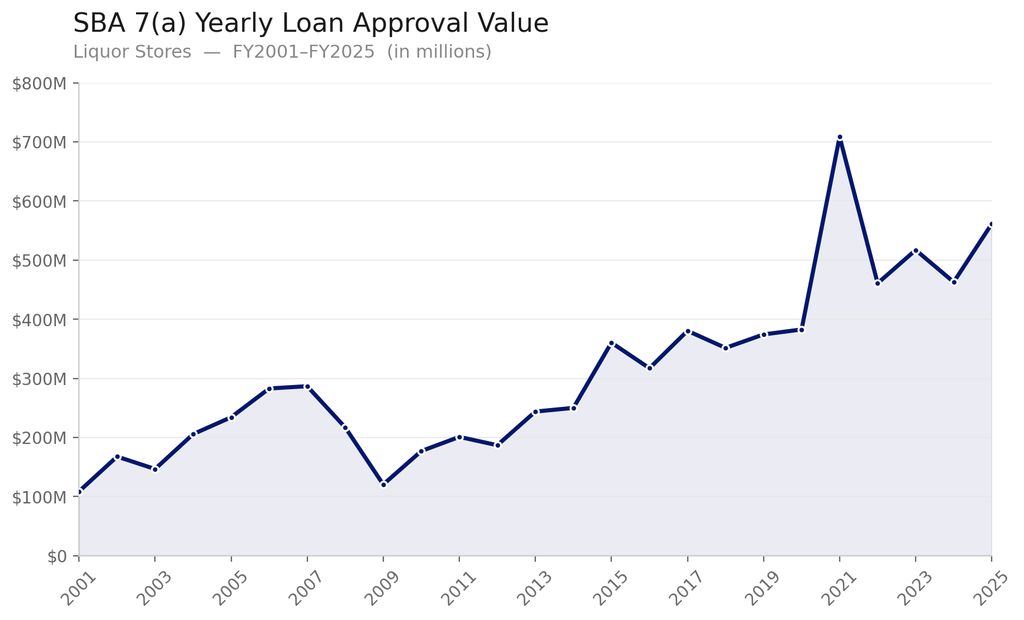
Here are the year-by-year* statistics of SBA 7(a) liquor store loans from Fiscal Year 2001 to today, including the number of 7(a) loans approved and total approval amount.
| Fiscal Year | Loans Approved | Approval Amount |
| 2001 | 484 | $108,621,349 |
| 2002 | 594 | $167,606,900 |
| 2003 | 651 | $146,561,634 |
| 2004 | 779 | $205,571,212 |
| 2005 | 907 | $234,141,550 |
| 2006 | 895 | $282,778,630 |
| 2007 | 925 | $286,677,812 |
| 2008 | 674 | $216,887,056 |
| 2009 | 406 | $120,386,500 |
| 2010 | 509 | $176,942,500 |
| 2011 | 528 | $200,895,900 |
| 2012 | 553 | $186,816,100 |
| 2013 | 532 | $243,749,800 |
| 2014 | 613 | $249,981,800 |
| 2015 | 765 | $360,340,600 |
| 2016 | 665 | $317,065,300 |
| 2017 | 747 | $380,368,100 |
| 2018 | 691 | $351,447,000 |
| 2019 | 589 | $374,220,200 |
| 2020 | 530 | $382,654,600 |
| 2021 | 800 | $708,628,400 |
| 2022 | 533 | $460,780,900 |
| 2023 | 634 | $517,100,300 |
| 2024 | 635 | $462,873,300 |
| 2025 | 748 | $561,262,300 |
Source: SBA, 7(a) & 504 FOIA
*U.S. Federal Government fiscal years
SBA 7(a) Liquor Store Loans On the Rise
The SBA 7(a) loan program has seen outstanding growth in the liquor store industry, with the annual total value of approved loans up over 5x since 2001.
Unique Things to Know for SBA Liquor Store Loans
We’ve covered all the basics, but there are still some extra things that are different about SBA 7(a) liquor store loans. These are good for a borrower to know.
Why the Building Changes a Liquor Store Deal
There is a reason experienced SBA lenders perk up when a package store comes with its real estate. Anything with property behind it underwrites differently. The collateral position improves immediately, the term extends and the payment lowers, and the location risk that hangs over every beverage retailer, a lease that can be repriced or not renewed on a space where the license is tied to the address, goes away with the deed.
It also changes the size of the request. A store bought on its own can be a modest transaction. The same store bought with its building routinely clears $1 million and lands in the range where lender selection is paramount. If you are weighing whether to buy the property now or later, run both versions before you apply, because the answer often changes which lenders will want the file and what SBA liquor store financing will cost you monthly.
Why Liquor Store Files Land Differently at Different Lenders
Most banks that originate 7(a) loans sell the guaranteed portion on the secondary market, which means the loans an institution wants to write are shaped by what it wants to hold and what it knows how to underwrite. A bank that has never looked at a package store has no internal reference for a 24% blended margin, no view on how to value a permit, and no comfort with an inventory count as a closing condition. The same application can be routine at one desk and unfamiliar at the next.
That is the work 7aSavvy does. Our founders spent more than 35 years in SBA lending at every level, from loan officer to bank founder, and we maintain over 100 lender connections and match borrowers to a Vice President or higher rather than a general inbox. We look at the store, the structure, and the buyer first, then place the loan with a lender whose appetite already fits, instead of letting a borrower find out about a lack of compatibility six weeks into an application. Our service is free to the borrower, because we are paid a referral fee by the lender only when the loan funds.
How the Inventory and the License Get Handled at Closing
Two closing mechanics separate a package store purchase from almost any other retail acquisition, and both belong in the loan request rather than in a side conversation the week of funding.
The first is the inventory count. Product is usually counted at cost the night before or the morning of closing, and the final number moves the purchase price. A store listed at one figure with product excluded can require another $200,000 or $300,000 in hand on the day. Build a dated count by category into the file early, mark the aged and slow-moving product honestly, and plan the size of the loan against the total, not the listing.
The second is the license. In most states a retail beverage license does not transfer on the deed, it transfers through a state process with its own application, its own investigation, and its own public notice period. California requires the transfer to run through escrow under Business and Professions Code Section 24074, with notice posted at the premises for 30 consecutive days. Transfers in Texas and Florida commonly clear in 60 to 90 days; California, New York, and Illinois more often run 120 to 180 days. The loan is frequently ready before the license is. Filing the transfer application the week the purchase agreement is signed, rather than after the commitment letter arrives, is the single most effective way to protect a closing date on liquor store acquisition financing.