
Fiscal Year 2025
1,230
Loans Approved
$515M
Total Value
Oregon entrepreneurs rarely struggle to find a good deal. They struggle to find the bank that will fund it. A buyer in Bend has a signed purchase agreement for a hospitality business and no idea which lender likes that industry. A machine shop in Clackamas County wants to buy the building it has rented for nine years. A Willamette Valley food producer needs equipment and working capital in the same request. Every one of those is financeable. The problem is that lenders do not read them the same way, and the first bank a borrower walks into is often the wrong one. That is the gap we fill. We are an SBA 7(a) loan broker in Oregon that reads the deal, knows which lenders fund that kind of request in this state, and makes the introduction.
An SBA 7(a) loan is made by an approved lender and partially guaranteed by the U.S. Small Business Administration. The SBA is not writing the check. Banks, credit unions, and non bank lenders provide the money, and the federal guarantee absorbs part of the lender’s downside if the loan goes bad.
That guarantee is why SBA 7(a) financing in Oregon reaches businesses a conventional credit committee would pass on. For most requests the ceiling is $5 million. The SBA guarantee generally runs to 85% on loans of $150,000 or less and to 75% above that, subject to SBA rules and the loan type.
Note: 7aSavvy is an SBA 7(a) loan broker, not a lender. The lender pays us, so our help costs you nothing. Instead of working through Oregon banks one at a time and hoping one of them says yes, you start with a short list of the lenders most likely to fund what you are asking for.
Uses of SBA 7(a) Loan Proceeds in Oregon
One of the practical strengths of Oregon SBA 7(a) loans is that a single loan can cover several needs at once. A buyer purchasing a company can fold the real estate, a working capital cushion, and the equipment replacement into one facility instead of stacking four separate debts with four different maturities.
That matters here more than people expect. Oregon’s small business base is broad and unusually spread out. The SBA’s Office of Advocacy counts roughly 410,000 small businesses in the state, about 99.4 percent of all Oregon businesses, employing around 843,000 people, a little over half the state’s workforce. Those companies are scattered from the Portland metro down the I-5 corridor through Salem, Corvallis, Eugene, and Medford, out to Bend and Hood River, and along the coast. Lender coverage is not evenly spread across that map. A bank that is active in Washington County may have almost no appetite east of the Cascades.
Sorting that out is a large part of what an SBA 7(a) loan broker in Oregon is for, and we do it before you apply. A restaurant purchase in Southeast Portland is a different lending conversation than a nursery operation in Marion County, a self storage build in Redmond, or a dental practice buy in Eugene.
Oregon SBA 7(a) loan proceeds may commonly be used for:
- Business acquisitions and partner buyouts
- Owner occupied commercial real estate purchases
- Equipment purchases
- Construction, renovation, or buildout projects
- Eligible business debt refinancing
- Working capital
- Business expansion needs
There is one boundary worth stating plainly. SBA 7(a) loans in Oregon are for active operating businesses. They are not for passive real estate investment, so a rental building your company does not primarily occupy and use will not qualify.
Buy
Buying is what most Oregon borrowers come to us for. SBA 7(a) financing in Oregon covers acquiring an existing company, purchasing a building for the business to occupy (or the building the business already occupies), or financing the equipment that keeps the doors open.
Oregon has a lot of businesses changing hands right now, and many of them are the kind banks find awkward. A retiring owner with twenty years of loyal customers and messy financials. A franchise unit in Beaverton. A body shop in Gresham where most of the value is goodwill and a technician crew rather than hard collateral. An SBA 7(a) loan in Oregon can carry that kind of deal because the guarantee lets the lender weigh cash flow and management more heavily than a conventional lender can.
Our SBA 7(a) loan brokers help Oregon buyers get the request into shape before it goes anywhere. What the seller’s numbers actually show. Where the collateral gap sits. Which lenders are comfortable with goodwill heavy acquisitions and which will price it as a problem.
Build
SBA 7(a) loans in Oregon may also fund construction, renovation, and improvement work tied to an operating business. Oregon adds a wrinkle here that most states do not have.
Oregon runs a statewide land use planning system, and every city sits inside an urban growth boundary. Commercial land inside those boundaries is finite and expensive, which pushes a lot of Oregon growth into renovating what already exists rather than building new on the edge of town. Buildouts, second floor conversions, seismic and structural upgrades on older brick buildings in Portland, Astoria, or The Dalles, and heavy tenant improvement packages are far more common here than greenfield construction.
Eligible business related projects may include:
- Leasehold improvements
- Interior buildouts
- Facility renovations
- Building additions
- Ground up construction for business use
- Improvements to owner occupied commercial property
Construction requests carry more paperwork than a working capital line. Lenders want the project budget, the contractor, the timeline, the permits, the collateral position, and a repayment story that holds up while the site is torn apart and producing nothing. Not every SBA 7(a) lender in Oregon wants construction risk, and the ones that do are specific about the size and type they will take. Sending a buildout request to a lender that avoids construction is a sure way to waste your time and energy.
Expand
Growth costs money before it makes money. An Oregon company may need funding to open a second location, hire ahead of demand, carry inventory through a slow quarter, or upgrade the equipment that is capping output.
SBA 7(a) financing in Oregon may be used to support expansion needs such as:
- Opening a new location
- Increasing operating capacity
- Hiring additional staff
- Purchasing inventory
- Adding equipment or technology
- Supporting seasonal working capital needs
- Strengthening cash flow during growth
- Expanding into new markets
Seasonality is a bigger factor in Oregon than in most states, and lenders know it. Coastal lodging, Columbia River Gorge tourism, Central Oregon recreation, agricultural processing, and nursery operations all run lopsided years. A borrower in Newport or Sisters asking for working capital in February is telling a different story than the same business asking in July, and a lender that does not understand the seasonal shape of Oregon revenue may read the business’s financials wrong.
Labor cost is the other thing that affects an Oregon file. The state runs a three tier minimum wage, and as of July 2026 that is $16.80 an hour in the Portland metro area, $15.55 in standard counties, and $14.55 in the eighteen non urban counties. For a labor heavy acquisition, which tier the business sits in changes the projected payroll line materially. It is the kind of detail that should be addressed in the request rather than discovered in underwriting.
SBA 7(a) Loan Industries in Oregon
SBA 7(a) loans in Oregon are open to most for profit businesses, which is why the program fits this state’s mix so well. This is not a one industry state. Semiconductors and electronics cluster in Washington County. Wood products and specialty manufacturing run through Douglas, Linn, and Lane counties. Wine, nursery stock, hazelnuts, and grass seed anchor the Willamette Valley. Outdoor and athletic brands sit around Portland. Health care and social assistance, accommodation and food services, and retail trade are the three largest small business employers in the state.
Common Oregon industries that use SBA 7(a) business loans include:
- Restaurants, breweries, and food service businesses
- Hotels, motels, RV parks, and lodging businesses
- Gas stations and convenience stores
- Retail stores
- Medical, dental, and veterinary practices
- Franchise businesses
- Service based companies and trades contractors
- Car washes
- Self storage facilities
- Food and beverage manufacturers
- Wood products, machine shops, and manufacturing
- Professional service firms
- Trucking, warehousing, and distribution along the I-5 corridor
Two Oregon quirks are worth knowing before you shop an SBA 7(a) loan in Oregon.
Oregon has no statewide sales tax. That shapes retail economics along the Columbia River, where shoppers from Vancouver and Clark County cross south to buy. A retail acquisition in Portland, Hood River, or Astoria may carry a cross border customer base that a lender outside the Northwest will not understand or credit.
Oregon is also a liquor control state. The Oregon Liquor and Cannabis Commission owns the distilled spirits inventory and appoints retail sales agents to run liquor stores rather than selling stores outright the way license states do. Anyone financing a package store or a bar acquisition here is buying something structurally different from the equivalent deal in California or Nevada, and the lender has to understand that structure before it will underwrite it.
Getting Oregon SBA 7(a) loans funded is less about finding any old lender and more about finding a lender who already understands the industry, the use of funds, and the repayment story underneath the request.
SBA 7(a) Loan Qualifications in Oregon
Qualifying for an SBA 7(a) loan in Oregon starts with the SBA’s basic eligibility rules. The business must be for profit, operate in the United States or its territories, meet SBA size standards for its industry, and use the money for an eligible business purpose.
SBA 7(a) financing is available to several common business structures, including:
- Sole proprietorships
- Corporations
- Partnerships
- Limited liability companies
- Other eligible for profit business entities
Clearing those rules gets you to the starting line, not the finish. After that the lender reviews the whole request: financial performance, credit profile, ownership structure, industry, collateral, use of proceeds, management experience, and the ability to repay.
The weight shifts depending on what you are asking for. An acquisition file lives or dies on the seller’s financials and the buyer’s relevant experience. A commercial real estate purchase turns on the appraisal and the location. A refinance turns on what the existing debt is doing to cash flow. A lender reviewing a Salem dental practice is looking at different things than one reviewing a Klamath Falls trucking company.
7aSavvy helps Oregon business owners start in the right place. Our SBA 7(a) loan brokering connects borrowers with lenders whose credit box actually matches the goal, the industry, and the size of the request.
SBA 7(a) Loans in Oregon: Pros and Cons
An SBA 7(a) loan in Oregon gives a business owner access to financing with a structure most conventional debt cannot match. Longer term, lower down payment, and one facility covering several purposes at once.
Because the loans are issued by approved lenders and partially guaranteed by the SBA, a lender can look at a request that does not fit the conventional box and still find a way to say yes. For an Oregon company with a strong plan, thin collateral, and a lumpy revenue history, that is often the difference. SBA 7(a) loans in Oregon reach businesses that conventional financing quietly passes over.
Key benefits may include:
- Longer repayment terms than most business financing options
- Flexible use of proceeds for eligible business purposes
- Financing for business acquisitions, expansion, equipment, working capital, eligible debt refinancing, and owner occupied commercial real estate
- Fully amortized repayment structures
- Competitive interest rates for qualified borrowers and eligible uses
- Lower upfront down payments compared with conventional financing options
The structural benefit of SBA 7(a) financing in Oregon matters as much as the access. A 25 year full amortized term on an owner occupied building means security for a growing company, instead of a five year balloon that forces a refinance right when the business is stretched.
There are real limits on Oregon SBA 7(a) loans. As of March 1, 2026, a business must be 100 percent owned by U.S. citizens or nationals to receive SBA financing. Lawful permanent residents are no longer eligible, which closes a door that had been open for decades. The $5 million ceiling is the other constraint, and it bites in the Portland metro where a commercial building plus the operating business can push a request past the limit.
SBA 7(a) Loans vs. Other Types of Loans
SBA 7(a) Loans vs Conventional Loans
A conventional business loan has no federal guarantee behind it, so the lender carries the whole risk. That tends to produce a tighter credit box: more collateral, more seasoning, more cash flow coverage, and less patience for anything unusual in the file.
An SBA 7(a) loan in Oregon works differently. An approved lender still makes the loan, but the SBA guarantee takes part of the risk off the lender’s books. That is what lets a bank fund a deal it would otherwise decline, and it usually comes with a smaller down payment and a longer, fully amortized term.
For Oregon borrowers the choice usually comes down to the shape of the business. Strong cash flow, real collateral, a simple use of funds, and a bank that already knows you? A conventional loan may be cheaper and faster. Limited collateral, less cash for a down payment, a goodwill heavy acquisition, or multiple things to fund at once? That is where SBA 7(a) loans in Oregon do work conventional debt will not.
SBA 7(a) Loans vs SBA 504 Loans
Both are SBA backed, but they are built for different jobs.
The 7(a) program is the flexible one. Business acquisitions, owner occupied commercial real estate, equipment, construction, working capital, eligible refinancing, and expansion all fit inside it, and they can be combined in a single loan.
The 504 program is built for major fixed assets. Owner occupied real estate and large equipment, financed long term at a fixed rate. If the entire project is real estate, construction, renovation, and/or equipment, a 504 loan deserves a look.
Some terms line up. Both commonly run a 10 percent down payment and a 25 year maximum term on real estate. The differences are where it gets practical. SBA 504 interest rates are usually lower and fixed, while SBA 7(a) rates are typically a bit higher and variable, priced off prime, though fixed rate 7(a) loans exist. The ceiling on Oregon SBA 7(a) loans is $5 million; the 504 ceiling is $11.25 million, which makes 504 the better tool for a large Oregon real estate project.
A 504 loan is also two loans stapled together, one from a conventional lender and one from a nonprofit Certified Development Company. That second party adds time. The 7(a) process is simpler and generally faster for the same business and the same purpose.
For an Oregon business buying a building and nothing else, either program may work. For a business buying a building and a company and needing working capital on top, 7(a) financing in Oregon is usually the cleaner structure.
SBA 7(a) Loan Program History
The SBA 7(a) loan program traces back to the Small Business Act of 1953, which created the Small Business Administration and set up a federal framework for helping small companies reach capital they could not otherwise get.
The name comes straight from the statute. Section 7(a) of that Act authorizes the program, and it has been the SBA’s flagship business lending program ever since.
For Oregon business owners, the length of that record is the point. Seventy plus years of lenders funding restaurants, clinics, contractors, manufacturers, and retailers that a conventional credit committee would have turned away is not a pilot program. It is a well worn path, and the SBA 7(a) lenders in Oregon who work it every week know exactly where the potholes are.
Oregon SBA 7(a) Loan Program Statistics
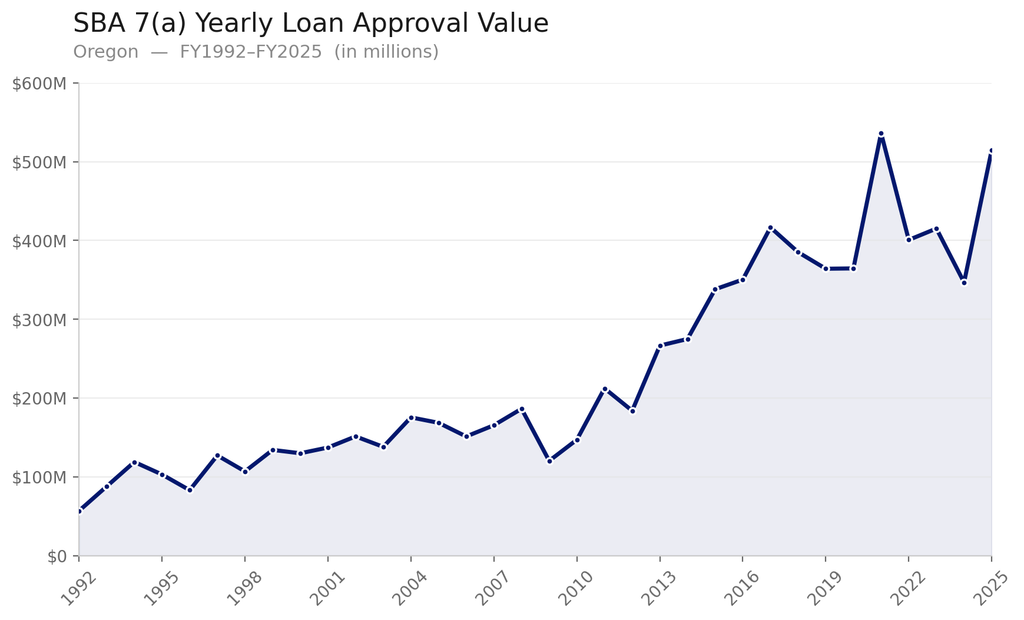
Oregon SBA 7(a) loans have grown substantially in annual approval volume since the early 1990s, both in the number of loans and in total dollars. Average loan sizes have climbed alongside it, driven largely by real estate backed acquisitions in the Portland metro and the higher price of commercial property statewide.
The practical read for a borrower is simple. More Oregon SBA 7(a) loans getting approved each year means more lenders competing for the good ones, and more variation in who wants which kind of deal. That variation is exactly why the introduction matters.
These are the year-by-year* statistics of the SBA 7(a) loan program in Oregon from Fiscal Year 1992 to today, including the number of 7(a) loans approved and total approval amount.
| Fiscal Year | Loans Approved | Approval Amount |
| 1992 | 253 | $56,888,168 |
| 1993 | 370 | $87,917,984 |
| 1994 | 503 | $118,920,640 |
| 1995 | 568 | $103,042,732 |
| 1996 | 408 | $83,113,669 |
| 1997 | 497 | $127,238,649 |
| 1998 | 442 | $106,915,790 |
| 1999 | 473 | $134,221,285 |
| 2000 | 492 | $129,954,650 |
| 2001 | 512 | $137,241,833 |
| 2002 | 601 | $151,337,536 |
| 2003 | 810 | $138,086,800 |
| 2004 | 906 | $175,490,145 |
| 2005 | 967 | $168,601,300 |
| 2006 | 1,108 | $151,281,800 |
| 2007 | 1,429 | $165,520,557 |
| 2008 | 1,007 | $186,400,490 |
| 2009 | 626 | $120,340,700 |
| 2010 | 652 | $147,164,400 |
| 2011 | 692 | $212,365,400 |
| 2012 | 650 | $183,936,300 |
| 2013 | 678 | $266,576,500 |
| 2014 | 701 | $274,974,800 |
| 2015 | 934 | $338,079,500 |
| 2016 | 895 | $350,385,600 |
| 2017 | 855 | $416,542,100 |
| 2018 | 895 | $385,115,100 |
| 2019 | 897 | $364,112,100 |
| 2020 | 782 | $364,541,500 |
| 2021 | 786 | $536,232,500 |
| 2022 | 759 | $400,690,200 |
| 2023 | 763 | $415,107,300 |
| 2024 | 1,055 | $346,810,300 |
| 2025 | 1,230 | $514,883,400 |
Source: SBA, 7(a) & 504 FOIA
*U.S. Federal Government fiscal years
SBA 7(a) Loans On the Rise
The SBA 7(a) loan program has seen extensive growth in Oregon, with the annual total value of approved loans up over 9x since 1992.
About 7aSavvy
7aSavvy is an SBA 7(a) loan broker in Oregon, a lender matching service for business owners and acquisition borrowers across the state. We are not a lender and we are not the SBA. We do not approve loans, set rates, or hold the paper.
What we do is narrower and, for most borrowers, more useful. We read your deal, we know which lenders fund that kind of request in Oregon, and we put you in front of the right one. The lender pays us when the loan funds, so the service costs you nothing.
Oregon is not a side market for us. The West Coast is our home footprint, and we work SBA 7(a) loans in Oregon alongside California and Washington every week. We built this business around larger requests, roughly $500,000 to $5 million, which is a range most online lenders skip.
Our team has decades of SBA loan experience, led by our founder and CEO, Brett Smith. He has worked on over $1 billion of SBA loans and has 15+ years of experience as both a lender and broker, giving him unparalleled experience and a unique perspective on every loan. We use that experience to put each borrower in front of the lender most likely to fund their deal.
How 7aSavvy Works
Step 1: You tell us about the deal. Use our Get Connected form to share the basics: loan purpose, rough size, industry, and where in Oregon the business sits. It takes minutes.
Step 2: We underwrite it internally first. Before your file goes anywhere, we look at the use of proceeds, the collateral position, the seller’s numbers if it is an acquisition, and the two or three things a credit officer will pick at. You should know what those are before a lender does.
Step 3: We introduce you to a decision maker, not a queue. Our lender contacts are Vice President level or higher, and we go to the SBA 7(a) lenders in Oregon already funding your type of request rather than dropping your application into a general intake pile.
Step 4: We stay on it until it closes. If the first lender stalls or passes, we take the deal to another one. We are paid when your loan funds, which means our incentive and yours point the same direction the whole way through.
Case Study
Here is the kind of Oregon deal that lands on our desk, with the details changed.
A couple had run a 22 room motel on the coast for eleven years and leased the property the whole time. The owner decided to sell the real estate. Buying it plus replacing the roof and the HVAC came to about $2.6 million, and they had 10 percent to put down.
They started at their own bank, where they had banked for a decade. Everyone was friendly. But the bank does very little lodging real estate, and coastal lodging with a seasonal revenue curve is not a file its credit committee enjoys. Four weeks in, it quietly died.
That is the situation an SBA 7(a) loan broker in Oregon is built for. The deal was not weak. It was in front of the wrong lender. Routed instead to a lender that funds hospitality real estate and reads a seasonal Oregon coast operator’s financials without flinching, the same request got underwritten on its merits instead of on unfamiliarity.