Fiscal Year 2025
337
Loans Approved
$228M
Total Value
An SBA 7(a) loan can help qualified borrowers finance the parts of a pharmacy deal that other lenders tend to break apart. The SBA 7(a) program is the U.S. Small Business Administration’s primary business loan program, and funds can be used for a wide range of eligible purposes, including real estate, equipment, working capital, inventory, business acquisition, debt refinancing, and ownership changes.
The loan itself is issued by an SBA-approved lender, not directly by the SBA. The SBA provides a guaranty to the lender, which can reduce lender risk and make financing more accessible for qualified borrowers. For most 7(a) loans, the SBA guaranty is up to 85% for loans of $150,000 or less and up to 75% for loans above $150,000.
7aSavvy helps pharmacy borrowers get connected with SBA 7(a) lenders that fit the deal. Our lender-matching process is built for owners who would rather not explain prescription file valuation, point-of-sale DIR adjustments, and PBM credentialing timelines to five different loan officers before finding one who has actually funded a pharmacy.
Why Pharmacy Borrowers Consider SBA 7(a) Financing
A pharmacy purchase is rarely one clean transaction. The buyer is acquiring a book of prescription files, a shelf of drug inventory that has to be physically counted and priced at wholesale acquisition cost before closing, fixtures and dispensing automation, a lease or a building, and a set of licenses and payer enrollments that do not travel with the keys. Financing that with separate instruments, meaning one loan for the business, a line of credit for the inventory, and a lease for the equipment, usually means separate underwriting, separate collateral positions, and separate payments starting on separate dates.
That is one reason many pharmacy entrepreneurs look at SBA loans. The program can be a fit when the borrower needs capital for more than one purpose at once, such as buying an independent pharmacy, funding the opening inventory, adding pouch packaging or robotic dispensing, refinancing eligible business debt, or covering operating costs while payer enrollments are reissued under new ownership.
A conventional bank loan may still be the right choice for an established pharmacy with a strong balance sheet. But the category itself has gotten harder to underwrite from the outside. The 2025 NCPA Digest reported that 2024 brought a ten year high in the cost of goods, a ten year high in average annual sales, and a ten year low in gross profits, which is a combination that makes some conventional lenders cautious even when the pharmacy in front of them is healthy. When the request bundles acquisition, inventory, equipment, and operating capital together, an SBA 7(a) pharmacy loan may offer a more practical path for qualified borrowers.
Uses of SBA 7(a) Pharmacy Loans
An SBA 7(a) loan can be used for most of the major costs involved in starting, buying, expanding, or modernizing a retail pharmacy. Because the program allows funds to be used for real estate, working capital, inventory, equipment, debt refinance, furniture, fixtures, supplies, and ownership changes, it can be a flexible option for pharmacy financing.
Pharmacy Acquisition
Buying an existing pharmacy is the most common reason borrowers consider SBA 7(a) financing. SBA 7(a) financing may be used for complete or partial changes of ownership, including a partner buyout or a staged transfer to a staff pharmacist who is buying in. The purchase price is usually built around the prescription files, because a stable base of maintenance patients is what produces predictable refill revenue month after month. Independent pharmacies commonly change hands at a multiple of seller’s discretionary earnings, in the range of roughly 2 to 4 times for a typical community pharmacy, with the drug inventory added on top at wholesale acquisition cost rather than retail. The deal may also include fixtures, dispensing automation, delivery vehicles, the balance of the lease, transition costs, and working capital for the first months after closing.
A pharmacy transition involves regulatory steps that most business sales do not. Pharmacy permits are generally not freely transferable, and most state boards treat an ownership change as a licensing event that requires a new application rather than a simple continuation. Requirements vary widely: California generally expects an application at least 30 days before the change, Georgia requires board approval before the change occurs, Maryland requires a new application from the new owner when a controlling interest changes, and Florida issues a new permit number so the old records close and new ones begin. The DEA generally expects notice before the sale, and the buyer files its own registration. NPI, NCPDP, Medicare and Medicaid enrollments, and PBM network agreements all have to be updated or reissued in the buyer’s name.
Store Buildout and Pharmacy Improvements
A pharmacy buildout is not a general retail buildout. The dispensary needs secured storage for controlled substances, a counseling area that gives a patient some privacy, refrigeration and monitoring for vaccines and other cold chain products, enough counter and shelving space behind the pharmacy line for staff to work without colliding, and a will-call system that can be pulled from quickly at the register. Adding a drive-thru window, a non-sterile compounding room built to USP 795 standards, or a cleanroom for sterile compounding under USP 797 moves the project firmly into construction. An SBA 7(a) loan may be used for improving real estate and buildings when the project meets program requirements.
Pharmacy Equipment and Technology
Pharmacies run on equipment that is expensive to buy and awkward to finance piecemeal. That includes robotic dispensing and pouch packaging systems, counting equipment, refrigeration and freezer units, alarm and camera systems, controlled substance safes, point of sale terminals, IVR and patient messaging, and the pharmacy management software that handles claims adjudication and DSCSA record keeping. SBA 7(a) financing may be used for purchasing and installing machinery and equipment, as well as furniture, fixtures, and supplies.
Working Capital and Inventory for Pharmacies
Working capital is a larger line item in pharmacy than in most other healthcare businesses, because the pharmacy pays its wholesaler on short terms and then waits on a payer cycle to be reimbursed for prescriptions it has already dispensed. Payroll for pharmacists and technicians, rent, insurance, delivery costs, and the cost of goods on high priced brand and specialty prescriptions all go out before the money comes back. An ownership change adds a second gap, since PBM credentialing and payer enrollment under the new owner can take weeks or months to complete. SBA 7(a) loans may be used for both short and long term working capital, and they may also be used for inventory, which matters a great deal in a business where the shelves themselves are one of the largest assets on the balance sheet.
Business Debt Refinance
Some pharmacies are carrying debt that was taken on during a tight stretch rather than a growth stretch. That can include wholesaler financing, equipment leases signed at unfavorable terms, a short term working capital product taken during a reimbursement crunch, or an older acquisition note. An SBA 7(a) loan may be used to refinance current business debt when the refinance meets SBA and lender requirements.
Real Estate Purchase or Refinance
Some owners use SBA 7(a) financing to buy or refinance owner-occupied business real estate. For a pharmacy, location is close to being the business, since foot traffic, proximity to prescribers, parking, and the ability to run a drive-thru all affect script volume. Owning the building can give the owner more control over occupancy costs and over improvements such as a compounding room or an expanded dispensary. An SBA 7(a) loan may be used for acquiring, refinancing, or improving real estate and buildings.
Multiple-Purpose Pharmacy Loans
Most pharmacy financing needs do not sit neatly in one category. An entrepreneur buying a pharmacy usually also needs to fund the inventory on the shelves, may want to add pouch packaging to serve assisted living facilities, and will need cash on hand while payer enrollments are reissued. The SBA 7(a) program allows multiple-purpose loans, which can make it practical for owners who need one financing structure covering several eligible uses instead of three lenders with three sets of conditions.
SBA 7(a) Pharmacy Loans: Terms and Eligibility
How Much Can Pharmacy Owners Borrow With an SBA 7(a) Loan?
The standard maximum loan amount for most SBA 7(a) loans is $5 million. That does not mean every pharmacy owner, buyer, or multi-store group will qualify for the full amount. The final loan size depends on the borrower, the pharmacy, the use of funds, repayment ability, lender underwriting, and SBA eligibility requirements.
For pharmacy borrowers, that ceiling leaves room for larger requests, such as buying an established independent pharmacy, funding the inventory that comes with it, purchasing owner-occupied real estate, building out a compounding room, adding automation, refinancing eligible business debt, or combining several approved uses into one loan.
A buyer acquiring a pharmacy may need capital for the purchase price, the inventory count at closing, equipment, improvements, and the transition period. An owner adding a second location may need funds for the lease buildout, opening inventory, staffing before the store is producing, and the software and hardware to run it. Because SBA 7(a) loans can support several eligible business purposes at once, they can be useful for pharmacy owners whose financing needs go well past a single equipment purchase.
SBA 7(a) Pharmacy Loan Repayment Terms
Repayment terms under the SBA 7(a) program depend on how the loan proceeds are used. For loans involving real estate, terms may extend up to 25 years. Longer repayment structures can help reduce monthly debt service compared with shorter-term financing, which matters in a business managing payroll for licensed staff, cost of goods that rises faster than reimbursement, and inventory that has to be replaced continuously.
For non-real estate pharmacy financing needs, 10 years is the maximum loan term. For multiple uses of proceeds including both real estate and non-real estate uses, the term will depend on the proportions of the different uses.
For pharmacy owners, the repayment structure deserves real attention. A loan that works on a spreadsheet still has to fit the pharmacy’s actual cash conversion cycle, where the pharmacy buys the drug, dispenses it, and waits on the payer. Lenders will usually want to see whether the business can support the debt while continuing to buy inventory, pay staff, and absorb the reimbursement swings that come with a payer mix weighted toward government programs.
SBA 7(a) Loan Qualifications for Pharmacy Borrowers
The SBA 7(a) program is designed for eligible small businesses. In general, a business must operate for profit, be located in the United States, meet SBA size standards, show a need for the requested credit, and use the loan proceeds for a sound business purpose.
For pharmacies, basic eligibility is only the starting point. Lenders also review creditworthiness, repayment ability, the requested use of funds, and the strength of the business or the transaction.
A pharmacy SBA loan request may involve review of:
- The owner’s pharmacy management and operating experience, and who will serve as pharmacist-in-charge
- Personal credit and financial profile
- Prescription volume, refill rate, and the mix of maintenance versus acute prescriptions
- Payer mix, including the share of scripts running through Medicare Part D and Medicaid
- Financial statements and tax returns, normalized for how DIR fees were recorded before and after the 2024 point-of-sale change
- Wholesaler statements, purchase history, and generic compliance
- Inventory value at wholesale acquisition cost, supported by a physical count
- Front-end retail, immunizations, DME, compounding, and long-term care revenue
- The purchase agreement, valuation basis, and prescription file transfer terms
- Licensing and payer enrollment status, including the state board application, DEA registration, and PBM credentialing timeline
- Lease terms and any non-compete or transition commitment from the seller
- Real estate details, if property is involved
- Working capital needs after closing
- Debt service coverage and repayment ability
For a pharmacy acquisition, lenders may also look at seller financials, goodwill allocated to the prescription files, patient retention expectations after the name on the door changes, and whether the buyer is prepared to run the business rather than just practice in it. For a new store or an expansion, lenders may review contractor estimates, project scope, prescriber density in the area, competition from nearby chains, and projected cash flow once the location is producing.
Important note: Meeting SBA eligibility requirements does not guarantee approval. A pharmacy owner may meet the basic program rules and still need to satisfy lender underwriting standards.
SBA 7(a) Pharmacy Loans: Pros and Cons
An SBA 7(a) loan can do more than cover a single expense. It can give qualified borrowers one financing structure for pharmacy projects that usually require several different kinds of capital at the same time.
For a pharmacy, one financing need may include the business purchase, the inventory that comes with it, equipment upgrades, store improvements, and operating capital for the transition. The SBA 7(a) program supports a wide range of eligible uses, including business purchase, real estate, equipment, inventory, working capital, eligible debt refinance, and ownership changes. That flexibility can make it a practical option for owners whose funding need covers the full scope of the project rather than one line on the closing statement.
The inventory point is worth stating plainly, because it is where pharmacy differs from most other healthcare businesses. A pharmacy that fills a meaningful volume of brand and specialty prescriptions can be carrying a significant amount of capital on the shelf at any given moment, and that inventory has to be paid for whether or not the payer has reimbursed the last cycle. A program that can fund inventory alongside the acquisition removes a financing problem that would otherwise need its own solution.
Repayment structure is another reason owners consider SBA 7(a) financing. For loans involving real estate, terms may extend up to 25 years, which can spread payments over a longer period than most other loan options. SBA 7(a) loans also include an SBA guaranty to the lender, which can help qualified borrowers access more advantageous financing when a conventional loan is not the right fit. For most 7(a) loans, the guaranty is 85% for loans of $150,000 or less and 75% for loans above $150,000.
The tradeoff is that SBA 7(a) loans are not fast approvals. Borrowers should expect documentation requests, lender review, and underwriting, and a pharmacy file usually carries extra paperwork because of licensing and payer enrollment. The program also has a standard maximum loan amount of $5 million, and the best conventional financing options may still be more attractive for some highly qualified borrowers with simple requests.
SBA 7(a) Loans vs. Other Pharmacy Financing Options
SBA 7(a) vs. Conventional Pharmacy Loans
Both SBA 7(a) loans and conventional business loans can be used for pharmacy financing, but they are not built the same way.
A conventional pharmacy loan may be a good fit for a borrower with strong credit, stable cash flow, a clear operating history, and a request that fits neatly inside a lender’s standard box. Some owners prefer conventional financing when they qualify for attractive terms without SBA support, or when they want to avoid SBA program rules.
An SBA 7(a) loan may be more useful when the borrower needs a longer term, lower down payment, or when the request covers several business purposes. A buyer acquiring a pharmacy may need funds for the business itself, the inventory count at closing, equipment upgrades, store improvements, and operating capital during the enrollment transition. An owner expanding may need capital for a buildout, opening inventory, automation, and payroll before the location is producing.
Collateral is often where the two paths separate. A large share of a pharmacy’s value sits in prescription files and inventory rather than in hard assets, and conventional lenders vary a great deal in how much credit they will give to either one. The SBA guaranty is designed to address exactly that kind of gap. For most 7(a) loans, the SBA can guarantee up to 85% of loans of $150,000 or less and up to 75% of loans above $150,000, which reduces lender risk. That makes lenders more comfortable with less collateral, and may make financing available to qualified borrowers who would not get the same structure conventionally.
The 7(a) program also includes a standard maximum loan amount of $5 million. That leaves room for most independent pharmacy acquisitions, expansions, real estate purchases, and multi-purpose projects, although the final approved amount depends on the borrower, the pharmacy’s financials, use of funds, repayment ability, and lender underwriting. However, it doesn’t cover larger deals over $5 million, where an SBA 504 or conventional loan would be the better option.
For pharmacy owners, the comparison usually comes down to fit. If the pharmacy has a straightforward need and qualifies easily through a bank, a conventional loan is worth comparing. If the request involves a purchase, an ownership transition, real estate, inventory, equipment, working capital, or eligible refinance needs in one structure, or if conventional qualification is not going to be easy, an SBA pharmacy loan may be the stronger option to explore.
7aSavvy can help pharmacy borrowers start that process through our SBA 7(a) lender matching, making it easier to reach lenders who have already underwritten a pharmacy file and do not need the payer mix explained to them from scratch.
SBA 7(a) vs. SBA 504 Loans for Pharmacies
SBA 7(a) loans and SBA 504 loans are both SBA-backed, but they are designed for different purposes. For pharmacy owners that distinction is unusually important, and it usually decides the question quickly.
The SBA 7(a) program is the more flexible option. Funds may be used for eligible purposes such as business acquisition, real estate, working capital, inventory, equipment, furniture, fixtures, supplies, eligible business debt refinance, ownership changes, and multiple-purpose loans.
SBA 504 loans are focused on major fixed assets. They are commonly used for buying land or buildings, constructing or improving facilities, and purchasing long-term machinery or equipment. However, SBA 504 loan proceeds cannot be used for business acquisitions, working capital, or inventory. For a retail pharmacy, where the inventory on the shelf and the cash needed to carry the payer cycle are two of the largest funding requirements in the deal, that single restriction rules 504 out of most acquisition scenarios on its own.
There are also structural differences. SBA 504 loans are partly delivered through Certified Development Companies, while SBA 7(a) loans are entirely issued by typical lenders such as banks and credit unions. The standard maximum loan amount for SBA 7(a) financing is $5 million, while the maximum 504 loan amount is $11.25 million. SBA 504 loans are generally designed as long-term, partly fixed-rate financing for major fixed assets, while SBA 7(a) loans may carry fixed or variable rates depending on the lender and the structure.
For a pharmacy borrower, the better option depends on the project. An owner buying the building the pharmacy already occupies, with no other funding needs, may find 504 financing attractive. A borrower buying the pharmacy itself, along with the inventory, the equipment, and the working capital to get through the transition, is usually looking at the 7(a) program.
Because the right path is not always obvious at the start, 7aSavvy helps pharmacy borrowers get connected with SBA 7(a) lenders that are aligned with the size and purpose of the request. Our platform is built for borrowers who want a more efficient way to explore SBA 7(a) financing.
Case Study: Independent Pharmacy Acquisition
Renee, a pharmacist with eleven years of experience, the last four of them as pharmacy manager for a regional chain, wanted to buy an independent pharmacy in a small city about an hour from where she had trained. The seller was retiring after 28 years. The pharmacy filled approximately 61,000 prescriptions in the prior year, ran a drive-thru and a small delivery route, held contracts with two assisted living facilities, and carried a front-end section that contributed a useful share of gross profit. It operated in leased space with six years remaining on the lease.
The total project cost was $1,340,000, broken down as follows:
- Business purchase price (prescription files, goodwill, fixtures, and existing equipment): $985,000
- Prescription drug inventory at wholesale acquisition cost, verified by a physical count before closing: $215,000
- Pouch packaging system and will-call upgrade to support the long-term care contracts: $60,000
- Working capital for the enrollment transition and the first months of operation: $80,000
Renee had $134,000 available for a down payment (10%) and was looking for financing for the remaining $1,206,000.
She approached two conventional lenders first, and neither one worked out. One required 25% down and would not advance against the prescription files, which was where most of the purchase price sat. The other was willing to finance the business but wanted the inventory carved out onto a separate revolving line at a higher rate, which would have left Renee closing on two facilities with two sets of covenants in the same week.
Through 7aSavvy, Renee was matched with an SBA 7(a) lender that had funded pharmacy acquisitions before. That lender already understood two things that had slowed the earlier conversations down. The first was that the seller’s older financials and the recent ones were not directly comparable, because DIR fees moved to the point of sale in 2024, and earlier statements had recorded those adjustments as retroactive clawbacks well after the prescriptions were filled. The second was that PBM credentialing and payer enrollment under a new owner take time, and the buyer needed working capital sized for that period rather than a best case assumption.
Loan Details:
- Total project cost: $1,340,000
- Down payment: $134,000 (10%)
- Loan amount: $1,206,000
- Interest rate: Prime + 2.5 (9.25% at the time of closing)
- Term: 10 years, fully amortized
- Estimated monthly payment: approximately $15,450
After normalizing the financials for the DIR change and for a market rate salary for the owner, the pharmacy showed cash flow available for debt service of approximately $242,000, which produced a debt service coverage ratio of about 1.31. That is comfortably above the 1.25 target most lenders look for. Renee’s management experience, the pharmacy’s steady refill base and long-term care contracts, and a seller who agreed to stay on part time for 90 days all supported the file.
The loan closed in 78 days. Combining the business purchase, the inventory, the packaging equipment, and the working capital into a single SBA 7(a) loan meant Renee was not negotiating a separate inventory line while also trying to complete a state board application and a DEA registration in the same window. The 10% down payment left her enough cash to keep buying inventory normally through the period when reimbursements were being reestablished under her ownership.
This is an illustrative example based on typical SBA 7(a) loan terms and a realistic independent pharmacy acquisition scenario. Actual loan terms, timelines, and outcomes vary based on the borrower, the pharmacy, and the lender.
SBA 7(a) Loan Program History
The SBA 7(a) loan program has been part of small business financing for decades. Its roots go back to the Small Business Act of 1953, which created the U.S. Small Business Administration and established federal support for small business lending. The program takes its name from Section 7(a) of that law, and for the past 70 years it’s been the SBA’s primary business loan program for helping small businesses access financing through approved lenders.
SBA 7(a) Pharmacy Loan Statistics
Independent pharmacy remains a large and active market for SBA borrowers. The 2025 NCPA Digest counted 18,960 independent pharmacy locations as of July 2025, close to 36 percent of all retail pharmacies in the United States, in a marketplace worth $103 billion in 2024. Average prescription volume at those pharmacies rose to 67,601 per store in 2024, up from 59,644 in 2023, while gross profits hit a ten year low, which is part of why financing structure matters so much in this category.
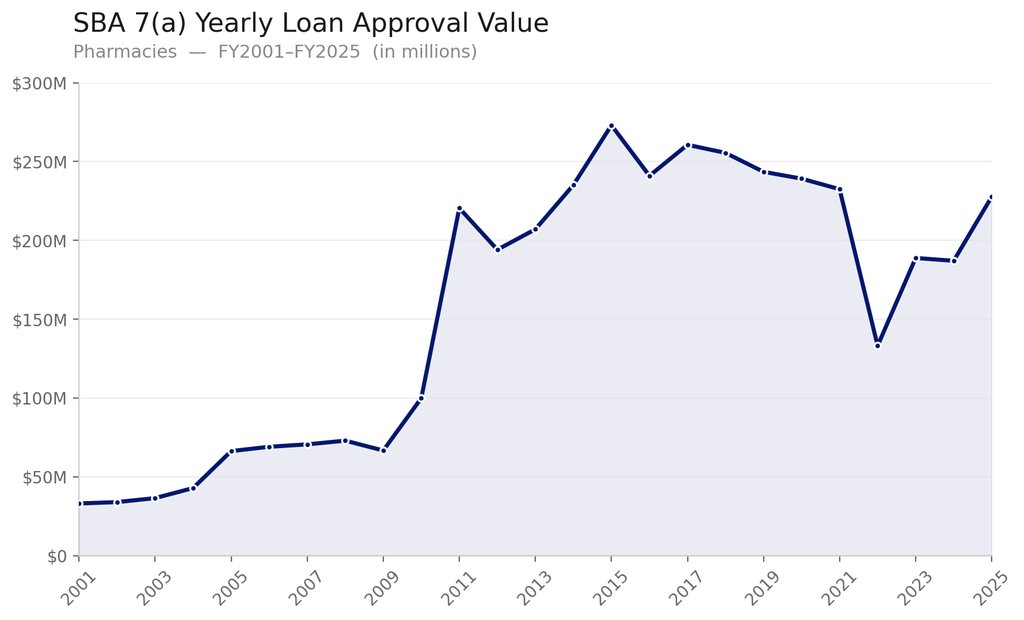
These are the year-by-year* statistics of SBA 7(a) pharmacy loans from Fiscal Year 2001 to today, including the number of 7(a) loans approved and total approval amount.
| Fiscal Year | Loans Approved | Approval Amount |
| 2001 | 145 | $33,078,859 |
| 2002 | 167 | $33,971,923 |
| 2003 | 218 | $36,500,704 |
| 2004 | 229 | $42,876,538 |
| 2005 | 252 | $66,321,258 |
| 2006 | 251 | $69,067,847 |
| 2007 | 218 | $70,599,290 |
| 2008 | 199 | $72,948,075 |
| 2009 | 194 | $66,701,421 |
| 2010 | 239 | $99,902,500 |
| 2011 | 382 | $220,483,000 |
| 2012 | 325 | $194,101,700 |
| 2013 | 374 | $207,071,500 |
| 2014 | 376 | $235,151,500 |
| 2015 | 459 | $273,065,100 |
| 2016 | 423 | $240,997,400 |
| 2017 | 381 | $260,665,000 |
| 2018 | 351 | $255,519,000 |
| 2019 | 353 | $243,507,600 |
| 2020 | 291 | $239,179,500 |
| 2021 | 273 | $232,475,200 |
| 2022 | 205 | $133,132,800 |
| 2023 | 270 | $188,851,300 |
| 2024 | 310 | $187,053,800 |
| 2025 | 337 | $227,709,600 |
Source: SBA, 7(a) & 504 FOIA
*U.S. Federal Government fiscal years
SBA 7(a) Pharmacy Loans On the Rise
The SBA 7(a) loan program has seen overall good growth in the pharmacy industry this century, with the annual total value of approved loans up almost 7x since 2001. This trend stagnated and reversed over much of the last decade, but the past few years have shown growth once again.