Fiscal Year 2025
811
Loans Approved
$290M
Total Value
Idaho has been adding businesses faster than it has been adding lenders who understand them. A buyer in Meridian wants to take over a plumbing contractor with twelve trucks. A packer outside Twin Falls needs a bigger cold room. A hotel owner in Coeur d’Alene wants the building he has been leasing for nine years. All three are financeable. All three can still spend weeks trying to get a loan before learning that the bank down the street can’t do their kind of deal. That is the problem an SBA 7(a) loan broker in Idaho exists to solve. We read your file, we know which lenders actually fund that request in this state, and we make the introduction.
An SBA 7(a) loan is made by an approved lender and partially guaranteed by the U.S. Small Business Administration. The SBA does not hand out the money itself. Banks, credit unions, and other approved lenders put up the funds, and the federal guarantee absorbs part of the lender’s downside if the loan goes bad.
That structure is why SBA 7(a) financing reaches Idaho businesses that a plain commercial loan would pass over. The maximum loan amount for most 7(a) loans is $5 million. The guarantee generally runs up to 85% on loans of $150,000 or less and up to 75% above that, subject to SBA rules and the loan type.
Note: 7aSavvy is an SBA 7(a) loan broker, not a lender. Lenders pay us, so our work costs you nothing. Rather than knocking on bank doors one at a time and guessing which one would be best, you start in front of the lenders most likely to say yes.
Uses of SBA 7(a) Loan Proceeds in Idaho
The 7(a) program is unusually broad about what the money can do. An Idaho borrower can use it to buy an existing company, buy the building the company operates from, finish a buildout, replace a line of equipment, refinance eligible business debt, or hold working capital through a slow quarter. One loan can cover more than one of those at once, which is a large part of why the program fits growing companies better than a single-purpose bank product.
As an SBA 7(a) loan brokering platform, 7aSavvy helps Idaho borrowers work out how SBA-backed financing fits the plan and then get in front of lenders aligned with the specifics. Buying a business in Boise is not the same credit story as buying a shop building in Idaho Falls, financing harvest equipment near Rexburg, or funding payroll for a construction crew in Nampa. Lenders are not interchangeable for those differences, even when their rate sheets look alike.
Our platform exists to shorten that search. Instead of applying lender by lender, Idaho borrowers start with a narrowed path toward SBA 7(a) financing.
SBA 7(a) loan proceeds may commonly be used for:
- Buying an existing business
- Purchasing owner-occupied commercial property
- Buying or replacing equipment
- Construction, renovation, and buildout work
- Refinancing eligible business debt
- Working capital
- Funding an expansion
Put together, those uses cover most of what an Idaho entrepreneur actually needs capital for, whether the goal is buying out a retiring founder, putting up a shop building, or getting some slack back into the cash flow.
One limit matters up front. SBA 7(a) loans are built for active operating businesses. They are not for passive real estate investment, including commercial or residential rental property the operating business does not mainly occupy and use.
Buy
Idaho entrepreneurs use SBA 7(a) financing to buy assets and to buy whole companies. That covers an acquisition with existing customers and revenue, a purchase of the owner-occupied property the business runs out of, and equipment that does the daily work.
Acquisition is where the program earns its reputation in this state. A lot of Idaho’s established businesses are held by owners in their sixties who want out in the next few years, and the buyer is usually a manager or a competitor rather than a private equity fund. SBA 7(a) loans fund those handovers across professional services, healthcare, restaurants, franchises, manufacturing, and the trades.
Our SBA 7(a) loan brokers help Idaho buyers pressure-test the funding request before it goes anywhere, understand what a lender will want to see in the seller’s numbers, and get matched to lenders that are comfortable with the deal structure on the table.
Build
SBA 7(a) proceeds can also pay for construction, renovation, and improvement work tied to an operating business. For an Idaho company that has outgrown its space, wants a better customer-facing room, or needs to fix a building it already owns, this financing supports work that improves both operations and the value of the asset.
Eligible business-related projects may include:
- Improvements to a leased space
- Interior buildout of a new unit
- Renovating an existing facility
- Adding square footage to a building
- Ground-up construction for business use
- Upgrades to owner-occupied commercial property
Construction requests carry more paperwork than a working capital request, and borrowers are often surprised by how much. Lenders will want the project budget, the contractor, the timeline, the permits, the collateral picture, the business financials, and a repayment story that holds up if the build runs long. Idaho’s short construction season makes the timeline question sharper than it is in warmer states, and a lender who has funded Idaho projects before will ask about it early.
Expand
Growth usually costs money before it makes money. An Idaho company might need capital to open a second location, add a crew, buy inventory ahead of a season, replace aging equipment, upgrade systems, or simply cover the gap while receivables catch up.
SBA 7(a) financing may be used to support expansion needs such as:
- Opening a second or third location
- Raising production or service capacity
- Bringing on more staff
- Stocking inventory ahead of demand
- Adding equipment or upgrading systems
- Carrying a seasonal working capital gap
- Taking pressure off cash flow during a growth stretch
- Moving into a new market or region
As an SBA 7(a) loan broker in Idaho, 7aSavvy sorts lenders by what the money is actually for. A growth-stage working capital request and a real estate purchase are read very differently in credit, even inside the same bank, and the lender who is fast on one can be slow on the other.
Our job is to put the request in front of SBA 7(a) lenders who already do that kind of financing. For Idaho business owners, that removes most of the wasted time at the front of the process.
SBA 7(a) Loan Industries in Idaho
Almost any for-profit business can use the 7(a) program, which is why it works across a state whose economy has strengths in so many industries. Southern Idaho’s food processing corridor, the Treasure Valley’s technology and semiconductor supply chain, the panhandle’s timber and tourism trade, and construction everywhere are all served by the same loan program and, often, by very different lenders.
The lending record behind Idaho SBA 7(a) loans backs that up. Specialty trade contractors are among the heaviest users of SBA financing in Idaho by number of loans, with manufacturing and food service close behind, and the typical manufacturing deal runs at roughly double the size of the typical contractor deal. A lender comfortable writing $150,000 for an electrical contractor may have nothing useful to say about a $2 million processing plant.
Common Idaho industries that use SBA 7(a) business loans include:
- Specialty trade contractors and construction firms
- Food processing and agricultural support businesses
- Restaurants and food service businesses
- Hotels, motels, RV parks, and outfitters
- Manufacturers and machine shops
- Medical, dental, and veterinary practices
- Auto repair shops and car washes
- Gas stations and convenience stores
- Self-storage and RV storage facilities
- Retail and franchise businesses
- Professional service firms
Those differences are most of what an Idaho SBA 7(a) loan broker is actually sorting for. A restaurant in downtown Boise may be financing a buildout and six weeks of payroll. A dairy support business near Jerome may be financing a piece of equipment that costs more than the building. A resort operator in Sandpoint may need working capital structured around a busy season that makes most of its money. Those are four different lender conversations.
For most Idaho companies the hard part is not the program, it is the fit. You need a lender who understands the industry, knows the use of funds, and has seen the repayment story before.
SBA 7(a) Loan Qualifications in Idaho
Qualifying starts with the basics. The business must be for-profit, operating in the United States or its territories, within SBA size standards for its industry, and putting the money toward an eligible business purpose.
SBA 7(a) financing is available to several common business structures, including:
- Sole proprietors
- LLCs
- Partnerships
- C corporations and S corporations
- Other eligible for-profit entities
Clearing those basics gets you in the door and no further. After that, the lender underwrites the whole request: financial performance, credit, ownership, industry, collateral, use of proceeds, management experience, and the ability to make the payment.
What gets weighted heaviest changes with the deal. A lender underwriting a business acquisition will spend much of the process on the seller’s financials and the borrower’s experience. A lender looking at an owner-occupied property purchase will spend it on the appraisal and the business’s financials. A construction request lives or dies on the budget and the contractor. Same program, different fight.
Idaho borrowers use 7aSavvy to skip the part where they learn that by trial and error. Our SBA 7(a) loan brokering matches the request to lenders whose credit box already fits the goal, the industry, and the amount.
District Offices and Lender Types
One thing worth knowing about SBA 7(a) loans in Idaho specifically: the state is split between two SBA district offices. The Boise District Office, at 380 E. Parkcenter Blvd. in Boise, covers 34 counties in southern Idaho along with six counties in eastern Oregon, while the ten northernmost Idaho counties are served out of Seattle. It doesn’t change the SBA 7(a) loan itself, and most borrowers will never interact with their district office, but it’s good to know.
Idaho also breaks a national pattern in a way that an SBA 7(a) loan broker can put to work. Credit unions do more SBA lending here than in most states, and in fiscal year 2025 the largest 7(a) lender in Idaho by dollar volume was a credit union, not a bank. Seventy-four lenders wrote Idaho 7(a) loans that year. A borrower who only talks to the two banks with branches in town is ignoring most of the market.
SBA 7(a) Loans in Idaho: Pros and Cons
An Idaho SBA 7(a) loan, whether you find the lender yourself or through an SBA 7(a) loan broker, gives a borrower access to flexible money for the things that are actual gamechangers: buying a company, housing it, equipping it, or carrying it through a growth stretch. For borrowers who qualify, the structure is usually friendlier than what a conventional business loan offers in the same situation.
Because the loan is made by an approved lender and partially guaranteed by the SBA, lenders can look at requests that would not survive a conventional credit box. That matters in a state with a lot of young companies, a lot of seasonal revenue, and a lot of owners whose net worth is tied up in the business itself.
Here is what Idaho borrowers get out of SBA 7(a) financing, and where it stops being the right tool.
Key benefits may include:
- Repayment terms longer than almost anything else on the commercial market
- One loan that can cover several eligible business purposes at once
- Money for acquisitions, expansion, equipment, working capital, eligible refinancing, and owner-occupied property
- A fully amortized term with no balloon at the end
- Competitive rates for qualified borrowers and eligible uses
- A smaller down payment than a conventional lender would ask for
The structural benefit of an SBA 7(a) loan in Idaho is often worth more than the access itself. A 25-year term on a real estate purchase changes the monthly number enough to keep a business hiring, and covering several needs with one loan beats stacking three facilities with three sets of covenants.
The program is not right for everyone, and an honest SBA 7(a) loan broker will tell you so. As of March 1, 2026 a business must be 100% owned by U.S. citizens or nationals to receive SBA financing; lawful permanent residents no longer qualify. The $5 million ceiling is a real limit too, though it’s a problem in Idaho less often than it is on the coast. The state’s average approved 7(a) loan in fiscal year 2025 was around $358,000, so most Idaho deals sit comfortably inside the cap. The ones that do not tend to be processing plants, hotels, and multi-property acquisitions.
SBA 7(a) Loans vs. Other Types of Loans
SBA 7(a) Loans vs Conventional Loans
A conventional business loan carries no federal guarantee, so the lender owns the entire credit risk. That tightens everything: more collateral, more seasoning, more cash flow coverage, less patience with a transaction that does not look like the last fifty the bank did.
An SBA 7(a) loan changes the math without changing who lends. The money still comes from the bank or credit union, but the SBA guarantee takes part of the risk off the table. That is what opens the door for businesses that are sound but do not fit the template, and it usually comes with a smaller down payment and a longer, fully amortized term.
For Idaho borrowers weighing SBA 7(a) financing against a conventional loan, the choice tends to sort itself out fast. Strong cash flow, plenty of collateral, one simple purpose, an existing banking relationship: take the conventional loan if the terms are good. Thin collateral, a limited down payment, seasonal revenue, or more than one thing to fund: an SBA 7(a) loan is usually the better option.
SBA 7(a) Loans vs SBA 504 Loans
Both are SBA-backed. They are built for different jobs.
SBA 7(a) loans in Idaho are the more flexible option. Working capital, acquisitions, owner-occupied commercial real estate, equipment, construction, eligible refinancing, expansion, or several of those in a single loan. That breadth is why 7(a) suits an Idaho business funding more than one thing at once, or a request that does not reduce cleanly to a fixed asset.
SBA 504 loans are the fixed-asset option. Major owner-occupied real estate and heavy equipment, mainly. If the whole project is a building or a big machine, 504 deserves a look.
The terms of an SBA 7(a) loan and a 504 rhyme in places. Both commonly run a 10% down payment and up to a 25-year term on real estate. Then they diverge. A 504 rate is usually lower and at least partly fixed; a 7(a) rate is usually a little higher and variable, though it can be fixed in some cases. The 7(a) ceiling is $5 million against $11.25 million for 504, which is why very large real estate projects lean 504.
There is also a large process difference. A 504 is two loans stapled together, one from a conventional lender and one from a nonprofit Certified Development Company, so it involves more parties and more time than a 7(a) on the same deal.
For an Idaho company buying a building, either program can work, and any SBA 7(a) loan broker worth their salt will say plainly when 504 is the better fit. For a company buying a building and the business inside it, or buying a building and needing operating cash on day one, the SBA 7(a) route is usually simpler.
SBA 7(a) Loan Program History
The 7(a) program is older than most of the businesses using it. It traces to the Small Business Act of 1953, which created the U.S. Small Business Administration and set up a federal framework for getting capital to small companies that banks would otherwise deny.
The name comes from the section of that Act which authorizes the program. Section 7(a). It has been the SBA’s flagship business loan program ever since, and it still works the same way: approved lenders make the loans, the government guarantees part of them.
Seventy-plus years is the point. An Idaho contractor, processor, hotel operator, or clinic owner looking at SBA 7(a) financing today, with a solid plan and an imperfect balance sheet, is not asking a lender to do something novel. SBA lenders have been underwriting exactly that file since the Eisenhower administration.
Idaho SBA 7(a) Loan Program Statistics
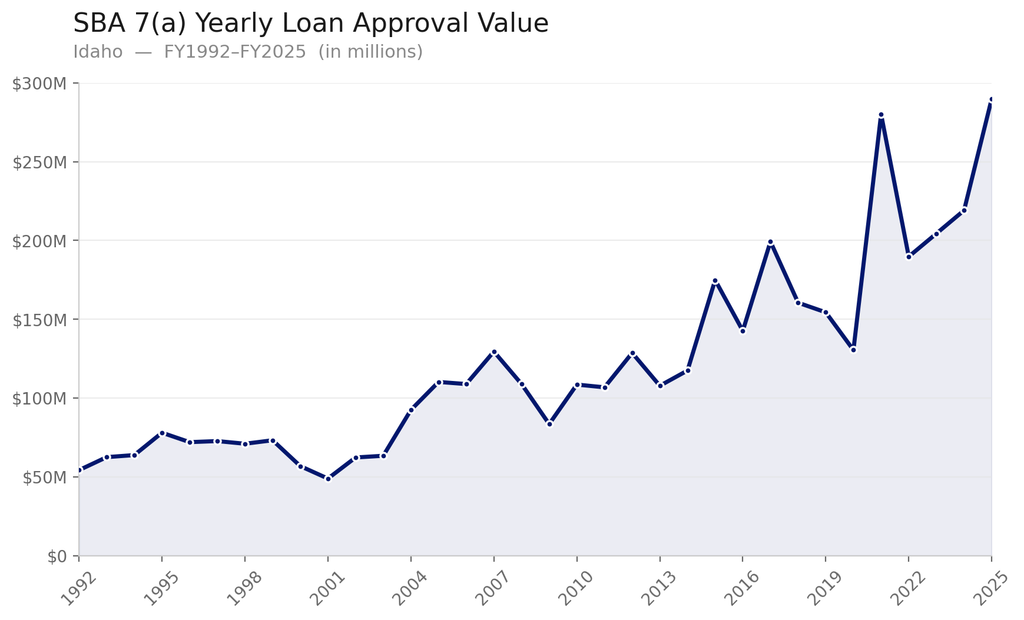
Idaho SBA 7(a) volume has grown more than five times over since 1992, from about $54 million a year to nearly $290 million in fiscal year 2025. That growth is the world an Idaho SBA 7(a) loan broker works inside every day. Loan counts tell a different story than dollars: the mid-1990s and mid-2000s spikes came from small-loan programs, while the recent climb is fewer, larger deals.
These are the year-by-year* statistics of the SBA 7(a) loan program in Idaho from Fiscal Year 1992 to today, including the number of 7(a) loans approved and total approval amount.
| Fiscal Year | Loans Approved | Approval Amount |
| 1992 | 283 | $54,275,395 |
| 1993 | 272 | $62,532,356 |
| 1994 | 327 | $63,833,343 |
| 1995 | 593 | $78,025,335 |
| 1996 | 501 | $72,040,824 |
| 1997 | 359 | $72,718,663 |
| 1998 | 380 | $71,021,154 |
| 1999 | 399 | $73,231,648 |
| 2000 | 360 | $56,836,447 |
| 2001 | 290 | $48,925,005 |
| 2002 | 370 | $62,309,451 |
| 2003 | 504 | $63,397,550 |
| 2004 | 698 | $92,471,123 |
| 2005 | 850 | $110,241,534 |
| 2006 | 854 | $108,895,600 |
| 2007 | 1,108 | $129,525,085 |
| 2008 | 842 | $108,895,325 |
| 2009 | 564 | $83,506,100 |
| 2010 | 604 | $108,562,000 |
| 2011 | 488 | $106,815,400 |
| 2012 | 443 | $128,655,700 |
| 2013 | 451 | $107,806,000 |
| 2014 | 446 | $117,465,100 |
| 2015 | 610 | $174,877,500 |
| 2016 | 539 | $142,685,000 |
| 2017 | 670 | $199,251,500 |
| 2018 | 520 | $160,492,500 |
| 2019 | 445 | $154,408,700 |
| 2020 | 369 | $130,475,600 |
| 2021 | 439 | $280,125,200 |
| 2022 | 419 | $189,760,300 |
| 2023 | 455 | $204,392,100 |
| 2024 | 644 | $219,102,100 |
| 2025 | 811 | $289,938,000 |
Source: SBA, 7(a) & 504 FOIA
*U.S. Federal Government fiscal years
SBA 7(a) Loans On the Rise
The SBA 7(a) loan program has seen impressive growth in Idaho, with the annual total value of approved loans up over 5x since 1992.
About 7aSavvy
7aSavvy is an SBA 7(a) loan broker and matching service for Idaho business owners. We are not a lender and we are not the SBA. We do not approve loans or set rates.
What an SBA 7(a) loan broker does is narrower and more useful than that. We read your deal, we know which lenders fund that kind of request in Idaho, and we connect you with them. The lender pays us, so the service costs the borrower nothing.
Our founder and CEO, Brett Smith, has worked on over $1 billion of SBA loans across 15+ years on both sides of the table, as a lender and as a broker. Sitting in the lender’s chair for that long is what tells you which files a given credit department will fight for and which it will quietly sit on. That is the part a borrower cannot look up, and it is most of what keeps a good Idaho file off the wrong desk.
How 7aSavvy Works
Step 1: You tell us about the deal. Every Idaho SBA 7(a) loan we place starts here. Use our Get Connected form to share the basics: loan purpose, rough size, industry, and where in Idaho the business sits.
Step 2: We read the request. We look at the use of proceeds (acquisition, real estate, equipment, refinance, or working capital) and the details a credit officer will stop on.
Step 3: We match you to the right lender. We know which lenders have the appetite, the industry fit, and the capacity for an Idaho deal of your size, and we make the introduction.
Step 4: We stay with the deal. We keep the request moving toward funding instead of leaving you to chase the bank alone.
Case Study
Here is an illustrative example of how an Idaho SBA 7(a) deal comes together, built from the kind of file we see most often in the state.
A manager at a food-processing equipment shop outside Twin Falls wants to buy the business from the founder, who is retiring, and he’s looking for an SBA 7(a) loan to fund it. The price is $1.6 million for the company plus $450,000 for the building it sits in. He has $205,000 in cash, which covers a 10% injection on a $2.05 million project. He needs a loan just under $1.85 million.
His local bank likes him, but does not want the deal. Food processing equipment is a thin resale market, the seller’s add-backs are messy, and the bank doesn’t have a dedicated SBA department. Nothing there is unusual, and none of it means the loan is unfinanceable. It means the file needs a lender who has bought that argument before. The right match is an SBA lender that already does manufacturing acquisitions in the Northwest, is comfortable with a business-plus-real-estate structure, and will not stall on the equipment appraisal.