
Fiscal Year 2025
1,345
Loans Approved
$611M
Total Value
From 1998 to 2022, small business employment in Utah grew 63.7%, the fastest rate of any state according to the SBA Office of Advocacy, and the lending market has had to scramble to keep up. A contractor in Saratoga Springs wants to acquire the equipment yard he’s been leasing. A dentist in Layton wants to buy out the practice she joined six years ago. A family in St. George has found a hotel they can finally afford to own. Every one of those deals can be financed. Every one of them can also stall for weeks at a bank that says yes on the first call and no on the ninth. An SBA 7(a) loan broker in Utah earns its keep by sending the file to the lenders who already say yes to that kind of deal, before the borrower burns months finding out who does not.
Here is the short version of how the program works. An SBA 7(a) loan is made by a bank, credit union, or other SBA-approved lender, and the U.S. Small Business Administration guarantees part of it. The SBA is not the one wiring the money. It stands behind a share of the loan, which lets the lender say yes to borrowers who would not clear a plain commercial credit test.
That guarantee is the reason SBA 7(a) loans in Utah reach businesses that conventional lending leaves out in the cold. Most 7(a) loans can go up to $5 million. The SBA generally guarantees up to 85% of loans of $150,000 or less and up to 75% of larger loans, depending on loan type and current SBA rules.
Note: 7aSavvy is an SBA 7(a) loan broker, not a bank. The lender pays our fee when your loan funds, so Utah borrowers pay us nothing. You skip the cold calls and start with lenders who already fund deals that look like yours.
Uses of SBA 7(a) Loan Proceeds in Utah
Most business loans are built for one job. The 7(a) program is built for several. A Utah borrower can use one SBA 7(a) loan to purchase a company, purchase the building it runs from, pay for a remodel, add equipment, refinance eligible debt, and keep enough working capital on hand to survive the first payroll after closing.
That flexibility is only useful if the lender reading the file sees the plan the same way you do. As a Utah SBA 7(a) loan broker, 7aSavvy helps owners sort out how the financing should be structured and then puts the request in front of lenders whose appetite fits. Buying an HVAC company in Draper is a different credit conversation than buying a retail building in Logan, refinancing a clinic in Provo, or carrying working capital for a tour operator in Moab. On paper the rate sheets look similar. In the credit committee room they are not.
That is where using a broker saves time. Utah owners do not have to shop the deal bank by bank. They start with a short list of lenders who fit the request.
SBA 7(a) loan proceeds may commonly be used for:
- Buying an existing business
- Purchasing owner-occupied commercial property
- Buying or replacing equipment
- Construction, renovation, and buildout work
- Refinancing eligible business debt
- Working capital
- Funding an expansion
For a Utah business, those uses map onto almost every serious capital decision an owner faces: buying out a partner, owning the building instead of renting it, adding capacity, or getting some breathing room back in the budget.
There is one boundary worth knowing on day one. SBA 7(a) loans in Utah are for operating businesses. Passive investment real estate, such as a strip center you plan to lease out or rental homes the business does not occupy and use, falls outside the program.
Buy
Buying is where a lot of SBA 7(a) financing in Utah starts. Borrowers use it to acquire a whole company with customers and cash flow already in place, to purchase the owner-occupied property the business operates from, and to buy the equipment that does the work.
Acquisitions carry more weight here than most people expect. In fiscal year 2025, change-of-ownership loans made up about 8% of Utah’s SBA 7(a) approvals by count but more than 20% of the dollars, with an average size of roughly $1.16 million. When you buy a business, you are buying its cash flow, and lenders spend most of their time on whether that cash flow is reliable and whether it will survive the handover.
Our Utah SBA loan brokering team helps buyers get the numbers straight before a lender ever sees them: what the seller’s returns really show, Whether the cash flow supports the price, and which lenders are comfortable with that structure and that industry.
Build
SBA 7(a) financing in Utah can also fund construction and improvement work for a business that operates in the space. For a Utah company that has outgrown its unit, wants a better storefront, or needs to bring an older building up to standard, this kind of financing pays for work that improves operations and adds to the value of what the owner holds.
Eligible business-related projects may include:
- Tenant improvements to a leased space
- Buildout of a new unit or suite
- Remodeling an existing building
- Adding onto a building the business occupies
- Ground-up construction for the business’s own use
- Upgrades to owner-occupied commercial property
Construction files take more work than working capital files, and there is no way around that. Lenders will want a signed contractor bid, a detailed budget, the draw schedule, permits, the timeline, the collateral picture, and financials that show the business can carry the payment if the project runs over. Lenders also look hard at the contingency line. A budget with no cushion reads like a budget that will need a second loan.
Expand
Expansion rarely pays for itself on day one. A Utah company might need money to open another location in a fast-growing suburb, hire ahead of demand, stock up before a busy season, replace worn-out equipment, or bridge the gap while receivables catch up with sales.
SBA 7(a) financing may be used to support expansion needs such as:
- Opening another location
- Adding production or service capacity
- Hiring more staff
- Buying inventory ahead of demand
- Adding or upgrading equipment
- Covering a seasonal working capital gap
- Easing cash flow while the business grows
- Entering a new market or region
As an SBA 7(a) loan broker in Utah, 7aSavvy sorts lenders by what the money will be used for. A lender that moves quickly on a $150,000 working capital request can take months on a $2 million acquisition with real estate attached, even though both are SBA loans.
We get the request in front of lenders who fund that specific kind of deal every week. For Utah borrowers, that cuts out most of the dead time at the start of the process.
SBA 7(a) Loan Industries in Utah
Nearly every for-profit industry can use the 7(a) program, which matters in a state where the economy looks different in every region. Software and professional services dominate the stretch from Lehi to Draper. Hospitality and outdoor recreation drive much of southern Utah and the Park City area. Construction runs everywhere a new subdivision is going up, which in Utah is most places. Energy and trucking carry the Uinta Basin.
The SBA’s own lending data backs this up. In fiscal year 2025, construction was the largest industry for SBA 7(a) loans in Utah, with 209 loans worth about $106 million. Health care and social assistance came next by dollar volume, followed by accommodation and food services. Manufacturing loans were fewer in number but much larger on average, around $650,000 each, which is a good reminder that loan size tends to follow the industry.
Common Utah industries that use SBA 7(a) business loans include:
- General contractors and specialty trade contractors
- Dental, medical, physical therapy, and veterinary practices
- Hotels, motels, and hospitality businesses
- Restaurants, franchises, and food service businesses
- Manufacturers and fabrication shops
- Professional services and technology firms
- Trucking, logistics, and wholesale distributors
- Auto repair shops, car washes, and dealerships
- Gas stations and convenience stores
- Self-storage and RV storage facilities
- Retail businesses
Those differences are exactly what an SBA loan broker in Utah is sorting for. A roofing company in West Jordan may need a loan to buy its shop and yard. A physical therapy group in Lehi may want to buy the building it has leased since it opened. A motel owner near Zion may need a structure that respects how the calendar really works in Springdale, with most of the year’s income arriving between spring and fall. Each of those is a different lender conversation, and a lender who loves one of them may pass on the other two.
Finding the opportunity is rarely the obstacle for a Utah entrepreneur. The obstacle is finding a lender that knows the industry, trusts the use of funds, and has already approved a borrower like you.
SBA 7(a) Loan Qualifications in Utah
The basic qualifications for an SBA 7(a) loan in Utah are simple. The business needs to be for-profit, operating in the United States or its territories, small under the SBA size standard for its industry, and borrowing for an eligible business purpose.
SBA 7(a) financing is available to several common business structures, including:
- Sole proprietors
- LLCs
- Partnerships
- C corporations and S corporations
- Other eligible for-profit entities
Meeting those rules gets you to the starting line. From there, the lender underwrites the whole deal: cash flow, credit history, ownership, industry, collateral, how the money will be used, management experience, and whether the business can make the payment with room to spare.
Which of those carries the most weight depends on what you are financing. On an acquisition, the lender spends its energy on the seller’s financials and on whether you have the experience to run the business the day after closing. On an owner-occupied building, the appraisal and the business’s financials take center stage. On a startup or a new location, it comes down to your experience in the industry and how much cash you are putting in.
Utah borrowers come to 7aSavvy so they do not have to learn all of that the slow way. Our SBA 7(a) loan brokering matches the request to lenders whose credit standards already fit the purpose, the industry, and the size of the loan.
Utah-Specific Things to Know
A detail that is good for Utah borrowers to know: the whole state is covered by a single SBA district office, at 125 South State Street in Salt Lake City, with a branch office in St. George.
Borrowers in Logan and Kanab deal with the same district, but that does not mean the same lenders are active in both places. Out of 1,344 Utah SBA 7(a) loans approved in fiscal year 2025, 488 went to borrowers in Salt Lake County and 294 to borrowers in Utah County. Rural counties get far fewer loans, and far fewer lenders compete for them.
Another lesson from the fiscal year 2025 data is that the lender that approves the most loans is not necessarily the right lender for a large one. Ninety-five lenders made SBA 7(a) loans in Utah that year. Zions Bank approved the most, 264 loans, at an average of about $153,000 each. Live Oak Bank approved only 30 Utah loans but lent about $42 million, an average of roughly $1.4 million. A credit union, Mountain America, was near the top by both count and dollars. Lenders based outside Utah approved fewer loans than in-state lenders but averaged about $566,000 per loan, compared with about $361,000 for Utah-based lenders. Loans of $500,000 or more made up only a quarter of Utah approvals by count but about three-quarters of the dollars.
For a borrower looking for $1.5 million to buy a business, that means the familiar branch down the street may not be the right place to apply. 7aSavvy is built for exactly that kind of request.
SBA 7(a) Loans in Utah: Pros and Cons
An SBA 7(a) loan in Utah gives an entrepreneur something that is hard to find elsewhere: long-term money that can cover several goals at once, whether that means acquiring a company, buying a building, adding equipment, or keeping enough cash on hand to grow. For borrowers who qualify, the terms usually beat what a conventional loan offers on the same deal.
Because the SBA guarantees part of the loan, the lender can approve requests that fall outside its usual credit box. That matters in Utah, where a large share of businesses are young, a lot of borrowers are buying their first company, and many would rather keep cash in the business than hand over a large down payment.
Here is what SBA 7(a) financing in Utah does well, and where it falls short.
Key benefits may include:
- Longer repayment terms than most commercial financing, up to 25 years when real estate is involved
- One loan that can combine several eligible uses
- Financing for acquisitions, owner-occupied real estate, equipment, working capital, expansion, and eligible refinancing
- Fully amortizing payments with no balloon due at the end
- Competitive rates for qualified borrowers and eligible uses
- A lower down payment than conventional lenders usually ask for
Key limitations may include:
- The business must be 100% owned by U.S. citizens or nationals to receive SBA financing
- The maximum SBA 7(a) loan size is $5 million
- All owners of 20% or more of the company must sign a full personal guarantee
- Loans with terms of 15 years or longer carry a prepayment penalty in the first three years
- More paperwork and a longer timeline than most conventional loans
- Passive investment real estate is not eligible
For many owners weighing SBA 7(a) loans in Utah, the size of the down payment matters more than anything else. A 10% down payment instead of the 20-30% a conventional loan might ask for can preserve capital to fund another hire or a second truck. Using one loan instead of stacking three separate facilities also means one payment and one set of covenants to track.
The limits on SBA 7(a) loans in Utah are real. Since March 1, 2026, lawful permanent residents no longer qualify as owners, so the business must be fully owned by U.S. citizens or nationals. The $5 million cap per 7(a) loan also stays in place, although since July 4, 2026, a borrower can combine 7(a) and 504 financing for up to $10 million in total SBA-backed debt. In practice, the 7(a) cap rarely gets in the way for most Utah deals. The average SBA 7(a) loan approved in Utah in fiscal year 2025 was about $455,000, and the median was $150,000. Larger requests do come up, usually for hotels, manufacturers, and acquisitions that include real estate.
SBA 7(a) Loans vs. Other Types of Loans
SBA 7(a) Loans vs Conventional Loans
With a conventional business loan, the lender carries all of the risk, and the terms reflect that. Expect a larger down payment, shorter terms, tighter collateral requirements, and less patience with anything unusual, such as a first-time buyer, a young company, or revenue that swings with the seasons.
An SBA 7(a) loan still comes from a bank, credit union, or non-bank lender, but the SBA guarantee reduces the lender’s exposure. That gives the lender room to approve a strong business that does not fit its standard template, and it usually means a lower down payment and a longer term for the borrower.
For business owners comparing a conventional loan with SBA 7(a) financing in Utah, the choice usually sorts itself out quickly. If the business has strong cash flow, plenty of collateral, a simple use of funds, and a long banking relationship, a conventional loan may be cheaper and faster. If the down payment is tight, the collateral is thin, the revenue is seasonal, or the loan needs to cover more than one purpose, an SBA 7(a) loan is usually the better fit.
SBA 7(a) Loans vs SBA 504 Loans
Both programs are backed by the SBA, but they solve different problems.
An SBA 7(a) loan in Utah is the flexible option. It can pay for an acquisition, owner-occupied real estate, equipment, construction, working capital, and eligible refinancing, and it can combine several of those in one loan. For a Utah business with more than one need, 7(a) is usually where the conversation starts.
The 504 program is built for major fixed assets, mainly owner-occupied real estate and long-life equipment. When the whole project is a building or a large piece of machinery, 504 is worth pricing out.
On some points the two programs look alike. Both commonly require 10% down and offer terms up to 25 years on real estate. The differences are in the rate and the structure. A 504 loan usually carries a lower fixed rate on the SBA-guaranteed portion, while a 7(a) rate is usually variable, though fixed-rate options exist. A 504 deal also involves two lenders, a conventional lender and a nonprofit Certified Development Company, so there are more parties at the closing table.
Since July 2026, the two programs can also work together more easily. A borrower can now combine up to $5 million in 7(a) financing with up to $5 million through 504, for as much as $10 million in SBA-backed financing. For a Utah company that wants to buy a building now and fund an expansion later, that combination opens up more room.
If you are buying real estate in Utah, either program can work, and a good SBA loan broker will tell you plainly when 504 is the better tool. If you are buying the building and the business inside it, or you need working capital at closing, the 7(a) loan is usually simpler.
SBA 7(a) Loan Program History
The SBA 7(a) program goes back to the Small Business Act of 1953, the law that created the Small Business Administration and gave the federal government a way to help small companies get credit when banks would not lend to them on their own terms.
The name comes from the section of the Act that authorizes the program: Section 7(a). It has been the SBA’s main business loan program ever since, and the basic idea has not changed. Private lenders make the loans, and the government guarantees part of each one.
That long history is useful to a Utah borrower. When a contractor, clinic owner, hotel buyer, or manufacturer applies for SBA 7(a) financing with a solid plan and a less-than-perfect balance sheet, the lender is not being asked to take a new kind of risk. SBA lenders have been approving that type of file for more than seventy years.
Utah SBA 7(a) Loan Program Statistics
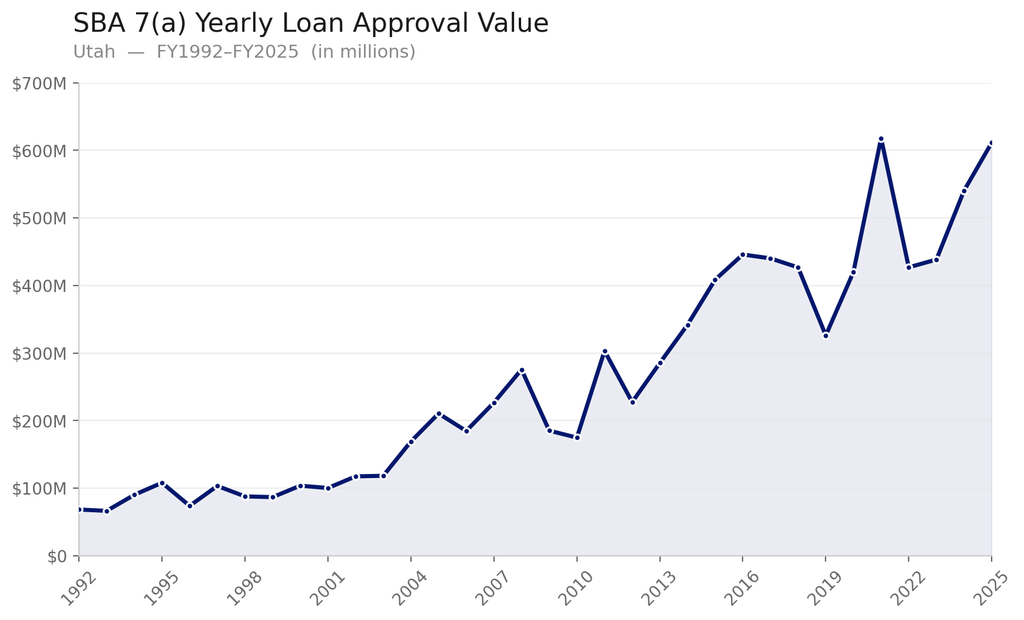
SBA 7(a) lending in Utah has grown almost 9x since 1992, from about $68 million in approvals that year to more than $611 million in fiscal year 2025. That is the market a Utah SBA 7(a) loan broker works in. The loan count tells a different story from the dollars: approvals peaked at 2,763 loans in 2008, when small loans made up much of the volume, while recent years show fewer but much larger loans. The pace has not slowed much in 2026 either, with 752 Utah loans worth about $370 million approved in the first nine months of fiscal year 2026.
Here are the year-by-year* statistics of the SBA 7(a) loan program in Utah from Fiscal Year 1992 to today, including the number of 7(a) loans approved and total approval amount.
| Fiscal Year | Loans Approved | Approval Amount |
| 1992 | 305 | $68,308,590 |
| 1993 | 272 | $66,360,294 |
| 1994 | 366 | $90,120,315 |
| 1995 | 636 | $107,940,565 |
| 1996 | 459 | $73,791,272 |
| 1997 | 498 | $103,236,809 |
| 1998 | 457 | $87,772,601 |
| 1999 | 519 | $86,680,450 |
| 2000 | 618 | $103,622,900 |
| 2001 | 571 | $100,162,722 |
| 2002 | 573 | $117,421,800 |
| 2003 | 944 | $118,297,850 |
| 2004 | 1,592 | $169,016,395 |
| 2005 | 1,765 | $210,461,621 |
| 2006 | 1,848 | $184,646,000 |
| 2007 | 2,648 | $226,581,050 |
| 2008 | 2,774 | $275,660,600 |
| 2009 | 1,824 | $185,139,400 |
| 2010 | 1,233 | $174,796,500 |
| 2011 | 1,311 | $303,089,500 |
| 2012 | 1,114 | $227,467,100 |
| 2013 | 1,088 | $285,270,200 |
| 2014 | 1,049 | $341,811,300 |
| 2015 | 1,183 | $408,587,400 |
| 2016 | 1,109 | $445,881,200 |
| 2017 | 1,073 | $440,163,300 |
| 2018 | 997 | $426,718,700 |
| 2019 | 770 | $326,052,200 |
| 2020 | 778 | $419,948,400 |
| 2021 | 896 | $617,987,500 |
| 2022 | 762 | $426,927,400 |
| 2023 | 902 | $438,376,300 |
| 2024 | 1,153 | $540,488,200 |
| 2025 | 1,345 | $611,449,600 |
Source: SBA, 7(a) & 504 FOIA
*U.S. Federal Government fiscal years
SBA 7(a) Loans On the Rise in Utah
The SBA 7(a) loan program has seen great growth in Utah, with the annual total value of approved loans up almost 9x since 1992.
About 7aSavvy
7aSavvy is an SBA 7(a) loan broker and matching service for Utah business owners. We are not a lender and we are not part of the SBA. We do not approve loans, and we do not set rates.
Our job is to find the right lender for your deal. We review the request, figure out which lenders are actively funding that kind of loan in Utah, and introduce you to a decision-maker there. The lender pays our fee, so Utah borrowers pay nothing for the service.
Our founders have spent more than 35 years in SBA lending, working in roles from loan officer to bank founder. That experience and those connections on the lending side is what tells us which credit teams are looking for a hotel deal this quarter, which ones have stopped doing car washes, and which will move a $3 million acquisition without letting it sit. That knowledge is not published anywhere, and it is the main reason borrowers use us instead of calling around.
How 7aSavvy Works
Step 1: Tell us about your deal. Every Utah SBA 7(a) loan we work on starts with the Get Connected form. It takes a few minutes and covers the purpose of the loan, the approximate amount, the industry, and where the business is located.
Step 2: We review the request. We look at the use of proceeds, whether that is an acquisition, real estate, equipment, refinancing, or working capital, and we spot the questions an underwriter is likely to ask before the file goes out.
Step 3: We match you with the right lender. We use our lender relationships to find the institutions with the right appetite, industry experience, and capacity for a Utah loan of your size, and we make the introduction.
Step 4: We stay involved until closing. We keep the loan moving toward funding, and if the first lender is not the right fit, we find another one.
Case Study
Here is an illustrative example of how a Utah SBA 7(a) deal comes together, based on the kind of request we see most often in the state.
A site-work and excavation contractor in Saratoga Springs had spent eight years leasing a three-acre equipment yard with a 6,000-square-foot shop. When the landlord offered to sell, the price was $1.95 million. The owner had $195,000 available for a 10% down payment and needed an SBA 7(a) loan of about $1.76 million, with a term of 25 years so the payment would stay close to what he had been paying in rent.
His bank, which had carried his equipment loans for years, turned it down. The concerns were familiar: revenue that swung from year to year as housing starts rose and fell, a large equipment debt schedule, and a property that the bank considered special-purpose because much of the value was in the yard rather than the building. None of those issues made the deal unfinanceable. They meant it needed a lender that regularly finances construction companies, understands how contractor cash flow is measured over a full cycle, and is comfortable with industrial yard collateral. That is the kind of match an SBA 7(a) loan broker in Utah is there to make.