
Fiscal Year 2025
1,255
Loans Approved
$666M
Total Value
Plenty of Phoenix entrepreneurs have a good deal in front of them and still get stuck on the financing. They walk into the bank that holds their business account, or they answer whatever loan ad showed up in their feed, and then they wait. The no that comes back usually has little to do with the quality of the business. The lender just does not fund that industry, that loan size, or that use of the money. That is the exact dead end an SBA 7(a) loan broker in Phoenix is built to skip. We are not a bank. Our job is to connect you with the lender that actually wants your deal before you waste your time and energy.
Here is why the match matters so much. Every SBA lender keeps its own private sense of what it will chase and what it will pass on, and no two of those lists line up. One bank loves restaurant acquisitions and will not look at ground-up construction. Another wants owner-occupied real estate but backs away from anything with seasonal or snowbird-driven revenue. Send the same file to both and you get two different answers. As a Phoenix SBA 7(a) loan broker, we keep a current read on those appetites, so your request goes to the lender whose preferences already fit it instead of one dealing with your kind of deal for the first time.
The loan itself is worth understanding before you shop your deal. An SBA 7(a) loan is not government money. It comes from a regular bank, a credit union, or a non-bank lender, and the U.S. Small Business Administration simply agrees to cover a portion of the balance if the borrower defaults. That backstop is the reason a lender will approve a request it might otherwise decline. The guarantee generally runs to 85% on loans up to $150,000 and 75% above that, and the program tops out at a $5 million loan. The final approval still comes from the lender, as do the rate and loan terms (within certain SBA parameters), which is why the lender you land on decides so much.
Note: 7aSavvy is an SBA 7(a) loan broker, not a lender. The lender pays us when your loan closes, so our help costs you nothing. Rather than contacting one bank after another and hoping for a fit, you start with a single focused path to the lenders most likely to fund your request.
Uses of SBA 7(a) Loan Proceeds in Phoenix
One reason the program is worth the paperwork is that one loan can solve several problems at once. A Phoenix owner does not have to arrange one loan for the building, a separate one for equipment, and a working capital loan on top of both. A single SBA 7(a) loan in Phoenix can fold a mix of eligible needs into one structure, which is why it suits businesses that are buying, growing, and re-tooling at the same time.
Proceeds are commonly put toward:
- Acquiring an existing company
- Buying a commercial building for a business to operate in
- Purchasing machinery, vehicles, or other equipment
- Paying for construction, remodels, or tenant buildouts
- Refinancing business debt that qualifies
- Covering payroll, inventory, and other working capital
- Financing a second location or other expansion across the Valley
One limit is worth saying plainly. This financing is meant for companies that actively run and occupy their space. It is not a tool for passive real estate held only as an investment, so a building your operating business will not use itself sits outside the program.
Buy
Buying is where a Phoenix SBA 7(a) loan broker sees the most volume, and it usually takes one of two shapes. The first is purchasing a company outright, one that already has staff, customers, and a track record a lender can examine. The second is buying real estate for a business to operate in, whether you’re purchasing it together with the business, moving from a rented space into an owned space, or purchasing the building your business already operates in. In our experience both of these are solid fits for the program. Each is exactly the kind of deal that should go to a lender that funds that industry and use of proceeds regularly rather than one learning them through your file.
Build
Construction and renovation money is the second bucket, and it stretches further than people expect. A dentist fitting out new operatories in Gilbert, a brewery adding a taproom in Tempe, a contract manufacturer expanding a Chandler facility to serve the semiconductor supply chain, a franchisee remodeling a Mesa storefront to hit brand standards, all of that is a great fit for an SBA 7(a) loan. Building costs and permitting timelines swing a fair amount across the metro, so the lender you pick should be comfortable with construction draws and the pace of the local market.
Expand
Growth burns cash before it produces any, and that gap is where a lot of good Phoenix companies stall. SBA 7(a) financing can bridge it, funding a new location, fresh equipment, a bigger crew, a jump in inventory ahead of a busy winter season, or the systems a growing company has outgrown. For an owner staring at more demand than the current setup can handle, that funding often decides whether the next opportunity gets taken or handed to a competitor down the street.
SBA 7(a) Loan Industries in Phoenix
The businesses that qualify run across nearly the whole Phoenix economy, and the metro’s business base is large. Maricopa County is home to roughly 141,918 business establishments supporting more than two million jobs, so the deals that cross a Phoenix SBA 7(a) loan broker’s desk in a given month rarely look alike.
Requests tend to cluster in industries such as:
- Restaurants, bars, and food service
- Resorts, hotels, and tourism-driven hospitality
- Convenience stores and fuel stations
- Medical, dental, and veterinary practices
- Auto repair, car washes, and service shops
- Franchise operations of many kinds
- Trucking, warehousing, and last-mile logistics near Sky Harbor
- Light manufacturing and semiconductor-adjacent suppliers
- Self-storage and specialty real estate users
- Professional, trade, and other service firms
The shape of Greater Phoenix’s economy explains much of that mix. Health care is one of the largest employers in the region, and roughly three of every five workers in the metro touch the health care sector in some way. Accommodation and food service rides on year-round visitors to Scottsdale resorts, Old Town, spring training, and the golf season. Construction stays busy on the back of steady in-migration, with the Valley adding tens of thousands of residents a year. On top of that, the wave of semiconductor and advanced-manufacturing investment led by TSMC’s plants in north Phoenix pulls in a long tail of suppliers, contractors, and service companies. Each of those large sectors eventually feeds smaller businesses that need acquisition, real estate, or equipment money, and that is usually the point where a Phoenix SBA 7(a) loan broker enters the picture.
SBA 7(a) Loan Qualifications in Phoenix
Eligibility works in two layers, and it helps to keep them apart. The first layer is the SBA’s own gate. Your business has to be for-profit, based and operating in the United States, small enough to fall under the size standard for its industry, and putting the money toward an approved purpose. Clear those and you are eligible to apply. Sole proprietorships, partnerships, LLCs, and corporations all pass this first layer without much trouble.
The second layer belongs to the lender, and it is the one that actually decides whether the loan is approved. Once the Phoenix business and borrower are found to be eligible, the lender looks at the substance: revenue and margins, personal and business credit, the equity you are putting in, the collateral on the table, your experience running this kind of operation, and whether the numbers show capacity for the loan to be repaid. The documentation shifts with the deal, since an acquisition, a building purchase, and a debt refinance each ask for a different stack of paperwork. The main reason borrowers start with an SBA 7(a) loan broker in Phoenix is to get that file pointed at a lender whose second-layer standards they can realistically meet.
Important note: Passing the SBA’s basic tests does not approve your loan. Approval rests on the specifics of your business, the use of proceeds, your credit and repayment ability, the documents the lender requires, and that lender’s own underwriting, none of which the SBA’s general eligibility rules can settle for you.
SBA 7(a) Loans in Phoenix: Pros and Cons
For most owners the appeal of an SBA 7(a) loan in Phoenix is simple. It makes financing possible for deals a conventional bank would wave off. Because the government absorbs part of the risk, lenders can fund requests with lighter collateral, a shorter history, or cash flow that swings with the season.
On the plus side, borrowers generally get:
- Longer repayment schedules than most conventional business loans offer
- The freedom to combine several eligible uses in one loan
- Access to acquisition, real estate, construction, equipment, refinance, and working-capital funding through a single program
- Full amortization, with no balloon payment waiting at the end of the term
- Competitive pricing for well-qualified borrowers and eligible uses
- Down payment requirements that run lighter than conventional financing
The tradeoffs deserve equal honesty. As of March 1, 2026, the business must be owned entirely by U.S. citizens or U.S. nationals, a stricter rule than the program carried before. The $5 million ceiling can feel snug on pricier real estate around Scottsdale, Paradise Valley, and central Phoenix, where a single property can eat most of the loan. And SBA loans require more documentation than a conventional loan, which is one more reason to have someone experienced steering the request.
SBA 7(a) Loans vs. Other Types of Loans
SBA 7(a) Loans vs Conventional Loans
The clearest way to see the difference is to look at who carries the risk. On a conventional loan the lender is exposed to the full amount, so it wants strong collateral, seasoned cash flow, and a tidy story. Fall short on any one of those and the answer is often no. An SBA 7(a) loan changes that math, because the guarantee takes part of the risk off the lender and frees it to approve deals a conventional lender would decline, usually with a lower down payment and a longer term. The catch is a heavier paperwork load and a slightly longer timeline. If your Phoenix business is flush with collateral and clean numbers, a conventional loan may be faster and simpler. If it is not, SBA 7(a) financing is often the only route that actually gets you funded with advantageous terms, and that judgment call is one an SBA 7(a) loan broker in Phoenix can help you make early.
SBA 7(a) Loans vs SBA 504 Loans
Both programs carry an SBA guarantee, but they are built for different jobs. The 7(a) is the utility player, good for acquisitions, equipment, working capital, refinancing, and mixed-use requests. The 504 is a specialist, aimed squarely at long-term fixed assets like owner-occupied buildings and heavy equipment, and it is structured as two loans, a bank piece plus a second loan through a nonprofit Certified Development Company. A 504 tends to offer a lower fixed rate and can reach $11.25 million, well above the 7(a) cap, which suits a large single-property purchase in an expensive part of the Valley. But it is slower and less flexible, so when a deal blends real estate with a business purchase or working capital, the 7(a) usually wins. When you honestly cannot tell which fits, a short call with a Phoenix SBA 7(a) loan broker sorts it out faster than reading another comparison chart.
SBA 7(a) Loan Program History
The SBA 7(a) loan program has been helping small businesses secure financing for more than seven decades. It began with the Small Business Act of 1953, which created the U.S. Small Business Administration and set up a national framework for expanding access to capital for qualifying small businesses.
The program takes its name from Section 7(a) of that act, the provision that authorizes the SBA to guarantee eligible business loans made by approved lenders. Since then the 7(a) program has grown into the SBA’s main lending initiative, supporting businesses that might struggle to qualify for conventional financing on standard terms.
For Phoenix entrepreneurs, that long track record matters. Restaurants, medical practices, franchise operators, contractors, manufacturers, retailers, and professional service firms can have significant revenue and a solid growth plan and still hit a wall with traditional funding. SBA 7(a) lenders are set up to weigh the broader strength of a business, which is what gives a qualified Phoenix borrower a path to financing for acquisitions, expansion, equipment, working capital, and owner-occupied real estate.
Phoenix SBA 7(a) Loan Program Statistics
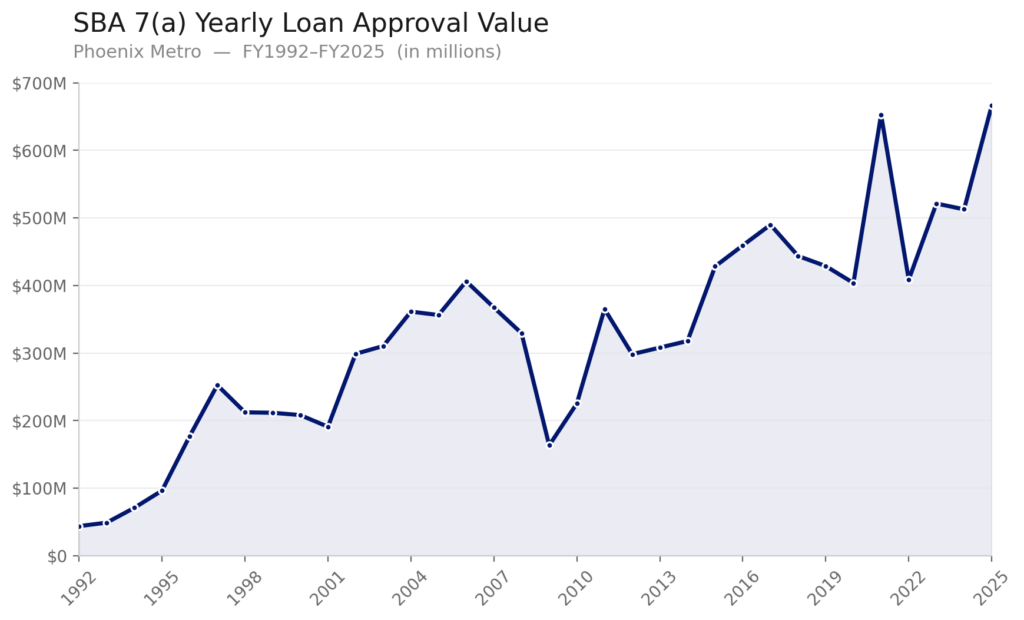
Arizona sits among the top handful of states for SBA loan volume each year, and Greater Phoenix drives most of that activity. Here are the year-by-year* statistics of the SBA 7(a) loan program in the Phoenix metro area from fiscal year 1992 to today, including the number of 7(a) loans approved and total approval amount.
| Fiscal Year | Loans Approved | Approval Amount |
| 1992 | 167 | $43,705,150 |
| 1993 | 191 | $48,883,475 |
| 1994 | 258 | $70,830,053 |
| 1995 | 465 | $96,309,755 |
| 1996 | 618 | $176,904,791 |
| 1997 | 800 | $252,486,633 |
| 1998 | 739 | $212,212,187 |
| 1999 | 700 | $211,566,048 |
| 2000 | 640 | $208,144,700 |
| 2001 | 645 | $190,870,427 |
| 2002 | 851 | $298,757,024 |
| 2003 | 1,195 | $310,398,192 |
| 2004 | 1,368 | $361,264,250 |
| 2005 | 1,336 | $356,330,416 |
| 2006 | 1,610 | $406,191,366 |
| 2007 | 1,866 | $367,396,700 |
| 2008 | 1,309 | $329,351,900 |
| 2009 | 558 | $163,353,200 |
| 2010 | 734 | $225,331,500 |
| 2011 | 875 | $365,114,300 |
| 2012 | 681 | $298,265,400 |
| 2013 | 649 | $308,053,300 |
| 2014 | 733 | $317,797,000 |
| 2015 | 920 | $428,276,800 |
| 2016 | 954 | $459,375,800 |
| 2017 | 951 | $489,895,200 |
| 2018 | 848 | $443,661,100 |
| 2019 | 813 | $428,717,500 |
| 2020 | 644 | $403,680,100 |
| 2021 | 803 | $652,877,600 |
| 2022 | 633 | $408,592,700 |
| 2023 | 882 | $521,330,200 |
| 2024 | 999 | $512,780,100 |
| 2025 | 1,255 | $666,314,900 |
Source: SBA, 7(a) & 504 FOIA
*U.S. Federal Government fiscal years
SBA 7(a) Loans On the Rise
The SBA 7(a) loan program has seen stellar growth in Phoenix, with the annual total value of approved loans up 15x since 1992.
Recent years have seen a particular increase, thanks in part to yearly new business applications doubling in Arizona since 2019, health care and construction continuing to add jobs, and the semiconductor build-out in north Phoenix pulling suppliers and service firms into the market.
About 7aSavvy
7aSavvy is a loan brokering platform for business owners across Greater Phoenix, and it is not a lender or the SBA. We do not fund anything, set rates, or approve loans. What we do is study your request, work out which lenders genuinely want that kind of deal, and hand you off to the right one. Because the lender pays us when your loan closes, the matching costs you nothing.
The firm was founded by Brett Smith, who has worked on more than $1 billion of SBA loans over a career spanning over three decades, about twenty years of it inside lenders and the rest on the brokering side. That background means extensive lender connections, which is how our matching can run on real, current lender appetite instead of a stale directory. As an SBA 7(a) loan broker in Phoenix, we concentrate on the larger end of the market, generally deals between $350,000 and the $5 million ceiling, and we do not broker startup loans.
How 7aSavvy Works
Step 1: You tell us the shape of the deal. Through the Get Connected form you share the essentials, what the money is for, roughly how much, the industry, and where in the Valley you operate.
Step 2: We read it the way a lender would. We look at the use of proceeds and the details underwriters weigh, so we understand the request before we place it anywhere.
Step 3: We introduce you to the right lender. We connect you with a decision-maker at the vice president level or higher inside a lender that funds your type of deal, not a general application queue.
Step 4: We stay on it through closing. If the first lender stalls or passes, we re-route the file to another one and keep going until the loan closes.
Case Study
Picture a contract manufacturer in Chandler that supplies parts into the semiconductor build-out and has outgrown its leased shop. The owner wants to buy a larger building nearby and add a few machines, about $2.4 million all in, with roughly 10% to put down. The company’s everyday bank likes the relationship but does not do much owner-occupied industrial lending, so the file drifts for a month and then quietly dies. That is precisely the kind of request a Phoenix SBA 7(a) loan broker can move on quickly, sending it to a lender that funds owner-occupied industrial real estate and equipment and understands the pace of the local supply chain, instead of leaving the owner to knock on doors one at a time. The example is illustrative, but the pattern is one we see often: the deal was fundable all along, it was just sitting in front of the wrong lender.