Fiscal Year 2025
2,531
Loans Approved
$1.1B
Total Value
Chicago runs on small businesses that have to move when the moment is right. A buyer finds a well-run HVAC company on the Northwest Side and has 90 days to close. A restaurant group wants to take over a second-generation space in the West Loop before it’s taken. A dental group in Naperville needs to fund an acquisition and re-equip two operatories at once. A freight brokerage near O’Hare needs working capital to float receivables before a national account ramps up. Every one of these owners needs capital, and every one of them needs a lender who actually understands the deal in front of them.
That is where the SBA 7(a) program earns its reputation across Chicagoland. It is one of the few financing tools flexible enough to cover very different business moves under one program. Proceeds can go toward business acquisitions, owner-occupied commercial real estate, equipment, construction and buildouts, renovations, eligible debt refinancing, working capital, or a combination of approved business purposes in a single request.
Most SBA 7(a) loans are capped at $5 million. For most 7(a) loans, the SBA guarantees 85% of loans of $150,000 or less and 75% of loans above $150,000, with the agency’s maximum guaranteed exposure generally capped at $3.75 million. That guarantee does not replace underwriting, but it lowers the lender’s risk enough that qualified requests which stall at a conventional bank often get a real look.
Note: 7aSavvy is an SBA 7(a) loan broker, not a lender. We are paid by the lender, so our help is free to you. Instead of approaching banks one at a time and hoping for a fit, you start with one focused path to the lenders most likely to fund your request.
SBA 7(a) Financing for Chicago Small Businesses
Greater Chicago is not built around a single industry, and that shapes how a financing decision should be made. A logistics operator near the Elgin–O’Hare corridor, a manufacturer in Cicero, a neighborhood restaurant in Pilsen, a med spa in Lincoln Park, a franchise owner in Schaumburg, and a professional services firm in the Loop are all chasing very different outcomes, and their loan requests should reflect that.
A strong SBA 7(a) request starts with the business purpose, not a round-number loan amount. What is the money actually supposed to do? Is the borrower buying a company, improving a facility, adding equipment, refinancing eligible debt, protecting working capital, or opening a second location? Once the purpose is clear, matching the request to the right lender becomes far more focused.
Our platform helps Chicago-area borrowers connect the specifics of a request with SBA lending options that fit the deal. Eligible uses commonly include:
- Buying an existing business
- Purchasing owner-occupied commercial real estate
- Financing equipment, machinery, fixtures, or vehicles used by the business
- Funding renovations, buildouts, leasehold improvements, or construction
- Refinancing eligible business debt
- Supporting working capital needs
- Expanding into another location
- Combining several approved uses into one loan request
There is an important limit worth stating up front. SBA 7(a) financing is meant for active operating businesses. It is generally not available for passive investment activity, such as buying commercial or residential property that the borrower’s operating business will not primarily occupy or use itself.
Buy
Buying an existing business is one of the most common uses of the SBA 7(a) program. The borrower is not financing a concept on a napkin; they are financing a company that already has customers, staff, revenue, and an operating history a lender can put under a microscope.
In Chicago, that might mean acquiring a plumbing or electrical company with a book of recurring service accounts, a dental practice with an established patient base in Oak Park, a franchise unit with real sales in Aurora, a car wash on a busy arterial, a corner grocery, a daycare center, a machine shop, or a professional services firm downtown.
The acquisition of real estate is also a common use of the program, which gives the owner more control over occupancy costs in a market where commercial rents rarely move in the tenant’s favor. Owning the building your business operated out of also gives long-term security and peace of mind.
Acquisition financing is one of the most detail-sensitive corners of SBA lending. A lender typically wants to understand the buyer’s background and industry experience, the seller’s financials, the purchase price and how it was valued, where the equity injection is coming from, the cash flow available to service the debt, the transition plan, and the collateral in play. A promising deal loses momentum fast when those pieces are scattered, or when the borrower starts with a lender that has no appetite for that kind of acquisition in the first place.
Build
Some Chicago businesses do not need to buy a company or real estate. They need a better space, a bigger facility, or a location that can finally keep up with demand.
SBA 7(a) proceeds can be used for a wide range of build-related purposes, including:
- Interior buildouts and tenant improvements
- Leasehold improvements
- Facility renovations and modernization
- Equipment installation and fit-out
- Building additions
- Ground-up construction for business use
- Improvements to owner-occupied commercial property
For borrowers across the metro, that plays out in a lot of ways: a surgical or dental group finishing out a clinic in Hinsdale, a restaurant converting an older storefront in Logan Square, a fitness studio building out leased space in the South Loop, a food producer upgrading a facility in the Stockyards or Bedford Park, or a childcare operator adapting a building to meet Illinois licensing standards. Older building stock across the city can also mean real renovation costs, from electrical service upgrades to bringing a space up to code.
These requests take more than a one-page application. Lenders may review contractor estimates, construction budgets, permits, timelines, contingency reserves, collateral, lease terms or ownership documents, and projected cash flow once the work is finished. The lender needs to see not only what is being built, but why the completed project supports repayment.
Expand
Growth can create a cash squeeze even when a business is doing well. Demand is rising, sales are up, and the opportunity is real, but capital is needed before they can take advantage of it.
SBA 7(a) financing can help qualified Chicago businesses fund expansion without leaning entirely on short-term debt or draining operating cash. Common expansion uses include:
- Opening an additional location or territory
- Hiring and training staff
- Buying inventory ahead of demand
- Adding vehicles, machinery, or technology
- Increasing production or service capacity
- Funding marketing tied to a specific growth plan
- Supporting seasonal or contract-driven working capital
- Investing in the systems a larger operation requires
Expansion looks different from one Chicago industry to the next. A trades contractor may need trucks and payroll to take on more jobs. A healthcare practice may need equipment and tenant improvements for a new suite. A franchisee may need capital to build a second or third unit. A retailer may need inventory before the holiday season. A distribution company may need working capital to take on a larger regional customer without falling behind on its own bills.
Industries That Use SBA 7(a) Loans in Chicago
The SBA 7(a) program supports a broad range of for-profit small businesses, which makes it especially useful in a market as varied as the Chicago metro. The same program can back a family restaurant, a boutique hotel operator, a dental practice, a third-party logistics firm, a franchise buyer, or a light manufacturer, but the loan story is different in every case.
Businesses that commonly explore SBA 7(a) financing include:
- Restaurants, cafés, bakeries, and food service businesses
- Hotels, motels, and lodging businesses
- Dental, medical, veterinary, and healthcare practices
- Professional service and B2B firms
- Franchise businesses
- Convenience stores, gas stations, and liquor stores
- Car washes and auto service shops
- Retail and specialty shops
- Childcare and education-related businesses
- Fitness, wellness, and personal care businesses
- Manufacturing and machine shops
- Distribution, warehousing, and logistics businesses
- Home services and skilled-trades businesses
- Owner-operated businesses with real estate needs
Lender fit shifts with the industry. A hotel renovation is not underwritten like a dental acquisition. A car wash purchase does not read like a professional services expansion. A restaurant buildout carries a different risk profile than a logistics working capital line. 7aSavvy helps Chicago borrowers stop treating those deals as interchangeable and instead connect with SBA 7(a) lenders that understand the business behind the numbers.
SBA 7(a) Loan Qualifications in Chicago
SBA 7(a) eligibility starts with the program’s baseline rules. In general, the business must be an operating, for-profit small business located in the United States or its territories, and it must meet the SBA size standards that apply to its industry.
Eligible business structures include:
- Sole proprietorships
- Limited liability companies
- Partnerships
- Corporations
- Other eligible for-profit entities
Those baseline rules are only the entry point. A lender still evaluates the borrower, the business, the use of proceeds, repayment ability, credit profile, collateral, ownership structure, and the overall risk of the transaction.
For a Chicago borrower, the documentation varies widely by loan purpose. A business acquisition may call for seller financials, a purchase agreement, valuation support, and transition details. A real estate purchase may require property information, occupancy details, an appraisal, and environmental review. A buildout may require contractor estimates and a project budget. A working capital request may lean more heavily on historical cash flow and a clear explanation of need.
7aSavvy helps borrowers approach the process with more structure. Our platform is built around connecting small business owners with SBA 7(a) lending options that fit the business type, use of funds, loan size, and borrower profile.
SBA 7(a) Loans in Chicago: Pros and Cons
The SBA 7(a) program is often attractive because it can support larger, longer-term business needs with more flexibility than many conventional or short-term financing options.
Benefits borrowers often weigh include:
- Flexible use of proceeds across approved business purposes
- Longer repayment terms than most other business loans
- Competitive interest rates, often lower than other comparable business loan options
- Financing for acquisitions, expansion, equipment, real estate, eligible refinancing, working capital, construction, and improvements
- Lower equity injection than conventional commercial loans
- Higher attainability due to SBA-backed financing through approved lenders
- Fully amortized structures, with no balloon payment
- The ability to combine multiple eligible uses into a single request
There is a real trade-off with SBA 7(a) loans. SBA-backed loans usually require more documentation and a more involved review than simpler financing. A borrower should be ready to provide financial records, tax returns, ownership information, debt schedules, collateral details, business plans or projections where needed, and transaction-specific documents. A construction request or an acquisition will nearly always take more work than a straightforward working capital request.
There are also hard limits. The 7(a) program tops out at $5 million, so a project that costs more may need a different structure, sometimes a 7(a) loan paired with conventional or SBA 504 financing. Ownership and citizenship rules for SBA loans have also tightened, with permanent resident owners ineligible. Complex ownership arrangements should confirm current eligibility early rather than assume.
A business with very strong cash flow, excellent collateral, a long banking relationship, and a simple need may find conventional financing a better fit. A business with a more complex request often benefits from the SBA 7(a) structure and from using an SBA loan broker in Chicago to find a better lender match.
SBA 7(a) Loans vs. Other Types of Loans
SBA 7(a) Loans vs Conventional Loans
A conventional business loan is made by a lender without an SBA guarantee. Because the lender carries the full risk, conventional loans tend to require stronger collateral, a higher down payment, longer operating history, cleaner financials, and/or a simpler transaction.
An SBA 7(a) loan includes a partial SBA guarantee to the lender. That guarantee can help qualified borrowers access financing when a conventional loan is not the right fit.
For a Chicago business with strong financials and a simple request, conventional financing may work well. For a borrower with more borderline financials, less capital available for a down payment, or a more complex request, the SBA 7(a) program is often worth a closer look.
SBA 7(a) Loans vs SBA 504 Loans
SBA 7(a) and SBA 504 loans are both SBA-backed, but they are built for different jobs.
The 7(a) program is the broader of the two. It can fund business acquisitions, owner-occupied real estate, equipment, construction, renovations, working capital, eligible refinancing, and expansion. That range is exactly what a Chicago borrower wants when a single loan needs to cover several approved purposes at once.
The 504 program is narrower and focused on long-term fixed assets, mainly owner-occupied commercial real estate and major equipment. It can be a strong fit for certain property or heavy-equipment purchases, but it is not designed for the acquisition or working capital flexibility of the 7(a) program.
A borrower purchasing only a building or a large fixed asset should compare both programs. A borrower who also needs acquisition financing, working capital, refinancing, or a more flexible structure will usually find that an SBA 7(a) loan is the better match.
Case Study: HVAC Company Acquisition in Chicago
Andre had worked in the HVAC industry for 14 years, the last six as an operations manager. When the owner of a well-established HVAC company in the western suburbs decided to retire, Andre saw a chance to acquire a business with a strong service contract base, experienced technicians, and steady year-round demand.
The total project cost was $1,325,000:
- Business acquisition (goodwill, service contracts, customer base, equipment and tools): $950,000
- Vehicles (four service vans and one box truck to replace aging fleet): $200,000
- Equipment upgrades (diagnostic tools, recovery machines, fabrication equipment): $100,000
- Working capital for the ownership transition: $75,000
Andre had $132,500 available for a down payment (10%) and needed financing for the remaining $1,192,500.
He approached two conventional lenders. One was uncomfortable with the size of the goodwill component relative to the hard assets. The other would consider it but wanted 20% down and offered only a seven-year term.
Through 7aSavvy, Andre was matched with an SBA 7(a) lender that had experience with service business acquisitions and understood how to evaluate them.
Loan Details:
- Total project cost: $1,325,000
- Down payment: $132,500 (10%)
- Loan amount: $1,192,500
- Interest rate: Prime + 2.0 (8.75% at the time of closing)
- Term: 10 years, fully amortized
- Monthly payment: $15,000
The business was generating annual cash flow of $240,000, giving it a DSCR of 1.33. Andre’s operational experience, the company’s long-standing service contracts, low customer turnover, and a solid transition plan all supported the approval.
The loan closed in 65 days. The 10-year term applied because the deal didn’t involve real estate. The new vehicles and equipment boosted productivity from day one, and the working capital gave Andre a buffer for the transition.
This is an illustrative example based on typical SBA 7(a) loan terms and a realistic HVAC business acquisition scenario in Chicago. Actual loan terms, timelines, and outcomes vary based on the borrower, business, and lender.
SBA 7(a) Program History
The SBA 7(a) program traces back to the Small Business Act of 1953, the law that created the U.S. Small Business Administration. The “7(a)” name comes directly from the section of that act which authorizes the loan program.
The program was designed around a stubborn, practical problem: plenty of small businesses have legitimate capital needs but do not fit the risk profile a conventional bank is comfortable with. By guaranteeing part of an eligible loan made by an approved lender, the SBA reduces the lender’s downside and widens access to capital for qualified small businesses.
More than seven decades later, the 7(a) program is still one of the primary SBA financing tools for small business owners. Across Chicago and the surrounding suburbs, it continues to back the moves that define a company’s next stage: buying a business, acquiring property, opening another location, investing in equipment, refinancing eligible debt, or shoring up working capital. It has helped fund countless neighborhood businesses that make up the backbone of the region’s economy, and it remains a practical path for both borrowers looking to get into small business ownership and owners who are ready to grow but need the right lender to get there.
Chicago SBA 7(a) Loan Program Statistics
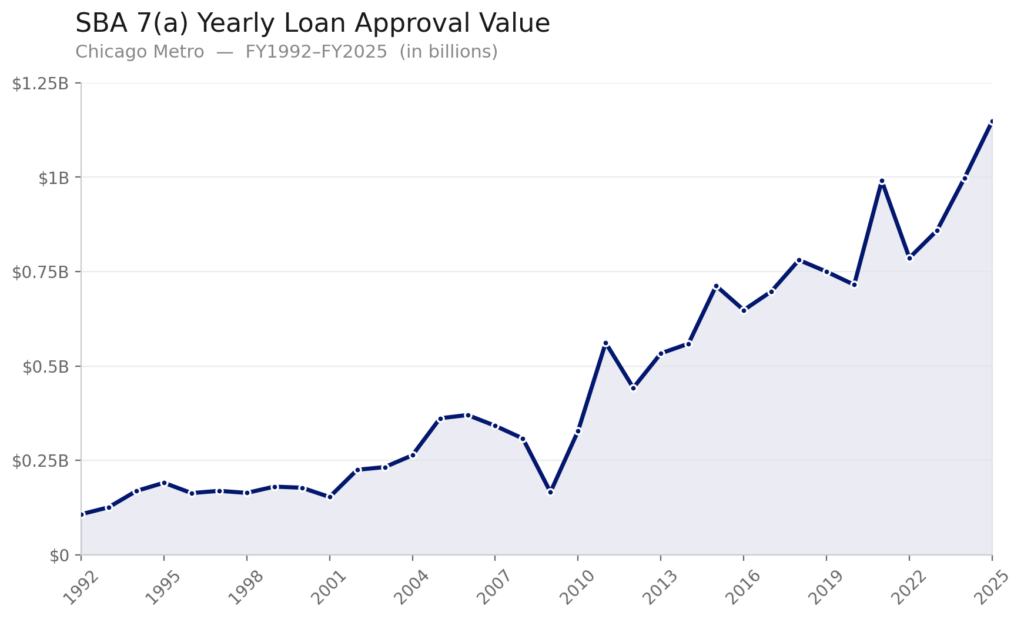
These are the year-by-year* statistics of the SBA 7(a) loan program in the Chicago metropolitan area from fiscal year 1992 to today, including the number of 7(a) loans approved and total approval amount.
| Fiscal Year | Loans Approved | Approval Amount |
| 1992 | 404 | $107,296,710 |
| 1993 | 430 | $125,789,317 |
| 1994 | 674 | $168,880,440 |
| 1995 | 1,381 | $190,649,619 |
| 1996 | 1,091 | $163,356,574 |
| 1997 | 967 | $169,329,316 |
| 1998 | 764 | $163,826,905 |
| 1999 | 810 | $180,477,256 |
| 2000 | 775 | $177,525,287 |
| 2001 | 677 | $152,973,453 |
| 2002 | 903 | $225,075,305 |
| 2003 | 1,157 | $232,194,102 |
| 2004 | 1,526 | $263,521,454 |
| 2005 | 3,031 | $361,418,756 |
| 2006 | 3,460 | $370,077,434 |
| 2007 | 3,691 | $341,467,132 |
| 2008 | 2,361 | $307,870,010 |
| 2009 | 953 | $165,954,466 |
| 2010 | 1,251 | $327,968,500 |
| 2011 | 1,500 | $561,311,100 |
| 2012 | 1,246 | $441,997,600 |
| 2013 | 1,184 | $533,451,400 |
| 2014 | 1,343 | $559,012,900 |
| 2015 | 1,737 | $712,264,500 |
| 2016 | 1,605 | $647,903,700 |
| 2017 | 1,637 | $697,315,100 |
| 2018 | 1,797 | $780,547,800 |
| 2019 | 1,594 | $749,655,900 |
| 2020 | 1,207 | $714,924,900 |
| 2021 | 1,461 | $990,400,300 |
| 2022 | 1,417 | $786,196,300 |
| 2023 | 1,746 | $858,750,400 |
| 2024 | 2,210 | $998,147,700 |
| 2025 | 2,531 | $1,148,180,500 |
Source: SBA, 7(a) & 504 FOIA
*U.S. Federal Government fiscal years
SBA 7(a) Loans On the Rise
The SBA 7(a) loan program has seen incredible growth in Chicago, with the annual total value of approved loans up almost 11x since 1992.