
Fiscal Year 2025
772
Loans Approved
$479M
Total Value
Austin entrepreneurs often have real growth in front of them, and the problem is finding the SBA 7(a) lender that will actually fund the deal. The city keeps drawing new companies, and demand for financing has followed. In 2025, lenders originated or approved $479 million in SBA 7(a) loans for businesses across the six counties that make up the Austin metro, which are Bastrop, Burnet, Caldwell, Hays, Travis, and Williamson, and 114 different lenders took part in that lending.
An SBA 7(a) loan is made by an approved lender and partially guaranteed by the U.S. Small Business Administration. That guarantee lowers some of the risk the lender carries, which is part of why the terms can be more workable than other kinds of business financing. For a qualified small business in Austin, that structure can make an SBA 7(a) loan a practical way to fund a purchase, a build-out, or an expansion.
Note: 7aSavvy is not a lender. We are a loan broker, and our job is to read your request and connect you with the lender that is the best fit for it, rather than having you apply to one bank and hope it lines up.
Uses of SBA 7(a) Loan Proceeds in Austin
Austin borrowers usually need financing that can move at the pace the deal is moving. The SBA 7(a) program is fairly flexible on how the money is used, which is one of the reasons it comes up so often for small businesses here.
Common uses include the following: business acquisitions; buying owner-occupied commercial real estate; equipment purchases; construction, renovation, or build-out work; refinancing eligible business debt; working capital; and funding an expansion. One point worth keeping in mind is that the SBA 7(a) program is built for active operating businesses, so it is not a fit for passive real estate investment where you are just holding property for income.
Buy
Austin entrepreneurs may use SBA 7(a) financing to buy the assets a business runs on, or to acquire an existing company outright. That covers a range of situations, for example a first-time buyer purchasing an operating business, an operator buying out a partner, a business buying commercial real estate it will occupy, or a company purchasing the equipment it needs to take on more work. Because Austin has a steady flow of owners looking to sell and buyers looking to get in, acquisition financing is one of the more common reasons people come to us.
Build
SBA 7(a) loan proceeds may also go toward construction, renovation, and improvement projects that are tied to an operating business. Depending on the deal and the lender, that can include leasehold improvements, interior build-outs, renovations to an existing facility, additions to a building, and ground-up construction. This tends to matter in Austin, where a lot of businesses are taking older retail and warehouse space and reworking it to fit what they actually do.
Expand
Growth usually asks for money before the return shows up, which is the plain version of the old line about spending money to make money. Expansion capital can go toward opening another location, hiring and training more staff, buying additional inventory, or upgrading the technology a business runs on. For a lot of Austin companies, the expansion is not optional so much as a response to demand that is already there, and SBA 7(a) financing can help bridge the gap between that demand and the cash on hand.
SBA 7(a) Loan Industries in Austin
Austin has a broad mix of businesses, and SBA 7(a) financing shows up across most of it rather than in one narrow slice. Some of the industries we see most often in the Austin area include the following:
- Restaurants, bars, and food service
- Hotels, motels, and short-stay hospitality
- Convenience stores and gas stations
- Retail shops
- Medical, dental, and other healthcare practices
- Franchise businesses
- Professional and technical service firms
- Car washes
- Self-storage facilities
- Light manufacturing and fabrication
- Fitness, wellness, and personal-service businesses
That list reflects how the local economy is put together. Professional, scientific, and technical services make up a large share of the workforce here, and healthcare, hospitality, and retail all employ tens of thousands of people across the metro. Advanced manufacturing and life sciences have grown as well, which adds another set of borrowers looking to buy equipment or space. Whichever category a business falls into, the lender still looks at the specific deal, so being in a common industry helps but does not decide the outcome on its own.
SBA 7(a) Loan Qualifications in Austin
Qualifying for an SBA 7(a) loan starts with meeting the basic eligibility rules for small business borrowers. In general terms, the business needs to be a for-profit operating business, based in the United States, within the SBA size standards for its industry, and the owners need to be able to show a reasonable ability to repay the loan. Most common business structures are eligible, including sole proprietorships, corporations, partnerships, limited liability companies, and other for-profit entities.
Beyond the basics, what a lender asks for depends on what you are trying to do. For example, a borrower who wants funding to acquire an existing business may need to provide different information and documentation than a borrower who is buying owner-occupied commercial real estate or refinancing eligible business debt.
Important note: meeting the basic SBA 7(a) qualifications does not guarantee approval. The SBA sets the outer boundaries, and the lender reviewing your file still has to be comfortable with the borrower, the business, and the numbers.
SBA 7(a) Loans in Austin: Pros and Cons
An SBA 7(a) loan can give an Austin entrepreneur access to flexible financing for a range of needs, from buying a company to expanding operations, purchasing equipment, refinancing eligible debt, or investing in owner-occupied commercial real estate. Some of the reasons borrowers tend to like the program include the following: repayment terms that are usually longer than conventional business loans; flexibility in how the proceeds are used; several eligible uses under one loan; fully amortized repayment, so there is no large balloon payment waiting at the end; interest rates that are generally competitive; and down payment requirements that are often lower than conventional options.
That said, the SBA 7(a) program is not the right answer for every borrower, and there are limits. As of March 1, 2026, the business has to be 100% owned by U.S. citizens or nationals to be eligible, which rules some owners out. There is also a maximum loan size of $5 million under the 7(a) program, so a larger project may need a different structure or an additional source of funds. The paperwork can be more involved than a quick conventional loan as well, which is part of why connecting with the right lender early is important.
SBA 7(a) Loans vs. Other Types of Loans
SBA 7(a) Loans vs Conventional Loans
The main difference comes down to the guarantee. With a conventional business loan there is no SBA guarantee behind it, so the lender carries the full credit risk on its own. To make up for that, conventional loans often ask for a larger down payment, a shorter term, and stronger collateral, and they can be harder to get for a first-time buyer or a younger business. An SBA 7(a) loan spreads some of that risk to the SBA, which is why the terms are frequently more workable for the kinds of deals small businesses in Austin are trying to do.
SBA 7(a) Loans vs SBA 504 Loans
Both are SBA programs, but they are built for different jobs. SBA 7(a) loans are the more flexible of the two, and they may be used for working capital, business acquisitions, owner-occupied commercial real estate, equipment, construction, eligible refinancing, and expansion, up to a $5 million loan amount. SBA 504 loans are aimed mainly at fixed assets such as real estate and heavy equipment, they use a different structure that involves a Certified Development Company, and they can go larger on those specific asset purchases, up to an $11.25 million loan. If the deal is a straightforward real estate or equipment purchase, 504 may fit; if the deal has moving parts or needs business acquisition financing or working capital in the mix, 7(a) is usually the more practical route.
SBA 7(a) Loan Program History
The SBA 7(a) loan program has been supporting small business lending for a long time. Its roots go back to the Small Business Act of 1953, which created the U.S. Small Business Administration and set up a federal framework for helping small businesses get access to capital. The “7(a)” name simply comes from the section of that law where the program is described, and the program has been in use in one form or another for more than 70 years. Over that time it has become one of the more common ways that small business borrowers in the United States, including a great many in Austin, finance a purchase or an expansion.
Austin SBA 7(a) Loan Program Statistics
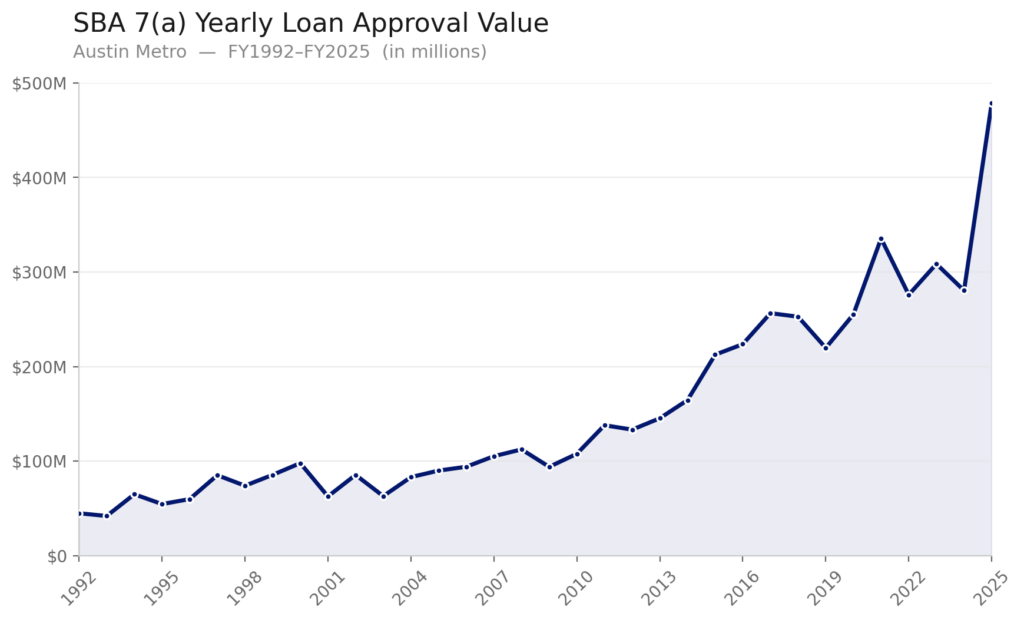
Texas is one of the largest SBA 7(a) markets in the country, and Austin makes up a meaningful and growing share of it. Here are the year-by-year* statistics of the SBA 7(a) loan program in the Austin metro area (Travis, Williamson, Hays, Bastrop, and Caldwell counties) from fiscal year 1992 to today, including the number of 7(a) loans approved and total approval amount.
| Fiscal Year | Loans Approved | Approval Amount |
| 1992 | 166 | $44,845,800 |
| 1993 | 169 | $41,949,310 |
| 1994 | 332 | $64,958,189 |
| 1995 | 360 | $54,537,608 |
| 1996 | 290 | $59,825,717 |
| 1997 | 301 | $85,091,393 |
| 1998 | 271 | $73,968,701 |
| 1999 | 285 | $85,431,143 |
| 2000 | 272 | $97,823,390 |
| 2001 | 206 | $62,653,500 |
| 2002 | 271 | $85,425,887 |
| 2003 | 381 | $62,968,505 |
| 2004 | 465 | $83,052,725 |
| 2005 | 504 | $89,970,668 |
| 2006 | 527 | $93,995,182 |
| 2007 | 617 | $105,180,545 |
| 2008 | 505 | $112,360,695 |
| 2009 | 358 | $93,943,814 |
| 2010 | 368 | $107,706,400 |
| 2011 | 385 | $137,942,600 |
| 2012 | 360 | $133,260,400 |
| 2013 | 302 | $145,317,800 |
| 2014 | 366 | $164,503,600 |
| 2015 | 450 | $212,496,500 |
| 2016 | 454 | $223,687,400 |
| 2017 | 551 | $256,462,500 |
| 2018 | 454 | $252,661,400 |
| 2019 | 364 | $219,693,200 |
| 2020 | 337 | $255,173,000 |
| 2021 | 389 | $335,432,100 |
| 2022 | 377 | $275,916,200 |
| 2023 | 464 | $308,537,600 |
| 2024 | 587 | $280,389,200 |
| 2025 | 772 | $478,709,600 |
Source: SBA, 7(a) & 504 FOIA
*U.S. Federal Government fiscal years
SBA 7(a) Loans On the Rise
The SBA 7(a) loan program has seen substantial growth in Austin, with the annual total value of approved loans up almost 11x since 1992.
About 7aSavvy
7aSavvy is an SBA 7(a) loan broker for Austin entrepreneurs. We are not a lender, and we do not underwrite or fund loans ourselves. What we do is read your request, figure out which lenders are the most likely to fund it, and make the introduction, and then stay involved while the deal moves toward closing. Because we are paid by the lender rather than the borrower, the matching service is free to you.
The company was founded by Brett Smith, who is the CEO. He has worked on over $1 billion of SBA loans and has more than 15 years of experience as both a lender and a broker, so he has seen these deals from both sides of the table. That background is a big part of how we can decide with confidence which lender is a good fit for a given request.
How 7aSavvy Works
Step 1: You tell us about the deal. You fill out the Get Connected form with the basics of what you are trying to finance.
Step 2: We read the request. We look at the use of proceeds, the size, and the type of business, so we understand what the deal actually needs.
Step 3: We match you to the right lender. We point you toward the lender or lenders most likely to fund a deal like yours the quickest and on good terms, instead of leaving you to guess.
Step 4: We stay with the deal. We keep the request moving and help keep things on track through closing.
Case Study
To show how this works in practice, here is an anonymized example of the kind of deal we handle. Maria ran a well-established taqueria in East Austin and had been leasing her space for years. When the building she operated in came up for sale, she wanted to buy it rather than risk the negatives a new owner could bring. The request combined the owner-occupied real estate purchase with a modest amount of money for kitchen equipment and improvements. We read the deal, matched her with a lender that was comfortable with restaurant real estate in the Austin market, and helped keep the file moving. The loan came together at roughly $1.9 million and funded in 76 days from first contact with the lender.